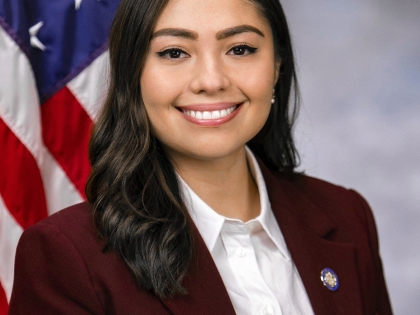
NYS State Senator Kristen Gonzalez, Chair of the Internet & Technology Committee, Testifies at NYC Council Hearing on AI
October 6, 2026
Watch Senator Gonzalez’s full testimony here.
NEW YORK, N.Y. – New York State Senator Kristen Gonzalez (SD-59), Chair of the Senate Committee on Internet & Technology, provided testimony and answered questions at the October 5th New York City Council Committee of the Whole Examining the Risks Posed by Artificial Intelligence. Senator Gonzalez is a former tech worker and has been Chair of the Internet and Technology Committee since she was sworn into office four years ago. She passed the first legislation in New York State regulating generative AI, and has focused on addressing the harms unregulated AI poses to users today.
The Senator held a public hearing in January to “review the risks of artificial intelligence in high-risk uses,” and also spoke with industry representatives, academics, auditors, and concerned labor spokespeople.
Senator Gonzalez sponsors leading legislation to ensure the responsible development and deployment of AI and automated-decision making tools. She passed the first in the nation labor protections for public sector employees and teachers at risk of AI displacement (S7543B and S7599A), and successfully worked in language in the 2024 NYS Budget to ban the use of deceptive AI deepfakes in political communications. In the latest legislative session, Senator Gonzalez introduced and passed various bills to promote transparency, accountability, and safety guardrails in the AI space, including the Responsible Data Center Development Act (S10642), a bill to ban minors’ use of unsafe chatbot features (S9051B), the NY AI Act (S1169), and more.
Senator Gonzalez said, “As government bodies, we have the responsibility to set guardrails on this new technology and the power to regulate and protect workers, consumers, and members of the public from potential danger. Interventions at every level of government are needed to ensure AI is developed in a responsible way that benefits the public, and not just the tech billionaires. Thank you to Speaker Menin and the New York City Council for holding this hearing, and highlighting the importance of regulation on a major policy issue.”
Read Senator Kristen Gonzalez’s full testimony here:
“I want to thank Speaker Menin and the New York City Council for your attention to a —if not the—major policy issue of our time. I am New York State Senator Kristen Gonzalez, representing the 59th Senate District, in midtown Manhattan, northern Brooklyn, and western Queens. I am the chair of two State Senate committees: Elections and Internet & Technology. Over the last 4 years, as chair of the State Senate Technology committee and as a former tech worker, I have led on the issue of AI in the legislature and have passed some of the state’s first laws on generative AI, including regulating deepfakes in elections, government use of AI, protecting workers from automation, adding warning labels on chatbots, responsible data center development and more.
I want to be clear, AI is not inevitable. We do not have to accept a vision for innovation driven by the very same tech oligarchs who have raised alarm that their models could lead to catastrophic events, and we certainly can’t trust the same people who have benefitted from rolling out risky models to regulate themselves.
As government bodies, we have the responsibility to set guardrails on this new technology and the power to establish regulations that protect workers, consumers, and members of the public from potential danger. Interventions at every level of government are needed to ensure AI is developed in a responsible way that benefits the public, and not just the tech billionaires.
Responsibly regulating AI absolutely means guardrails on frontier models and super intelligence that pose significant threats; however, meaningfully reining in this technology to protect New Yorkers means regulating the AI-powered tools these companies are rushing to embed into every part of our lives with little oversight and accountability. We shouldn’t have to wait for future harms to take action, because the harms of imperfect AI tools are already being felt across the country. For example, uses for mass surveillance of immigrant communities and workers, chatbots creating intimate partner relationships with children and adults—going as far to encouraging self harm, and documented cases of algorithmic bias in decision making—such as in hiring, healthcare and housing.
I believe we have the power to set the terms of innovation, so that this technology is used for the maximum public good. This is why our state legislation has prioritized a rights-based approach to AI. We should have the fundamental right to privacy, which is why I’ve introduced the NY Privacy Act. We should have a right to protections in the workplace, which is why I’ve introduced the BOT Act to protect from workplace surveillance. We should have the right to know when AI is making high-risk, consequential decisions about our lives and subjecting us to algorithmic bias, which is why I introduced the NY AI Act. This bill requires third party audits, compliance with international safety standards, disclosures, transparency, and importantly, for a human to be in the loop in consequential decision making, much of which we heard about today.
Finally, two of my bills sitting on the Governor’s desk this year include the right to keep our kids safe online and the right to protect us all from the buildout of massive data centers.
In September 2024, 16-year-old Adam Raine asked ChatGPT for help with his homework. Adam continued to chat with ChatGPT, and within months, was sharing his deepest thoughts including occasionally self harm. ChatGPT pushed Adam to engage with his suicidal ideation, mentioning suicide over 1300 times, more than six times more than Adam mentioned it. ChatGPT eventually coached Adam to take his life. Our bill S9051B bans unsafe features for kids, and passed unanimously in both chambers of the legislature.
Just like with S9051B, New Yorkers are united in the fight against hyperscale data center development. At the end of August I embarked on a statewide tour of communities that are affected by the AI data center buildout explosion. I went to 13 different communities facing major noise pollution, health impacts, environmental degradation, and threats to their water supplies. I was proud to work with the Governor in her first in the nation moratorium on the largest data centers and am now working to get the Responsible Data Center Development Act signed into law.
While the tech CEOs say they want regulations, they have spent their time in Albany fighting against each of the common sense guardrails I have mentioned. For the lip service they pay to supporting legislation, it is only for versions that would do little to change their models or hold them to account. Together, we have the ability to meet this moment, pass real legislation, protect New Yorkers and build a future that allows us to benefit from innovation while protecting us from harms.”
Newsroom
Go to Newsroom