New York State Senate Advances 2026 One-House Budget Resolution
March 10, 2026

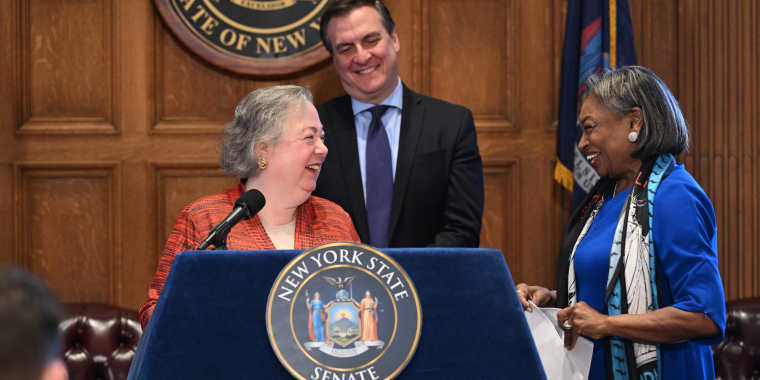
Senate Majority members brief the media on the one house budget resolution.
Today, the New York State Senate Majority unveiled its One-House Budget Resolution, a bold and responsible financial plan that invests in the needs of everyday New Yorkers while standing firm against harmful federal cuts. With a focus on affordability, economic opportunity, and fairness, the Senate’s budget prioritizes housing, healthcare, education, infrastructure, and economic development, laying the groundwork for a stronger, more equitable future for all New Yorkers.
Senate Majority Leader Andrea Stewart-Cousins said, “As Washington continues to cut essential programs New Yorkers rely on, our one-house budget aims to strengthen funding to support the well-being of New York’s working families and invest in local economies across our state. We are advancing a fiscally responsible budget that seeks to protect access to affordable healthcare coverage, get us closer to universal childcare, support small businesses, continue our climate goals, and strengthen overall investments to ensure the continued vibrancy and resiliency of our state’s diverse communities. While our state faces cuts from the federal government, our one-house budget advances responsible revenue raisers to provide municipalities with the funds they need to provide vital services and allocate resources towards the kitchen-table issues that impact the daily lives of New Yorkers. The Senate Majority remains firmly united in ensuring our state remains an affordable and equitable place to live for all New Yorkers.”
Senate Deputy Leader Michael Gianaris said, “The Senate budget proposal would accomplish what is needed to carry New Yorkers through the current affordability crisis. By ensuring the wealthy pay their fair share so we can provide services like childcare and fare free buses, we are laying the blueprint to help New Yorkers remain and thrive in our state.”
Senate Finance Chair Liz Krueger said, “I am proud to be part of a Senate Majority that is putting forward a strong One-House Budget proposal designed to protect New Yorkers from the damage being inflicted by the federal administration and to address the ongoing challenges our constituents face every day. This proposal expands aid to localities, including assistance to our most in-need cities, as well as allowing New York City to adjust its own taxes to address its budget priorities. It invests in healthcare and benefit programs to counter the Trump Administration’s cruel and short-sighted attacks on the neediest Americans. And it continues our commitment to expanding early childhood care to ensure that parents can go to work knowing their children are in safe, caring, and nourishing environments. I look forward to continuing to work with my colleagues over the next month to ensure that the final budget reflects these priorities that put the needs of New Yorkers first.”
The Senate Majority advances responsible revenue measures that ensure the wealthiest individuals, large corporations, and luxury industries contribute their fair share. This budget generates sustainable state revenue to support municipal budgets, including critical support for New York City.
Statewide
- .5% Personal Income Tax Surcharge on the top two income brackets: $1.1 Billion (S.4437A).
- Statewide Corporate Tax: Increase the top corporate tax rate from 7.25% to 9% for those with business income over $5 million.
- Adjust the NYS PTET Credit to 90%: $1.8 billion.
- End Tax Breaks for Climate Polluters: $109 million first year, $652 million annually thereafter.
- End Sales Tax Exemption on Gold Bullion over $1,000, totaling $456 million for the first year and $608 million annually thereafter.
- Decouple from the H.R. 1 Expansion of the Qualified Small Business Stock Deduction: $101 million (also saves NYC and Yonkers a combined $16 million).
- Decouple from Opportunity Zones Tax Program: $249m in savings starting in SFY 29-30.
- Yacht Tax- The Senate advances language ending the sales tax exemption of boats valued above $230,000 (S.3874).
New York City: Provide over $5 billion in revenue and funding
- Authorize an increase to NYC corporate tax for financial sector firms from 9% to 10.8% and for non-finance sectors from 8.85% to 10.62%: $1.5 billion.
- Authorize an increase to NYC Unincorporated Business Tax (UBY) rate from 4% to 4.4% for those with business income over $5 million: $250 million
- Reduce the NYC PTET Credit to 75%: $700 million
- City Mansion Tax and supplemental tax on the transfer for residential property with a value of over $5m: $321 million
- End Sales Tax Exemption on Gold Bullion over $1,000: $300 million
- $500 million for shelter reimbursements.
- $193 million for TANF reimbursements.
- $263 million for additional state aid for foster care.
- $431 million School Aid.
$604 million to provide AIM funding for two years.
The Senate Majority is continuing an affordability agenda that lowers everyday costs for working families while strengthening programs that support children, seniors, and vulnerable New Yorkers. This proposal expands access to childcare, invests in energy affordability and consumer protections, and safeguards critical benefits that help families make ends meet during a time of economic uncertainty and federal threats to essential programs.
Child Care: Supporting Families & Expanding Access
The Senate continues to build on its commitment to making childcare more affordable and accessible for families while supporting the workforce that makes these services possible.
- Senate supports pathway to provide universal childcare to all families in New York State.
- $34 million in additional support for childcare pilot programs for children aged 0-3 in cities with a population of less than 1 million, for a total of $100 million.
- Accepts executive’s Child Care Assistance Program to provide $2.2 billion in childcare subsidies to families below 85% of the state median income.
- $500 million total to support the childcare workforce through the Child Care Worker Retention Grant Program.
- NYC 2-Care Seats: $73 million total to begin implementation of contract-based childcare program for two-year-olds in New York City.
- First time money for 3-K NYC.
- $16 million in new quarterly Diaper Allowances, in addition to a $1 million increase for National Diaper Banks, for a total of $18.5 million to support diaper access for families.
- $10 million for Facilitated Enrollment Pilot Programs.
Lowering Utility Costs & Strengthening Energy Affordability
The Senate Majority is advancing policies that lower energy costs for New Yorkers while maintaining the state’s commitment to clean energy and climate leadership.
- $200 million for the Energy Affordability Program.
- Heat Pump Rebate Program - provides a rebate of up to $2,000 or 30% of the overall cost of the heat pump.
- Adds $2.75 million for Public Utility Law Projects (PULP), for a total of $3.25 million.
- Continue to allocate 10% of HEAP funding to the federal Weatherization Assistance Program (WAP).
- Previously Owned Zero Emission Vehicles Rebate Program (S.2032A) - provides a rebate of up to $2,000 for eligible pre-owned zero emission vehicles.
- $1 million for Intervenor Reimbursement Fund - Creates a fund to support parties representing consumer and small business interests in rate cases (S.2477).
- The Senate advances Article VII modifications of the Public Service Law as follows:
- Requires utilities to return revenues in excess of their authorized Rates of Return on Equity to consumers (S.7693).
- Adds additional inappropriate utility expenses to have the PSC review (S.3734B, S.1012A).
- Modifies rate case timelines for litigated cases (S.5593).
- Adds additional reporting and transparency requirements to the Executive's proposal on energy affordability monitors.
Protecting Benefits from Federal Threats
This year’s budget includes protections to vital services and benefits that are under threat from the federal government.
- Senate advances language to establish a state-run Compensation Program and a dedicated fund to reimburse individuals receiving SNAP benefits or cash assistance who have had their benefits stolen or fraudulently obtained (S.403).
- Senate adds $3 million total for stolen SNAP and cash assistance benefit reimbursement.
- Senate adds $15 million for Special Nutrition Women, Infants and Children (WIC) providing $41.3 million total.
- The Senate advances language to prohibit drug manufacturers, pharmacy benefit managers, and other third parties from placing unilateral limitations on providers in the 340B Drug Pricing Program and looks to lower the cost of prescription drugs (S.1618).
The Senate adds $50 million to expand access to civil legal services, increasing capacity for legal service providers and community-based organizations across the State to assist New Yorkers with enrollment in public benefits.
This year’s budget includes protections for New York consumers while increasing transparency and accountability in the insurance industry. Together, they help protect personal data, provide clearer explanations for insurance costs, and encourage safety protocols to lower premiums for New Yorkers.
- Requires data brokers to register with the Department of Financial Services and creates a centralized process for consumers to request deletion of their personal data.
- Enforces prior approval for certain insurance rate filings and written explanations for premium increases.
- Enacts insurance premium reductions to improve risk mitigation.
- Improves consumer data privacy protections by providing discounts for non-commercial passenger vehicles equipped with an operating dashboard camera.
New York’s children deserve a world-class education and the support they need to thrive both inside and beyond the classroom. Building on the success of last year’s Universal School Meals program, the Senate joins the Executive in continuing this initiative, while calling for the expansion of the Farm-to-School program to include breakfast and snack purchases. The Senate also strengthens Foundation Aid to better support high-need students and invests in youth development and afterschool programs that help students succeed beyond the school day.
- Accepts executive proposal to increase funding for the universal school meals program with $395 million total, an increase of $55 million.
- Restores $1.5 million for a total of $22.7 million in direct funding for 4201 Schools for the Blind and Deaf. Increases tuition rates for Special Act, 853 schools, 4410 schools with inflation.
- Adds $2.1 million for the Foster Youth Initiative, for a total of $10 million.
- Adds $181.9 million to increase Transportation Aid reimbursement for high-needs schools.
- $2.5 million total for a K-12 laundry pilot program.
- Accepts proposal for statewide universal pre-k and proposes allowing districts to receive transportation aid for UPK.
- Increases library aid funding per pupil and adds $10 million for library operating aid for a total of $114.7 million, $20 million for library construction aid for a total of $54 million, and adds $1 million total for a pilot program to expand social work services in libraries.
- Adds $10 million total to expand civic education.
- $10 million total for new P-TECH grants.
- Adds $105M for Community Schools.
- Restores Teacher Career Centers.
- High Impact Tutoring Pilot Program to provide grants to public and charter schools to implement this program prioritizing low-income, underserved and rural students.
- $10 million total for the Youth Sports Grant Program.
- $30 million in additional support for the Learning and Enrichment Afterschool Program Supports (LEAPS), for a total of $146.1 million.
- The Senate adds language to ensure that this additional support funds programs in districts that do not currently have a LEAPS program.
- $1 million total for the Sunrise Day Camp, an increase of $450,000.
- $20 million total for year-round Youth Employment (S.184).
- Accepts the Executive’s “Back to Basics” Math Curriculum (ELFA Part B).
Key Differences:
- Adds $285.3 million in additional Foundation Aid for a total of $27.4 billion.
- Expands Farm-to-School program to include breakfast and snack purchases.
- Increases the Foundation Aid pupil needs index weighting for English Language Learners to .60.
- Amends the Foundation Aid Formula to add a weight of .12 in the pupil needs index for students experiencing homelessness or in foster care.
- Expands Building Aid reimbursement for the Big 5 and other high needs school districts.
- Expands Transportation Aid reimbursement for high needs school districts.
- Allows school districts to receive Transportation Aid for UPK school bus transportation costs.
“Safe by Design Act” intended to protect minors on digital platforms, by closing a loophole exempting certain gaming platforms and requiring platforms to disable friend suggestions for minors.
The Senate Majority is committed to expanding access to higher education and strengthening workforce pipelines across New York. This budget increases financial aid for students, supports workforce training programs, and invests in SUNY, CUNY, and community colleges to ensure students from every background can pursue affordable higher education.
- Expansion of nursing programs Opportunity Promise Scholarship.
- Bilingual educator pipeline.
- $500,000 total for the Asian American/Asian Research Institute.
- SUNY Capital Plans
- Adds $1.8 billion to advance the first year of a five-year capital plan for SUNY, for a total of $3 billion SUNY capital funding.
- Adds $4 million for NY Opportunity Promise Scholarship, for a total of $39 million for SUNY campuses.
- Adds $7.2 million in general operating assistance for community colleges, for a total of $465M.
- Restores $1.7 million for County Cooperative Extension Association Grant Program, for a total of $6.12 million.
- Restores $300,000 total for Housing and Food Insecurity Support at Dutchess Community College.
- CUNY Capital Plans
- Adds $1.8 billion to advance the first year of a five-year capital plan for CUNY, for a total of $2.2 billion CUNY capital funding.
- Adds $4 million for NY Opportunity Promise Scholarship, for a total of $26 million for CUNY campuses.
- Adds $4.8 million for community college operating assistance, for a total of $254.3 million.
- Restores $108,000 for the Arthur O. Eve opportunity program, for a total of $1.9 million.
- Community College Funding.
- LIFT Act - The Senate advances language to enact the Licensure Incentives and Fee-Support for Testing (LIFT) Act, which establishes a social work licensure exam voucher program to provide low-income individuals with vouchers to cover the cost of the examination required for licensure as an LMSW or LCSW (S.9125).
- Adds $19 million for additional TAP awards.
- Committed to supporting professions and institutes impacted by HR1.
Key Differences:
- Adds $4 million each to CUNY and SUNY to expand the New York Opportunity Promise Scholarship Program to all CUNY/SUNY campuses, for a total of $26 million for CUNY and $39 million for SUNY.
- Removes the distinction between dependent and independent students for the purpose of Tuition Assistance Program coverage (S.1498).
- Allows students with intellectual disabilities to receive awards from the Tuition Assistance Program for post-secondary education experience or transition programs (S.3369).
- Emergency Aid grants to students experiencing unexpected hardship (S.9044).
Phase out graduate student fees (S.9034A).
The Senate Majority is committed to strengthening New York’s health care system and ensuring New Yorkers can access affordable, high-quality care. This budget protects coverage for New Yorkers in the face of federal threats, invests in hospital and community health providers, and expands mental health and behavioral health services across the state.
Protecting Reproductive Freedom & Maternal Health
The Senate Majority continues to advance policies that safeguard reproductive freedom and improve maternal health outcomes, particularly for communities facing the greatest disparities.
- Emergency contraceptive vending machines at each SUNY and CUNY campus (S.2058).
- $6 million for Abortion Clinical Training Program (S.1438-A).
- Adds $5 million for the Abortion Medication, providing $25 million total.
- Adds $10 million for the Reproductive Freedom and Equity Grant Program for $35 million total.
- $500,000 for the CUNY sponsored midwifery program.
- Maternal Health Monitoring Pilot (S.9084).
- $1.5 million for Westchester Maternal Health Program
Medicaid:
- Protecting Health Coverage: Directs the Department of Health to maximize state and federal resources to maintain affordable health coverage and minimize potential coverage losses resulting from federal policy changes.
- Health Care Strategy Commission: Directs the Department of Health to establish a commission of public officials, practitioners, and stakeholders to develop a long-term plan addressing healthcare access, affordability, financing, and system efficiency.
- Directs the Department of Health to make at least $30 million in financial resources available in grants to local governments to assist with public benefit program enrollment.
- Additional $50 million to expand access to civil legal services, increasing capacity for legal service providers and community-based organizations across the State to assist New Yorkers with enrollment in public benefits.
- Additional $500 million for financially distressed hospitals.
- The Senate adds $405 million for a total of $560 million for hospital investments in rate increases and quality incentive programs and adds $50 million for a total of $80 million for FQHCs and Non-FQHC Clinics.
- The Senate adds $270 million for Nursing Homes/Hospice/Assisted Living, for a total of $470 million.
- The Senate adds $300 million capital for Healthcare Facility Capital Projects Grants.
- Accepts to extend existing Medicaid outpatient behavioral health ambulatory patients' group (APG) rates to 2031.
Additional Health Care Investments:
- Accepts the Executive proposal to strengthen insurance transparency, extend continuity of care to 90 days, including through pregnancy and postpartum, require the publication of prescription drug formularies, and limit utilization reviews for chronic conditions.
- Caps cost sharing for substance use disorder at $500 for up to 60 visits on commercial health insurance (S.1763A).
- The Senate advances language to codify New York State's existing 2-1-1 hotline as a statewide, state-overseen essential services hotline (S.6913).
- Expands “Daniel’s Law” community crisis prevention pilot programs.
- Increases rural healthcare access.
- $50 million to expand access for legal services to assist New Yorkers public benefits.
- Accepts Executive Proposal to require insurance coverage for gambling addiction treatment.
- $50 million for continued biomarker testing.
- $11.1 million for jail-based medication assisted treatment (MAT) programs for a total of $20 million.
Key Differences:
- Rejects rate cuts to the Medical Indemnity Fund (MIF).
- Rejects cuts to Enhanced Quality of Adult Living Program, Enriched Housing Operating Assistance Program, Tick-Borne Disease/Lyme.
- $4 million for gender-affirming care fund (S.7924).
- Modifies $750 million in State-Share Healthcare Stability Fund:
- The Senate adds $405 million for Hospital investments to support rate increases and quality incentive programs, providing $560 million in total HSF Funding.
- The Senate adds $270 million for Nursing Homes, Hospice and Assisted Living Programs (ALPs), providing $470 million total HSF Funding, to support, 15 percent Capital Rate, Upstate CINERGY demonstration, and enhanced funding for Not-For-Profit (NFP) Nursing Homes.
- The Senate adds $50 million for Federally Qualified Health Centers (FQHCs) and Non-FQHC Clinics, providing $80 million total HSF Funding.
- The Senate adds $25 million total HSF Funding for Certified Home Health Agencies (CHHAs).
The Senate Majority continues to stand with our brothers and sisters in labor, strengthening worker protections and cracking down on wage theft.
- TII 4% increase with 1.3% dedicated to workers’ wages.
- $7.5 million for Workforce Recruitment and Retention initiative.
- Establishes the Worker Protection and Labor Enforcement Fund (S.2455).
- Requires public employers to develop plans to prevent abuse/bullying in the workplace (S.4925).
- $25 million total for the Jobs and Housing pilot program.
- $57 million for S.2234 (workers comp board hearing).
- $5 million for Temporary Disability Insurance (S.172).
Key Difference:
- The Senate supports continuing to reform Tier 6 to provide improved benefits to Tier 6 members and address recruitment and retention challenges in public service.
- The Senate advances the Didarul Islam Police Recruitment Act to allow certain members of the New York City police pension fund to buy back pension credit from service as former school safety agents, New York City corrections officers, New York City traffic enforcement agents, or New York City police department cadets (S.9274).
- Senate advances language to establish a 20-year service retirement plan for Tier 3 New York City correction officers and certain sanitation workers (S.9130).
- Directs $5.1 million in grants to the Department of Labor to conduct wage theft investigations in-house.
Small businesses and vibrant main streets are the backbone of New York’s economy. The Senate Majority’s budget makes critical investments to support small businesses, expand access to capital, and revitalize downtowns, ensuring economic growth reaches every corner of the state.
- Establish a New York Aid and Incentives for Municipalities (AIM) redesign task force, similar to S.3269. The task force would also make recommendations on the expansion of AIM funding to the City of New York.
- $40 million total for the New York Statewide Investment in More Swimming initiative (NYSWIMS).
- Restores $25 million for the New York Building Recreational Infrastructure for Communities, Kids, and Seniors (NYBRICKS), for a total of $100 million.
- $10 million total for Zoos, Botanical Gardens, and Aquaria.
- Senate advances language to require the Worker’s Compensation Board to hold an initial hearing within 60 days of receiving a claim and medical report from an injured worker or their employer (S.2234).
- Arts Funding: Restores and Increases
- $39.4M for NYSCA Operating.
- $10M total for NYSCA Stabilization Grants.
- $5M total for Arts Westchester.
- $1 million for the Tourism Matching Grants Program, providing $3.45 million total.
- Adds $3 million for the Centers of Excellence (COE) program, providing $15 million total.
- $20 million total for Senate Parks Capital Priority Funding Lump.
- $15 million total for economic development legislative grants, including $3 million for chambers of commerce.
- Accepts the Commercial Security Tax Credit reauthorization to help businesses purchase cameras and security software to prevent retail theft.
Key Differences:
- Adds $10 million for new Food Retail Establishment Subsidization for Healthy “Fresh” Communities Act to provide grants and loans to support grocery stores and other food retail businesses that sell healthy and locally sourced food in underserved areas (S.6017).
- Adds $1 million MWBE funding, going beyond the Executive’s plan to expand access to contracts and financing, for a total of $1.6 million.
- Adds $5 million total for Alive! Downtowns.
- Modernizes the Alcoholic Beverage Control Law and SLA Licenses:
- Ensuring the SLA can protect children from branding that appeals to those under 21 without harming small producers.
- Ending the price posting mandate to help make costs fairer for retailers. (S.9162-B).
- Including language to prevent large internet retailers from becoming fulfillment centers.
- Requiring servers at special events serving alcohol on campuses with the new higher education licenses to be trained to prevent serving underage individuals.
Making it easier for certain hotels to sell beverages and bottles to their guests.
The Senate Majority continues to lead on climate action by standing up for and advancing the goals of the Climate Leadership and Community Protection Act (CLCPA), while also investing in clean energy, protecting water quality by removing ‘forever chemicals’ from our water, and strengthening environmental safeguards across the state.
- Restores $1 billion for the Sustainable Future Program.
- Increases the Environmental Protection Fund by $75 million for a total of $500 million.
- Increases Clean Water funding by $138.3 million for a total of $888.3 million to include:
- Adds $100 million for Lead pipe remediation.
- Adds $20 million for Emerging Contaminants Remediation (S.672B).
- Adds $17.3 million for Private Well Testing (S.3972).
- Adds $1 million for Drinking Water Grants.
- Directs $20 million of the Executive’s $200 million water infrastructure for housing proposal for Septic System Replacement in Upstate counties.
- The Senate advances language authorizing the Department of Environmental Conservation to establish a grant program for private well users for installation of PFAS remediation systems as well as rebates for system maintenance.
- The Senate advances legislation to establish a five-year moratorium on spreading wastewater biosolids containing PFAS on land; fund the testing of soils, water, and biosolids for PFAS; and provide financial assistance to farmers whose farms have been contaminated with PFAS from biosolids, similar to S.9115-A.
- Advances grants and loans to non-public water systems for the removal of PFAS.
Key Differences
- Senate modifies executive proposal to reform SEQRA by limiting the proposal’s exemptions to only infill multifamily housing projects, particularly in urban areas, conditioned upon the project fulfilling minimum environmental and infrastructure standards and scaling the size of developments exempted to community context.
- Advances a range of policy actions including the Accelerate Solar for Affordable Power (ASAP) Act, and continues to support the implementation of cap and invest to facilitate CLCPA compliance and meet our energy goals.
Double the credit for installing solar energy systems from $5,000 to $10,000 and making the credit refundable for low-income taxpayers (S.2626).
The Senate Majority is investing in transportation infrastructure while improving safety and affordability for New Yorkers who rely on public transit and roadways every day.
- Continued support of NYC Fare-free Bus Pilot program.
- Expands the second-degree assault to cover additional transportation and highway-related workers, creating new offenses for Menacing a Highway Worker and Intrusion into an Active Work Zone, and authorizing mandatory driver license suspensions upon conviction for certain related offenses.
- Works to make tolls fairer and more transparent with greater protections for motorists.
- Increases CHIPS funding by $250 million for a total of $898 million.
- $75.8 million increase for a total of $1.09 billion in STOA funding for non-MTA public transit, a 15% increase.
- Increased funding for bedrock roads funding programs like BRIDGE NY and Extreme Winter Recovery.
- Dedicated increases in roads funding for Regions 4, 8, and 10.
- $10 million total for the Transit Equity Fund Pilot Program.
- $25 million total for the purpose of implementing a weekly and monthly City-Ticket with discounted transfers between commuter rail and subways and buses.
- Allocates funding for West of Hudson rail feasibility study.
Key Differences
- The Senate advances language increasing fines for work zone speeding violations (S.4647A).
Modifies Executive proposal for NYC pilot program on speed camera violations “super speeder bill” speed restrictor program.
New York continues to invest in the well-being, professional development, and recognition of our veterans and first responders. These measures provide additional benefits, training, and resources, ensuring that those who serve our communities and country are supported every step of the way.
- Increases the volunteer firefighters’ and ambulance workers’ tax credit from $200 to $600 and allows eligible individuals to claim both the credit and a property tax exemption.
- Advances a statewide program to provide one free SUNY, CUNY, and community college course per semester to active volunteer first responders.
- Permanently authorizes tuition benefits for members of the New York Army and Air National Guard and the Naval Militia through the Recruitment Incentive and Retention Program (RIRP).
- Advances language directing the MTA to establish a 10% discount transit program for veterans upon receipt of State funding.
- Restores $500,000 total funding for the New York State Defenders Association Veterans Defense Program.
- $275,000 for New York Helmets to Hardhats.
- Directs the Division of Veterans’ Services to create a searchable database of veteran-owned businesses (S.4597).
- Senate adds $350,000 total funding for the Veterans Mental Health Training Initiative (VMHTI).
- Establishes an optional 25-year retirement plan for public safety dispatchers and emergency communications staff employed by state, county, and municipal emergency service departments.
- Advances $500,000 to establish a peer-to-peer program for first responders, providing $3.5 million total.
- Expands the use of body scanners in OCFS facilities.
- $750,000 total for the New York State Professional Fire Fighters Association (NYSPFFA).
Accepts the Executive Budget proposal to provide Critical Incident Leave for members of the State Police who respond to traumatic events.
New York’s farmers play an indispensable role in feeding our communities and sustaining our state’s economy. These investments support farmers at every stage — from new and historically underserved producers to established farms — providing funding for a wide range of start-up and operational costs while offering support for marketing, training, and more.
- Additional $22 million for Emergency Food Assistance Programs, including Nourish NY and the Hunger Prevention and Nutrition Assistance Program (HPNAP), bringing total funding to $150 million.
- $3 million for Double Up Food Bucks
- FRESH Communities Act to promote public health by providing financial assistance to attract, retain, and expand food retail establishments that sell fresh food in underserved communities and participate in New York State Grown and Certified (S.6017).
- Restores $50,000 for the New York Young Farmers Loan Forgiveness Incentive Program, for a total of $200,000.
- $100,000 for Black Farmers United.
- $100,000 for the Cannabis Farmers Alliance.
- $5 million for Cornell University's College of Agriculture and Life Sciences.
- $20 million for the Farm Weather Resiliency Grants Program (S.8707A).
- $1.3 million for the Beginning Farmers Grant Program.
- $1.3 million for the Socially and Economically Disadvantaged Farmer Grant Program.
- Standardizes the definition of “farmer” for certain tax credits, making it easier for emerging and beginning farmers who may not yet meet traditional income thresholds to access existing state tax benefits.
Key Differences:
- Extends the Farm Workforce Retention Credit permanently.
- The Senate advances language to increase the Farmworker Housing borrowing cap from $200,000 to $400,000.
Doubles the existing farm donations to food pantries credit (S.9193).
Keeping New Yorkers safe requires meaningful investments in violence prevention, emergency response services, and resources for victims of crime. This budget will help address the root causes of violence, support the work of our volunteer first responders, and improve investigative procedures to ensure justice for survivors.
- $1.5 million for the New York State SNUG Outreach Program (SNUG), providing $22.5 million total.
- $35 million for the VFIRE Volunteer Firefighter Grant.
- Expands the definition of criminal interference with healthcare or religious services to protect access and safeguard individuals from intimidation or harassment.
- $10 million for the Victims of Crime Act (VOCA).
- Accepts the Executive proposal to reform protocols for the collection and management of sexual offense evidence kits to ensure they are properly preserved and available for investigation.
- Additional $1 million to expand Crime Laboratories.
- Shifts $500,000 for additional oversight and assistance on gun reform oversight.
Buffer Zone - Modifies the Executive proposal with legislation that establishes a new misdemeanor offense for unlawfully obstructing access to a place of worship. This new legislation strengthens existing laws that protect religious institutions. It also affirms the Senate’s commitment to upholding the First Amendment rights to free speech and free exercise of religion.
Protecting the safety of New Yorkers goes hand in hand with investing in programs that strengthen communities, support vulnerable populations, and create pathways away from involvement with the justice system. This budget includes expanding services for at-risk youth, supporting community-based violence prevention efforts, strengthening legal and reentry services, and ensuring vulnerable individuals have access to the resources and protections they need.
- Rights for pregnant incarcerated individuals.
- $5 million total for community violence intervention program.
- Legal Services Assistance Fund.
- Alternative to incarceration and re-entry.
- $25 million for the Parental Representation Statewide Expansion, providing $50 million total.
- Moves to reform sexual offense evidence kit procedures and retention periods.
Key Differences:
- Adds $110.8 million for Office of New Americans for legal services for a total of $175 million, with additional funds dedicated to new emergency legal defense services as well as infrastructure and capacity building to meet the demand of the moment.
The Senate carves out $50 million from the $250 million appropriation for Raise the Age and uses those funds to establish the Youth Justice Innovation Fund.
The Senate Majority’s budget continues decisive action to combat New York’s housing crisis by expanding access to affordable housing, preventing homelessness, and protecting tenants. By investing in rental assistance, public housing, homeownership opportunities, and the rehabilitation of vacant units, this budget ensures that more New Yorkers have safe, stable, and affordable places to live.
- Increase of $200 million for housing access voucher program, for a total of $250 million.
- $8 million for fair housing testing.
- $120,000 for Just Fix.
- $5 million for Senior homeowner foreclosure arrears assistance fund.
- $100 million total for Mitchell-Lama Preservation.
- $30 million for Statewide supportive housing for formerly incarcerated individuals.
- Increase $500 million total capital funding for NYCHA.
- $25 million for a Jobs and Housing pilot program.
- Accepts Executive Proposal to Increase the Number of Land Banks.
- Establishes the New York First Home Savings Program (S.1157).
- $20 million for the Shelter Arrears Eviction Forestallment (SAEF) program.
- Legal Service Representation for eviction (NYC and ROS).
Key Differences:
- Modifies Executive proposal to extend and reform existing J-51 to increase the number of eligible buildings (S.8170A).
- Modifies Executive Budget Proposal to raise the increase threshold for SCRIE and DRIE.
- Farmworker housing borrowing cap from 200K to 400K.
The Senate modifies the Executive proposal to require auto, homeowners’, and residential property insurers to provide written explanations for premium increases over 10% by requiring explanations for every increase (S.9281).
New York is making targeted investments to protect the integrity of our elections, strengthen democratic institutions, and ensure every New Yorker is counted and represented.
- $5 million restored for the 250th American Revolution Commemoration Commission.
- $10 million allocated to the New York State Board of Elections.
- $175,000 for the Electronic Registration Information Center (ERIC).
- $1 million for the Election Security Navigator Program.
- Accepts $2.5 million for Dr. John L. Flateau New York Voting and Elections Database and restores $250,000 total for related research and analysis at Medgar Evers College.
$30 million total for the New York State Office of the Census.
New York City Mayor Zohran Kwame Mamdani, said: “New Yorkers have long been told that the things our families need — universal child care, fast and free buses, well-funded public schools, and housing we can actually afford — are out of reach. Yet the barrier to them has never been resources, it's been a lack of political will. The Senate Majority is showing that a different path is possible. By advancing smart, progressive taxation and investing in a social safety net that working people rely on, they are taking meaningful steps to rebalance the state's relationship to the City and make New York more affordable for the people who keep it running. I'm grateful to Majority Leader Andrea Stewart-Cousins and the Senate Majority Conference for the leadership they've shown in this budget proposal — one that pairs fair revenue with the strong support New York City needs. Together, we are proving that when government chooses to stand with working people, we can build a more affordable, prosperous city for all.”
Mario Cilento, President, New York State AFL-CIO, said: “We applaud Leader Andrea Stewart-Cousins and the Senate Majority for advancing a budget proposal that builds on their long-standing commitment to working families across the state. The proposal reiterates the union movement's commitment to fixing Tier 6, a top priority. It will help restore fairness and affordability for people looking to build a career in public service, alleviate staffing shortages that plague every level of government, and improve the delivery of services. The proposal includes $25 million in funding for a new Jobs and Housing Pilot program to develop affordable housing for working families. This includes strong labor and apprenticeship requirements in construction. The proposal also advances numerous improvements to worker safety, wage theft, and workers’ compensation that will protect the rights and safety of workers across the state. Importantly, the Senate proposal also acknowledges that we need to restore fairness to our tax code and ensure we have adequate revenue to fund these necessary programs and projects.”
Yvonne Armstrong, 1199SEIU President, said: “The frontline healthcare workers of 1199SEIU appreciate the leadership of Majority Leader Andrea Stewart-Cousins, Finance Chair Liz Kruger, Health Chair Gustavo Rivera, and their Senate colleagues for prioritizing New York’s healthcare system in their One House Budget. As we confront unprecedented federal healthcare cuts, this investment will help ensure New Yorkers get the quality care that they deserve. We also appreciate the Senate’s recommendation for serious consideration of a move to a managed fee-for-service structure in home care, to improve transparency and accountability and save the state billions each year.”
Melinda Person, President of NYSUT, said: “The Senate’s one-house budget proposal is a powerful statement about what New York values, and it reflects the priorities NYSUT members have been fighting for on behalf of students and communities across this state. Hundreds of millions in additional education aid and increased support for public higher education, an investment in community schools, and resources to promote civic education speak directly to what educators know students need: stable funding, wraparound supports, and preparation for citizenship. NYSUT looks forward to working with our partners in the Legislature as the budget process moves forward, and we remain committed to ensuring the final enacted budget reflects the full scope of what our public education system needs.”
James McCartney, President, PBA of New York State, said: “The PBA of New York State is grateful to the New York State Senate for recognizing the importance of providing all law enforcement officers with a fair and equitable 20-year retirement, a long-overdue reform that will address years of an inferior pension structure and boost recruitment, retention, and officer morale. Establishing this fair pension will ensure that New York's Park Police, University Police, Environmental Conservation Officers, and Forest Rangers are respected for the critical work they do, and we remain committed to working with Senate leadership and Governor Kathy Hochul to see it enacted into law.”
Stephan Edel, Executive Director of NY Renews, said: “We appreciate the leadership of the New York State Senate and Leader Andrea Stewart-Cousins for standing firmly behind solutions that make energy more affordable while keeping New York on track to meet its climate law mandates. By restoring funding for the Sustainable Future Program, strengthening consumer protections in utility oversight, investing in clean water and environmental protection, and supporting policies like Cap and Invest, the Senate is showing that affordability and climate action go hand in hand. If lowering energy bills is the goal, the path forward is clear: invest in efficiency, solar, batteries, smart tech, and renewable energy that reduce reliance on volatile fossil fuels while delivering real savings and healthier homes for New Yorkers.”
Laurie Wheelock, Executive Director of the Public Utility Project (PULP), said: “As households across the state are reeling from high winter utility bills, PULP thanks the Senate Majority for making energy affordability a priority in their one-house budget. We deeply appreciate the Senate’s continued support for PULP’s work and for the programs that help low-income New Yorkers keep the lights on and heat their homes. From supporting stakeholders financially through intervenor funding, to investing in energy affordability and efficiency programs and advancing creative reforms to strengthen utility oversight, the Senate recognizes the scale of the energy affordability crisis and is taking meaningful steps to protect residential utility consumers across the state.”
New York Disability Advocates said: “We are grateful to the New York State Senate leadership and the members who championed a larger Targeted Inflationary Increase. Provider agencies that support New Yorkers with intellectual and developmental disabilities continue to face significant inflationary pressures across every aspect of care — from residential services and day programs to complex medical care, meals, and job training. At the same time, we must keep pace with rising costs to support our CareForce, the dedicated professionals who are the heart of this system and deserve fair compensation for their work. The Senate’s position recognizes that sustaining high-quality care requires strengthening the entire support system.”
Rebecca Bailin, Executive Director, New Yorkers United for Child Care, said: “With this budget proposal, the Senate has committed to making child care affordability a top priority. Child care costs are driving families out of New York and families are counting on their leaders to deliver for them. The Legislature is ready to do that, with plans to significantly build on Governor Hochul’s bold proposals and ensure families with children under three aren’t left out. 2-K for New York City residents and Pre-K for New York State will mean tens of thousands of dollars back in working families’ pockets and a boon to our state’s economy. But 96% of three-year-olds outside New York City have no access to publicly funded preschool. Statewide 3-K would finally give families across New York room to breathe. And if we want universal public child care we must fund it for the long term with dedicated progressive revenue. We are ready to join the Senate in this fight.”
Robert Schneider, Executive Director, New York State Schools Boards Association, said: “The budget resolution passed by the state Senate today contains several proposals that promise to strengthen public education in New York and build off the many positives in the governor’s executive budget. NYSSBA applauds its focus on guaranteeing all school districts a minimum 2% Foundation Aid increase, tweaking the Foundation Aid formula to make it more equitable and helping defray some of the costs of transitioning school bus fleets to all-electric vehicles. We also support making pre-k transportation aidable and restoring prior year aid claim funding.”
Michael Mulgrew, President, United Federation of Teachers, said: “We thank Senate Majority Leader Andrea Stewart-Cousins and Assembly Speaker Carl Heastie for seeking to update the Foundation Aid to better support New York City students, and for supporting necessary reforms to the Tier 6 pensions. We look forward to working with you and Gov. Hochul for a final budget that supports public education and the state's critical workforce.”
Greater New York Hospital Association, said: "The Senate's one-house budget resolution proposes important investments to strengthen New York’s health care delivery system in the wake of HR 1’s catastrophic federal cuts. The Senate significantly bolsters Governor Hochul's strong budget proposal to protect New York's financially struggling hospitals at this critical moment. The entire hospital community is grateful to Senate Majority Leader Andrea Stewart-Cousins, Senate Health Chair Gustavo Rivera, Senate Finance Chair Liz Krueger, and their colleagues for their deep commitment to safeguarding New York’s health care delivery system.”
HANYS President Bea Grause, RN, JD, said: “The Healthcare Association of New York State applauds the Senate Majority for safeguarding patient access to care and strengthening hospitals and health systems in the face of the serious threats posed by H.R. 1 and other federal policies. The Senate Majority budget proposal takes important steps to ensure all New Yorkers have access to the care they need and deserve. This proposal supports New York’s nonprofit and public hospitals and nursing homes and rejects proposed funding cuts to the hospital Vital Access Provider Assistance Program. We are also grateful the Senate Majority included the 340B Prescription Drug Anti-discrimination Act’s provisions in their proposal, affirming the essential role of the 340B program in sustaining critical healthcare services in communities across the state.”
Sumathy Kumar, Director of Housing Justice for All, said: “Rental assistance is a key to ensuring New Yorkers can leave the shelter system and stay in homes they can afford. We’re grateful to the Senate and Assembly for including the full $250 million for the Housing Access Voucher Program and call on the Governor to include this funding to ensure that this program meets the needs of New Yorkers. As the federal government moves to kick families off of rental assistance, standing up a robust statewide rental assistance program is even more essential to tackling the housing affordability and homelessness crisis. In one of the wealthiest states in the richest country in the world, the legislature is clear: we can afford to make sure all New Yorkers have a safe place to call home.”
Carolyn Martinez-Class and Rebecca Garrard, Co-Executive Directors at Citizen Action of New York, said: “At a time when New Yorkers are struggling to keep up with the cost of living, the State Senate’s one-house budget shows what it looks like to put working families first. We applaud the Senate’s inclusion of proposals to make the ultra-rich pay their fair share. Doing so will result in billions of public dollars that can be allocated towards the things our communities actually need, like the Housing Voucher Access Program, raising wages for childcare workers, and keeping New Yorkers insured. These priorities reflect what people across the state have been demanding, and we look forward to working with Senate leadership to make sure these proposals remain in the final budget.”
Elizabeth Joynes Jordan, Co-Legal Director, Make the Road New York, said: “At a moment when politicians in Washington, D.C. are slashing vital social services in order to pay for tax cuts to billionaires and to fund the cruel mass deportation regime, we need elected officials at the state level to step in and ensure that all New Yorkers have the tools they need to live a dignified life. We commend the legislature for providing a major boost in funds for the Office of New Americans, for immigrant legal services, and for restoring the funds for the Interest on Lawyers Account (IOLA). We urge lawmakers to prioritize these funds in budget negotiations so that every New Yorker has access to justice in our state.”
Andrés Vives, Chief Executive Officer, Hunger Solutions New York, said: “Hunger Solutions New York applauds the Senate’s investments in food security, including $8.5M to sustain New York’s network of SNAP navigators. This network will be more critical than ever as federal policy changes make SNAP harder to access. We also applaud the Senate’s inclusion of additional WIC funding to ensure our youngest New Yorkers and their families can access vital nutrition and health services. As food insecurity and grocery costs continue to rise, it is imperative that our state leaders protect access to SNAP and WIC, two of our nation’s largest and most effective anti-hunger programs. We thank the Senate for championing these investments and urge our state leaders to prioritize them in the final budget.”
David Fisher, President, New York Farm Bureau, said: “New York Farm Bureau thanks the Senate for including important agricultural funding and legislation in their one-house budget proposal. Specifically, we are grateful for the proposed increase in funding for Nourish NY and critical funding for Cornell CALS, along with increasing the borrowing cap for the farmworker housing revolving loan. We also appreciate the Senate including language that would extend the farm workforce retention credit permanently, doubling the existing credit for farm donations to food pantries and creating a farm weather resiliency grants program. We look forward to working with the Senate, Assembly and Governor Hochul to ensure the final state budget gives farmers the tools they need to succeed.”
Murad Awawdeh, President and CEO, New York Immigration Coalition, said: “We thank the Majority Leader Andrea Stewart Cousins and the entire Senate for their robust investments in supporting and defending immigrant New Yorkers at a time when our communities are facing unprecedented attacks, family separation, and economic hardship. The proposed investments in legal and social services recognize the essential need for counsel and critical community-based supportive programs as escalating ICE terror continues and hundreds of thousands of cases remain pending in immigration court. The Senate’s One House budget reflects an important commitment to investing in the strength of our families, communities, and the health and well-being of all New Yorkers across the state, even as federal priorities move in the opposite direction. We look forward to working with the Senate to build on these investments in the coming weeks.”
Ulster County Sheriff Juan Figueroa, President, New York State Sheriffs’ Association said: “We are encouraged once again by the Senate’s commitment to supporting the efforts of Sheriffs in providing medication-assisted treatment to incarcerated individuals in local correctional facilities through the allocation of an additional 11 million dollars in state aid to assist in this endeavor. It is the Sheriffs’ collective hope that this continued support will be realized in the final budget agreement, and will result in reduced rates of recidivism, more positive re-entry transitions for incarcerated individuals, and safer communities.”
Barbara Van Epps, Executive Director, NYCOM, said: “NYCOM applauds the Senate for its strong support of local governments in its one-house budget. The plan provides critical investments in municipal aid and infrastructure by accepting the Governor’s proposed increase in Temporary Municipal Assistance for all cities, villages, and towns, and providing additional funding for the CHIPS, Extreme Winter Recovery and BRIDGE-NY programs. It also builds on the Governor’s clean water initiatives to tackle pressing issues like lead service line replacement and PFAS remediation, recognizes the unique challenges facing the state’s largest cities with targeted financial assistance, and supports municipal recruitment efforts by raising the salary cap for public sector retirees. We thank the Senate for prioritizing the stability of cities and villages across New York and look forward to working with them to ensure strong, resilient communities.”
Kate Daniel, Northeast Director, CCSA, said: “CCSA applauds the Senate for including measures to advance distributed solar in its one house budget proposal. The ASAP Act and funding for the NY-Sun program will allow New York to double down on its most successful clean energy sector, building local, clean, fuel-free power generation to protect New Yorkers from price shocks from volatile fossil fuels. We thank the Senate for their leadership and urge the Governor and the Assembly to adopt these measures in the final budget package.”
William Geary, President, New York State County Highway Superintendents Association, said: “After a harsh winter across New York, counties are seeing significant impacts on our local roads and bridges. The Senate’s proposal to increase CHIPS by $250 million, is an important investment in the infrastructure our communities rely on every day. It is critical that these funds and strong investment in our roads and bridges are included in the final budget so county highway departments can repair winter damage and keep our transportation network safe and reliable for New Yorkers.”
Liz Moran, New York Policy Advocate with Earthjustice, said: “As international conflicts, inflation, and aging infrastructure push gas prices higher and higher, the Senate’s proposed budget offers both policy and investments in clean energy that will protect New Yorkers and their wallets. With one in four New York households already suffering from unaffordable energy bills, measures that reduce our dependence on gas and cut costs need to be the top priority. We applaud the Senate for putting New Yorkers first and recognizing that climate action and energy affordability run hand-in-hand.”
Shayna Kessler, Director of the Vera Institute’s Advancing Universal Representation Initiative, said: “At a moment when immigrant families across New York are facing violent and lawless federal attacks, we commend the New York State Senate, which, along with the Assembly, acted with conviction by proposing a $175 million investment in their one-house budgets to bolster urgently needed legal defense programs. This investment shows that New York will not stand idly by and will instead lead with courage and defend family unity, economic prosperity, community stability, and due process. We look forward to working with the legislature and governor to ensure New York enacts the nation-leading investment of $175 million in immigration legal services and to pass the Access to Representation Act and the BUILD Act so that every New Yorker at risk of deportation has access to the legal support they need.”
Noah Ginsburg, Executive Director of NYSEIA, said: “At a time when New Yorkers are seeking relief from rising electricity bills, scaling up distributed solar is a key solution. Not only does the ASAP Act establish a more ambitious distributed solar goal — it outlines a realistic pathway to achieve it cost-effectively by modernizing the interconnection process. We thank the NYS Senate, Leader Stewart-Cousins, Senator Harckham, and Senator Parker for including the ASAP Act and residential tax credit modernization in the Senate budget proposal. We urge the Governor and Assembly to join the Senate and include this critical energy affordability measure in the final FY2027 New York State Budget.”
Annita Gundanna and Vanessa Leung, Co-Executive Directors of the Coalition for Asian American Children and Families (CACF), said: “CACF commends the New York State Senate for including $30 million for the AAPI Equity Budget in its One-House Budget. The AAPI Equity Budget is a crucial investment in our communities and comes at a time when AAPI families are facing increased strain from federal cuts and the erosion of critical social safety nets. From Buffalo to Brooklyn, the community-based organizations uplifted by the AAPI Equity Budget serve as key connectors for families seeking culturally and linguistically accessible services, healthcare access, food support, and other vital services. Additionally, we are heartened by the Senate’s commitment to both the AANHPI Education Equity Act Advisory Committee — whose work will bring New York a step closer to having an AANHPI curriculum in our classrooms — and SUNY’s AANHPI Leadership Institute. By investing in our stories and our leaders, the Senate is ensuring that AAPI New Yorkers are not only supported but truly represented.”
Yonkers Mayor Mike Spano, said: “I want to thank Senate Majority Leader Andrea Stewart-Cousins for always fighting for Yonkers. By including additional funding for our city in the Senate’s One House Resolution, she recognizes Yonkers’ unique challenges and the needs of the families and students we serve. We are grateful for her leadership and are hopeful that this critical funding will be included in the final state budget.”
Dr. Jacqueline Simms, Executive Director, Cleary School for the Deaf, said: “Clearly, the students, parents, and staff of the Cleary School for the Deaf, a 4201 State-Supported School, are very grateful for the support of the NYS Senators. The Cleary family of students and educators participates in a unique, excellent, and rich educational environment to become productive residents of New York. ‘Thank you’ to each Senator for your belief and support in allowing us to do the work we do daily.”
Community Health Care Association of New York State said: “CHCANYS is grateful to the Senate for including a $100M investment in community health centers in their One House Budget and for championing policies that protect access to care for the one in eight New Yorkers who rely on health centers. The Senate’s leadership on safeguarding the 340B program and protecting access to telehealth is critical to strengthening New York’s health care safety net. We look forward to working together to ensure the final budget continues this momentum.”
Joan D. Mandle, Executive Director of the Democracy Matters Institute, said: “Democracy Matters applauds the New York State Senate Majority’s 2026 budget proposal. At this moment in our history, the Senate’s understanding of the need to protect elections, promote civic engagement, and advance climate justice is exactly what young people across the state and the nation deserve. We urge the passage of this proposal and the inclusion of voting protections in the final budget.”
Sierra Kraft, Executive Director of the ICARE Coalition, said: “Every year, thousands of immigrant children in New York face one of the most complex legal systems in the country without a guaranteed right to an attorney. Right now, whether a child stays safe often depends on whether they can find a lawyer in time. We are grateful that the Senate and Assembly recognized the urgency of this moment by including $175 million for immigration legal services in their One House budgets. This investment reflects New York’s leadership in protecting due process and will help ensure that children and families have a fair chance to be heard in court.”
Michelle Jackson, Executive Director of the Human Services Council, said: “For decades, human services workers have been the backbone of our state’s economy. This long overdue investment in the Senate’s budget proposal acknowledges their dedication by directly addressing wage increases and expanded eligibility. We will remain engaged with every stakeholder to ensure these resources reach the final budget, guaranteeing support for our essential workforce and the communities they serve.”
Maribeth, Board Chair, MHAction, said: “For families in manufactured home communities, replacing an aging home that’s no longer safe shouldn’t mean losing everything you’ve built. Codifying this program into law gives New York homeowners a real path forward, and it shows the state is willing to invest in communities that are too often overlooked. We hope the Legislature will keep building on this momentum.”
Gary LaBarbera, President of the New York State Building Trades, said: “It is critical that we continue to put forward policy that is centered around improving the lives of hardworking New Yorkers and bolstering our middle class, as that is what will be the catalyst for economic growth. The Senate One House bills reflect that philosophy by including measures that would help generate more affordable housing, create family-sustaining union careers, improve our infrastructure, and keep more workers safe on the job. We applaud Senate Leader Stewart-Cousins and the Senate Majority for their recognition of the importance of these initiatives and commitment to advancing them.”
Land Grant Affairs for Cornell CALS said: "New York State farmers and eaters will need more science in the years to come, not less, to keep our local food system vibrant and healthy for future generations. Cornell’s College of Agriculture and Life Sciences appreciates the extraordinary recognition and support from Senator Michelle Hinchey, Chair of the Senate Agriculture Committee and the Senate Majority for our satellite research farms and forests across the state of NY, and to help support sectors poised for growth like dairy and maple that keep rural communities thriving.”
Mike Elmendorf, President & CEO of the Associated General Contractors of New York State (AGC NYS), said: “New York’s construction industry is pleased to see the Senate Majority’s budget resolution include increased funding for local roads, SUNY and CUNY capital needs and environmental infrastructure across New York. We are also encouraged that the Senate has advanced proposals to increase penalties for unsafe driving in work zones and assault of highway workers as well as requiring a long-term needs assessment for the New York State Department of Transportation. We look forward to continuing to work with the Senate, Assembly and Governor on a final budget agreement that fully meets the needs of New York’s economy.”
Kevin Chlad, Deputy Director, Adirondack Council, said: “On behalf of the Adirondack Council, we thank the New York State Senate for their continued commitment to protecting our natural resources and communities. Increasing the Environmental Protection Fund to $500 million strengthens one of New York’s most important conservation tools. $700 million for clean water infrastructure funding will support business and affordable housing development while protecting the iconic waterbodies of the Park. A $2 million investment in the Survey of Climate and Adirondack Lake Ecosystems and $2.1 million for the Timbuctoo Institute will help expand climate leadership, education, and opportunity across the Adirondack region. These investments demonstrate the central role that the Adirondack Park plays in New York’s fight against climate change. We now ask the Governor to make sure these vital programs are included in the final version of the budget when it comes to a vote in April.”
Dr. Lara Skinner, Founding Executive Director of Cornell ILR’s Climate Jobs Institute, said: “Thank you to Senate Majority Leader Stewart-Cousins and the Majority Conference for their commitment to building a clean energy economy that tackles New York’s energy and climate crises, creates high-quality careers, and delivers greater affordability for working New Yorkers. The Climate Jobs Institute, part of New York State’s Labor School, provides relevant research, effective policy solutions, and educational programming to guide New York’s transition to a strong, equitable and climate-safe economy. We look forward to working with all stakeholders to make sure the Institute is included in the final State Budget plan adopted this year.”
Dustin Czarny, Democratic Caucus Chair, NYS Election Commissioners Association, said: “The New York State Senate understands the importance of properly funding our democracy. These investments in local county Boards of Elections, along with the expansion of vital voter registration programs, are essential to ensuring that this year’s midterm elections are conducted efficiently, securely, and fairly. I want to thank Senate Majority Leader Andrea Stewart-Cousins and the entire New York Senate for including these priorities in their budget proposal. I urge the Governor to accept this additional funding request so that we can continue to preserve and protect our democracy in New York State.”
Lola W. Brabham, President, Commission on Independent Colleagues and Universities (CICU), said: “The New York State Senate’s one-house budget reflects a continued commitment to expanding educational opportunities for students across New York. Increased investments in educational opportunity programs including HEOP, STEP, and CSTEP, along with additional support for the Tuition Assistance Program and policies that expand eligibility for students — including those with disabilities — recognize the important role these initiatives play in helping more New Yorkers access and succeed in higher education. New York’s independent colleges and universities are proud partners in advancing these important programs, and we look forward to working with the Legislature to provide the full range of support needed to strengthen pathways to higher education for students pursuing degrees in critical fields.”
Donato A. Bianco Jr., Vice President and New England Regional Manager of the Laborers’ International Union of North America (LIUNA), said: “We applaud Majority Leader Andrea Stewart-Cousins and the entire NYS Senate for proposing a budget that prioritizes hard-working New Yorkers. Robust funding for the Sustainable Future Program and the inclusion of provisions to increase distributed solar goals will ensure that the state continues a balanced approach toward a reliable energy future, while also creating good union jobs in the green economy. We also commend the Senate for its commitment to work zone safety, an issue that is paramount to our skilled members across the state.”
Eric Walker, Energy Justice Senior Policy Manager at WE ACT for Environmental Justice, said: "We are deeply grateful to the Senate Majority Leader Stewart-Cousins, Senator Harckham, and Senator Parker for their steadfast support for climate action and the communities that need it most. The Senate’s $1 billion investment in the Sustainable Future Program is a bold and necessary commitment to energy affordability and environmental justice. Programs like EmPower+ provide immediate, tangible relief to low- and moderate-income households struggling with rising energy costs, while NY-Sun and other renewable energy investments are building the affordable and equitable clean energy future New York families deserve. This is the kind of leadership that proves Albany can deliver for people and the planet at the same time."
Adrienne Esposito, Executive Director of Citizens Campaign for the Environment, said: “We are delighted to see the Senate budget prioritize clean water funding for diverse programs. Testing for emerging contaminates, replacing lead pipes, funding the replacement of old cesspools and sceptic systems and continuing the state’s successful grant program to upgrade wastewater and drinking water infrastructure are all bipartisan programs strongly supported by the public. This budget advances clean water objectives and addresses critical needs of the public across New York state. We are immensely appreciative of the Senate leadership in advancing a pro environmental agenda for our state.”
Elmer Flores, Statewide Policy & Advocacy Manager for the NEW Pride Agenda, said: “We are grateful that Majority Leader Stewart-Cousins and the Senate are prioritizing the healthcare and housing needs of New York’s queer community amid intensifying federal attacks. As some New York hospitals capitulate to cancel gender-affirming care, this $4 million investment in the life-saving treatment sends a clear message that we reject federal intrusions into personal medical decisions. And as the Trump administration guts rental benefits, this $200 million investment in the Housing Assistance Voucher Program will help fill the hole federal housing officials have left. This is especially impactful for queer youth — all told, more than a quarter of LGBTQ+ young people experience homelessness at some point in their lives. We thank Leader Stewart-Cousins and this chamber for standing alongside advocates as we fight for our very existence amid unending attacks.”
Wayne Ho, President & CEO of the Chinese-American Planning Council (CPC), said: “We are grateful to see that the Senate has included meaningful investments in food security, childcare, housing, and immigrant legal services in its one-house. These commitments from strengthening the Housing Access Voucher Program and emergency food assistance to expanding legal services and supporting immigrant communities through the Office for New Americans reflect the real needs facing families across New York. We are also encouraged by investments in the human services workforce and resources that uplift AANHPI communities. Together, these measures move us closer to a more equitable New York where immigrant and working families have the stability and support they need to thrive. We will continue to work with our State leaders across the Senate and the Assembly to ensure that all proposed items are included in the final adopted budget.”
Christopher Goeken, Executive Director, Association of Public Broadcasting Stations of New York, said: “We are grateful to the Senate Majority for recognizing the essential role public media plays in communities across New York. By including continued support for Section 236 funding along with additional investments for both public television and radio, the Senate is helping ensure that millions of New Yorkers have access to trusted local journalism, educational programming, and lifesaving emergency communications now and into the future. At a time when local news resources are shrinking and stations are facing significant federal funding losses, this support will help sustain the locally governed nonprofit stations that serve every region of the state.”
Dr. Frederick E. Kowal, Ph.D, President, United University Professions, said: “The Senate Majority Conference has always been a strong supporter of public higher education. I thank Majority Leader Andrea Stewart-Cousins and the majority conference members for once again valuing the work that UUP members do across SUNY’s state-operated campuses. As state budget negotiations get underway, we look forward to partnering with the Conference so as to continue building a stronger financial future for all of the campuses where UUP members work.”
Northeast Dairy Producers Association said: “We greatly appreciate our Agriculture Committee Chair Michelle Hinchey, along with her colleagues in the Senate, for proposing investments that support our skilled workforce, ongoing environmental stewardship efforts, and continued economic viability as family businesses in NYS. By extending the Refundable ITC, supporting the $15M farm modernization grant program, and making the Workforce Tax Credit permanent, family dairy farms will be better prepared to meet the increased demand for milk as dairy processing continues to expand and grow across the state. We also appreciate the increased investment in Cornell PRO-DAIRY, which provides necessary research and data that inform decisions on farms, and look forward to working together in the coming weeks to ensure the program is fully funded in the final enacted budget.”
Glenn Liebman, CEO, MHANYS, said: “We thank the Senate Majority for their proposed additional funding of 4% for the Targeted Inflationary Increase (formerly the COLA). This proposed additional funding will help support our dedicated workforce as well as the Providers that continue to run programs. There are several other initiatives that we support, including $15 million in funding for Daniel’s Law Pilot program and $500,000 for peer support models for First Responders. In addition, we support the Senate Majority in rejecting the Executive cut for adult home advocacy and support. Residents of adult homes desperately need strong internal advocates and funding to support their activities of daily living.”
Ben Furnas, Executive Director of Transportation Alternatives, said: “We're very pleased to see that the State Senate is including Stop Super Speeders in its budget. The majority of drivers who receive one or two tickets never receive another, but a small number continue to speed, putting all of us at risk. Stop Super Speeders finally slows down these reckless drivers and ensures our streets are safer for everyone. We look forward to working with the State Assembly to ensure this essential bill makes it into the final state budget this year. New York families are in danger today, and we can't afford to wait.”
Amy Cohen, Founder & President of Families for Safe Streets, said: “In 2013, my son Sammy was killed by a reckless driver just outside our home in Brooklyn. For over a decade, I’ve been fighting for safer streets in New York City, and that includes fighting for safer cars and smarter technology. I’m so grateful the Senate has included Stop Super Speeders, a bill to slow down the worst-of-the-worst reckless drivers, in its budget. This is an enormous step forward for this critical bill, and we look forward to the State Assembly following through in the coming weeks to include Stop Super Speeders in the final state budget.”
Dr. Michael L. Grossfeld SLPD CCC, President of Agencies for Children’s Therapy Services (ACTS), said: “We are gratified to see that the Senate recognizes the chronic underfunding of the Early Intervention system, where current rates are actually lower than they were as far back as 1994. While the proposed $13 million increase in EI rates will not solve the problem, it represents a significant down-payment toward adequate reimbursement. Along with the Assembly’s proposed $11.5 million increase, the Legislature has once again shown that it appreciates the value of investing in early childhood services for kids with developmental challenges.”
Jennifer Carlson, Executive Director of SAANYS, said: “In its release of its one-house budget bill, the Senate continues to demonstrate its commitment and support of building leaders and their schools. The recommendations for an increase in Foundation Aid and its addition of an index weighing for students experiencing homelessness or foster care support the real and changing characteristics of our student population. We also appreciate the inclusion of funding for the professional development of building leaders. We look forward to continuing the work towards a final and on time budget.”
Roger Downs, Conservation Director for the Sierra Club Atlantic Chapter, said: “Instead of playing politics with our Climate Law, Senate leadership has built a budget platform that takes on the affordability and climate crisis together. We laud the Senate for pushing to reinstate a revenue generating ‘Cap and Invest’ program, and fund a billion dollar ‘sustainable future fund’ that will reduce costs for electric school buses, clean heat retrofits, and home grown renewable energy. These targeted measures will lower utility bills, wean NY off of expensive fossil fuels and reduce the pollution choking our communities. This includes measures to protect NY’s waters, farmland, and communities from PFAS-laden sewage sludge/biosolids. We urge the senate to stay strong in maintaining the integrity of our climate and environmental laws. Retreat from these protections is our most expensive option.”
John T. Cooney, Jr., Executive Director of the Construction Industry Council of Westchester and Hudson Valley, Inc., said: “The Construction Industry Council of Westchester and Hudson Valley Inc. thanks Senate Majority Leader Andrea Stewart-Cousins and the New York State Senate Majority for their one-house budget proposal. The additional $100 million included for Region 8 is a vital investment for the Hudson Valley, where the leader and her conference have long advocated for more road and bridge funding. This increased support helps restore the purchasing power of NYS DOT and local communities, addressing the impact of rising construction material costs. The Construction Industry Council and our labor partners thank the Senate Majority for adding $250 million to CHIPS and for all their efforts to secure funding that will put local companies and workers to work improving New York's infrastructure. Also, we thank the Senate Majority for standing up for transportation worker safety. The construction and transportation industries deserve to have all workers involved to have a safe and protected work environment. The proposals for the expanded work zone camera program and expanded transportation worker harassment and assault protections deserve to be a final product of this year’s New York State Budget.”
Rochester Mayor Malik D. Evans said: “I commend New York Senate Majority Leader Andrew Stewart-Cousins, Finance Chair Liz Kreuger, and Rochester’s Senate delegation for presenting a One House Budget Resolution that recognizes the financial demands increasingly being placed on New York’s cities. These budget amendments build upon the commitment to Upstate communities reflected in Gov. Hochul’s budget proposal by accelerating the pace of economic growth and providing more financial flexibility to confront the challenges of crime and poverty. This resolution will make an already strong New York State budget even stronger for New York’s cities.”
Illegra Schorr, President of COMPA (Coalition of Medication-Assisted Treatment Providers and Advocates of New York State), said: “New York is still in the midst of an opioid epidemic despite modest improvements in the number of fatalities; the incidences of reversed overdoses remain high. COMPA supports New York establishing a loan forgiveness and loan repayment program specific to OASAS-licensed providers and OASAS workforce titles, funded through a portion of unanticipated or excess State gambling revenue. The addiction treatment workforce has unique credentialing structures and shortages not addressed through existing programs. Reinvesting gambling revenue into loan repayment creates a sustainable workforce pipeline while directly addressing addiction-related harms.”
Michael J. Borges, Executive Director, Rural Housing Coalition of New York, said: “The Rural Housing Coalition greatly appreciates the continued efforts of the Senate Majority to fund housing programs that address the needs of Rural New York. The Senate’s increase in funding for the Rural Preservation Program, and the restoration of funding for the USDA 515 Preservation and the Small Rental Development Initiative show a true commitment to solving the state's housing crisis no matter where you live.”
Joel Burg, CEO of Hunger Free America, said: “Given that food insecurity is soaring statewide, and that nearly 3 million state residents (one in seven) can’t afford enough food, it is entirely appropriate that the State Senate’s one-house budget proposes significant investments in food support for the most vulnerable. We are particularly pleased that the budget would strengthen key safety net programs by increasing funding for WIC for pregnant women and children under five, by increasing food purchases at farmers markets, and by re-paying struggling families for SNAP benefits stolen from them. We thank Majority Leader Stewart-Cousins and the Senate Majority for advancing these vital priorities, and we hope the Assembly and the Governor agree to them in the final budget deal.”
Marc Herbst, Executive Director of Long Island Contractors’ Association, said: “We are grateful to our legislative leaders for including additional funding for critical infrastructure across Long Island in their one house budget proposals. Our roads and bridges are in desperate need of more investment to keep our families safe, and dedicated funds for CHIPs and other local programs will create good-paying jobs while delivering long-term benefits to our communities. We are hopeful that this additional support will be included in the enacted budget.”
Therese Daly, President and CEO of United Way of New York State and 2-1-1 New York Inc., said: “United Way of New York State is grateful to Senate Majority Leader Andrea Stewart-Cousins and the New York State Senate for their continued support of funding for 211 as residents across the state face the rising cost of housing, food, utilities, childcare, and other essentials. More people are turning to 211, the statewide 24/7 referral network, to connect with local services and support. Last year, more than 2 million New Yorkers relied on 211 to connect with housing, food, and other essential services. Sustained investment in community resources like 211 helps ensure people can access assistance when they need it most.”
Maria Alvarez, Executive Director, NY StateWide Senior Action Council, said: “Today the Senate Majority released its One House Resolution, which represents a comprehensive set of bills that, if enacted, would address some important infrastructural, service and affordability needs for New York’s elders and their families. In addition, this bill displays the commitment to improving the lives of older New Yorkers by continuing to work on non-budgetary matters during the legislative session. We appreciate the Senate Majority's consideration in taking this action.”
Nancy Hagans, President, New York State Nurses Association, said: “NYSNA nurses were in Albany this week lobbying for a state budget that protects and invests in quality patient care. We are pleased that the State Senate budget includes many of our priorities, including improving access and affordability of care, increasing fair funding for public and safety net hospitals, and rejecting a proposal to lower nurse practice standards in residential healthcare facilities. Nurses look forward to working with the legislature to protect care in the face of federal funding cuts and on longer-term solutions to guarantee quality care for all New Yorkers.”
Manny Pastreich, President, 32BJ, said: “The Senate and Assembly One-House Budget Proposals show a strong commitment to working families across New York. We’re pleased to see that both Houses included the full $175 million for the Office of New Americans to expand immigration legal services, including high-quality training to build the next generation of immigration attorneys — a priority 32BJ SEIU advocated for alongside a coalition of immigrant justice organizations. For many of our members, who are immigrants or part of immigrant households, access to legal representation can mean the difference between stability and the risk of family separation. We also appreciate the enhancements to the Brownfield Tax Credit Program that will support the construction of at least 500 affordable homes while ensuring the work is done under strong labor standards. These investments help create good union jobs while addressing the housing challenges facing the essential workers who keep New York running. Along with many other important investments in these proposals, these priorities help move New York closer to being a state where working people can build stable lives and strong communities.”
Dennis G. Trainor, Vice President, CWA District 1, said: “We applaud the Senate for releasing a budget proposal that reflects the realities of the working people in New York. We support the commitment to reducing inequality by raising taxes on the wealthiest New Yorkers and corporations and investing in much-needed programs and services, including universal childcare. The one house budget includes several proposals that CWA members fought hard for: additional funding for financially distressed hospitals, protections for healthcare workers, a commitment to phase out mandatory fees for graduate student workers, and a recognition that Tier 6 reform is urgently needed. We thank Senate Majority Leader Andrea Stewart-Cousins and the entire Senate Majority Conference for their commitment to make meaningful investments for New Yorkers.”
Eugene Perry, President of the Firefighters Association of the State of New York (FASNY), said: “The volunteer fire service is very grateful to the Senate for its continued support of our state’s almost 1,800 volunteer fire departments and the 80,000 men and women who answer their neighbors' calls for help in times of crisis. Our volunteers save New Yorkers over $4 billion dollars in additional local taxes via their community service. Providing access to capital funds for vital equipment and facilities, committing funding to peer support mental health programs, recognizing the sacrifices and service of our volunteer firefighters via additional tax relief and providing access to free classes at SUNY and CUNY schools are all important parts of a comprehensive approach to volunteer firefighter recruitment and retention. FASNY thanks the Senate for their ongoing focus on helping our volunteers serve their communities.”
Vanessa Fajans-Turner, Executive Director, Environmental Advocates NY, said: “The Senate’s one-house budget prioritizes clean water, public health, reliability, and affordability, showing strong leadership for New Yorkers. We applaud the inclusion of $1 billion for the Sustainable Future Program, a key environmental Superbill. The budget also makes major commitments to New York’s environmental future, including $500 million for the Environmental Protection Fund, increased funding for clean water, new policies to protect our land from sewage sludge contamination, and continued support for solar energy and food security — proving that New York can advance ambitious climate priorities while keeping affordability front and center.”
Blair Horner, Senior Policy Advisor, NYPIRG, said: “The Senate’s budget improves significantly on the governor's baseline proposal. NYPIRG particularly appreciated inclusion of TAP expansion to graduate programs, restored funding to ‘opportunity’ programs, supported the governor’s undergraduate tuition freeze, added significant support for SUNY and CUNY capital needs, required that colleges offer emergency contraception through vending machines, protected the Climate Law, eliminated wasteful tax benefits for fossil fuel companies, protected consumers by rejecting unnecessary insurance measures, provided assistance for schools to protect kids from lead in drinking water, supported the governor’s proposal for tax parity between cigarettes and non-tobacco nicotine products. We look forward to the Senate harmonizing its approach with the Assembly and then hammering out a budget with the governor that advances these important issues to improve the quality of life for New Yorkers.”
New York State Public Employees Federation said: “The 60,000 members of the New York State Public Employees Federation appreciate the work of the Senate Majority Leader Andrea Stewart Cousins and the entire NYS Senate Majority in supporting Tier 6 reforms; expanding the use of body scanners to keep clients and staff safe at OCFS and meet the promise of ‘Raise the Age’ law; to provide additional funding and fundamental long-term funding reforms to facilitate the ability of the Department of Labor to pursue wage theft claims; and to expand funding for assertive community treatment teams at OMH to deliver critical intervention services to New Yorkers in crisis in its one house budget proposal. These investments advance common-sense goals including reducing unnecessary personnel costs caused by staff attrition, the use of private consultants and an overreliance on overtime; to enhance public safety; and to enforce the state’s labor laws to protect vulnerable workers. PEF looks forward to working with the NYS Assembly and the Executive to include these important policies in the final 2026-27 State Budget.”
Stuart Appelbaum, President of the Retail, Wholesale and Department Store Union (RWDSU), said: “The Senate’s ‘One House’ budget proposal would put money directly into workers’ pockets and seeks to protect the most vulnerable New Yorkers. By providing critical funding for worker education, job safety, and the emerging cannabis industry, Majority Leader Andrea Stewart- Cousins and the Senate are ensuring our workforce is prepared now and for the future. From providing a healthcare lifeline for workers in need to expanding childcare access and strengthening voter protections, this budget recognizes that a strong New York requires a protected and empowered workforce. We urge the state to keep these essential investments at the heart of the final budget.”
Christopher A. Koetzle, Executive Director, NYAOT, said: “The New York State Association of Towns supports the Senate’s efforts to strengthen local governments and invest in critical community priorities. We particularly appreciate the proposed increase in CHIPS funding to help communities maintain local roads that are vital to New York’s economy. Establishing a task force to redesign AIM funding is an important step toward ensuring municipal aid is modernized and distributed more fairly to reflect current needs. Investments in lead pipe remediation, emerging contaminants, and private well testing will help towns protect public health and maintain essential services. Finally, increasing the retiree earnings cap to $50,000 will help local governments retain experienced workers and address ongoing workforce shortages. Together, these initiatives provide meaningful support for towns as they work to serve residents and strengthen their communities.”
New York League of Conservation Voters said: “NYLCV is thrilled with the State Senate’s One-House Budget that includes $1 billion for the Sustainable Future Fund — with $200 million for thermal energy networks — along with $500 million for the EPF, increased funding for clean water, and a suite of energy affordability measures, including the Accelerate Solar for Affordable Power (ASAP) Act to expand access to solar energy. Critically, the Senate showed strong leadership by calling for the implementation of a Cap-and-Invest program to ensure we meet our CLCPA goals. NYLCV applauds Senate Majority Leader Andrea Stewart-Cousins, Environmental Conservation Committee Chair Pete Harckham, Finance Committee Chair Liz Krueger, and Energy Committee Chair Kevin Parker for their commitment to protecting our environment and advancing an affordable clean energy future.”
Samuel A. Fresina, President, New York State Professional Fire Fighters Association (NYSPFFA), said: “New York’s 18,000 professional firefighters do a difficult, dangerous job working 24 hours a day, 365 days a year, keeping New Yorkers safe. Our members are more likely to face chronic illness and injury due to the dangerous and physically demanding jobs we do, so the support from the Senate is critical to our long-term well-being. We thank the members of the New York State Senate for their continued support for firefighter health and safety funding.”
Robin Chappelle Golston, President & CEO of Planned Parenthood Empire State Acts, said: “At a time when bodily autonomy is under near constant attack, we applaud the Senate for issuing a one-house budget that reflects a deep commitment to reproductive freedom for all New Yorkers and all who seek care here. The Senate has taken a bold and necessary step by including language to enact the Gender Affirming Care Access Program, which would help individuals accessing critical and medically necessary health care, in addition to funding the program. The additional investments by the Senate in the state's Reproductive Freedom + Equity Program and the Family Planning Grant are a further bulwark to ensuring that New York remains committed to protecting reproductive rights. Planned Parenthood Empire State Acts is proud to stand with the Senate and continue our partnership to enact a state budget that truly reflects a commitment to protecting and advancing access to reproductive and sexual health care for all.”
Jasmine Gripper, State Director of the New York Working Families Party, said: “We applaud Majority Leader Stewart-Cousins’s leadership in calling for investments in New York’s working families by taxing the ultra rich. New York is in the midst of an affordability crisis and Governor Hochul must join the legislature to raise revenue to enact meaningful investments and ensure New York is a place where working families can live and thrive. Trump and his harmful policies have caused chaos across our state at a time when working families are struggling to make ends meet. This is a moment for bold investments in universal childcare, truly affordable housing, healthcare for all and protections for immigrant New Yorkers. The leadership in the NY State Senate has heard voters loud and clear; we can make real investments in working families by taxing the ultra rich and corporations.”
North Atlantic States Regional Council of Carpenters said: “The New York State Senate’s proposed budget makes clear that investing in working people builds the foundation of stronger communities. By supporting affordable housing, combating wage theft, and expanding benefits for workers and families, the Senate’s one-house budget delivers real progress for blue collar workers across New York. We commend the Senate for prioritizing policies that create opportunity, protect workers, and strengthen the skilled trades.”
Kate Breslin, President & CEO, Schuyler Center, said: “The Senate’s budget proposal sends a clear message: New York’s children and families are a priority. We are especially encouraged by the Senate’s $500 million commitment to the child care workforce and its commitment to our emergency food infrastructure, including expanded funding for Nourish NY, HPNAP, Double Up Food Bucks, and WIC. In the face of federal cuts to the programs families rely on, these investments are crucial and we expect state leaders to continue prioritizing investments in children and families as budget negotiations proceed. We are very grateful for the Senate’s restoration of $230,000 for adult home resident advocacy. We urge leaders to restore funding for the Coalition of Institutionalized Aged and Disabled (CIAD) and $6.5 million for the EQUAL program to support adult home residents’ quality of life and address challenging living conditions in adult homes.”
Geraldine Laybourne, Co-Founder, DAY ONE Early Learning Community, said: “Early learning is essential infrastructure, and this budget recognizes that with real investment. Right now, 56% of early childhood programs in New York are reporting teacher shortages and closing classrooms. The Senate One-House budget takes that crisis seriously, with real investments in the workforce and a meaningful commitment to expanding access for our youngest children. What we have built in Dutchess County shows what happens when communities get the support they need: families can work, children thrive, and community members build careers as early childhood educators. The Senate understands what is at stake, and we urge full passage of this budget."
Thomas A. Callahan, President, NYS Conference of Operating Engineers, said: “The New York State Conference of Operating Engineers greatly appreciates the New York Senate’s leadership for its continued investment into our state roads by increasing funding for essential programs like CHIPS, BRIDGE NY and Extreme Winter Recovery. We welcome the Senate’s investments into our state’s Clean Water Infrastructure, which is more than necessary to ensure clean drinking water in our communities and safer roads, delivered through good union jobs. We also would like to applaud the Senate’s One-House in its inclusion of language to the New York State Worker Protection and Labor Enforcement Fund to ensure that labor laws are enforced.”
Twyla Carter, Attorney-in-Chief and Chief Executive Officer at The Legal Aid Society, said: “We thank the New York State Senate for including in their one-house budget resolution language and funding for initiatives that will benefit many of the low-income people and communities we serve. These investments include increased funding for the Housing Access Voucher Program to combat widespread housing insecurity, resources for youth services to help implement New York’s widely successful Raise the Age law, funding to bolster student loan assistance for public interest attorneys, and language to preserve the Interest on Lawyer Account Fund to help ensure that low-income New Yorkers have access to critical legal services. We look forward to working with Governor Hochul and the State Legislature in the weeks ahead to ensure the final budget reflects the needs of the people we serve and delivers real solutions for low-income New Yorkers across the state.”
Brahvan Ranga, Campaign Manager, Invest in Our New York, said: “The Senate’s proposal to raise taxes on the wealthiest New Yorkers and most profitable corporations indicates that lawmakers understand the need to protect New Yorkers from dangerous federal funding cuts; sustain vital public programs and services that working-class families need; and meaningfully address the affordability crisis, including through truly universal childcare statewide. This commitment also signals that lawmakers are listening to voters, who overwhelmingly want the very rich to pay their fair share in taxes.”
Karen Wharton, Democracy Coalition Coordinator, Citizen Action of New York, said: “The Senate’s one-house budget reflects thoughtful leadership and a strong commitment to strengthening New York’s democracy. By fully funding the Public Campaign Finance Program at $116.1 million, the Senate is helping ensure that New York’s small-donor matching system can empower everyday people to play a meaningful role in our elections, especially as statewide candidates participate for the first time. We also applaud the Senate for investing in the future of civic participation through $10 million for civic education, supporting the Dr. John L. Flateau Voting and Elections Database, restoring funding for research at Medgar Evers College, and rejoining ERIC to improve the accuracy of our voter rolls. Together, these investments move our state closer to a more inclusive, informed, and trusted democracy.”
Tuulikki Robertson, Executive Director, The Black Institute, and member of the New York BIPOC Democracy Table, said: “Building a truly inclusive democracy requires intentional investment in the communities that have historically been excluded from political power. The Senate’s one-house budget recognizes this by strengthening civic education, supporting local boards of elections, protecting election infrastructure, and investing in the data needed to ensure our system works for everyone. For Black communities and other communities of color, these resources are essential to expanding participation and accountability in our democracy. We appreciate the Senate Majority’s leadership in prioritizing these investments.”
Larry Marx, CEO of The Children’s Agenda, said: “We applaud the NYS Senate for building on Governor Hochul’s proposed budget with bold investments that will transform the lives of children and families across New York. Our statewide voter poll showed that 61% of parents struggle with the cost of child care, and 92% of voters think raising pay for child care workers will have a positive impact. We are deeply appreciative of the Senate’s proposal to invest $500 million for workforce compensation, to add $34 million to funding for child care pilot programs outside NYC, and to support Universal Pre-Kindergarten statewide. We are also glad to see the Senate recognize the need to strengthen the state's Early Intervention program by adding $13 million to support provider rate increases.”
Marina Pino, Counsel, Elections and Government Program, Brennan Center for Justice at NYU Law, said: “We applaud Majority Leader Stewart-Cousins and the Senate for their steadfast support of New York’s election system, the voters who participate in it, and the officials who run it. By proposing to fully fund the state’s public campaign finance program, the Senate is reaffirming its commitment to reducing the outsized influence of money in politics. The program has already proven effective in amplifying the voices of small donors. The proposal also provides crucial support for state and local election officials by increasing funding for local boards of elections, supporting the continued implementation of voting reforms, and allotting new funding for a program that would bolster election security. While the federal government undermines our election infrastructure, the New York state Senate is stepping up to strengthen democracy.”
New York State Association of Counties said: “Counties applaud Senate Majority Leader Andrea Stewart-Cousins and the Senate Majority Conference for advancing a one-house budget that maintains critical protections for counties while supporting key local priorities. The Senate proposal preserves the local Medicaid cap — one of the most important fiscal protections for counties — while also investing in clean water infrastructure, environmental protection, higher education, and efforts to address affordability, including the cost of energy. These investments strengthen our communities and recognize the critical role counties play in delivering state services and implementing state policy. We continue to work with the Legislature and the Governor to ensure the final budget protects counties and the residents we all serve.”
Susan Lerner, Executive Director of Common Cause NY said: “Common Cause NY is encouraged by the strong pro-voter, pro-economic equality measures announced by the Senate in its One-House Budget Resolution. We look forward to seeing the final budget include such forward-looking measures as the establishment and funding of the Election Security Navigator Program, support for the Electronic Registration Information Center (ERIC) and the Dr. John L. Flateau NY Voting and Elections Database and significant funding to prepare for the census and to expand civic education and support local Boards of Elections as well as popular revenue raisers that make our tax system more fair and progressive.”
Mark Dorr, President, New York State Hospitality & Tourism Association, said: “Every year the state’s tourism industry sets a new record for visitors coming to our great state. In 2025, tourists spent more than $95 billion on, among other things, hotel stays, amusement park tickets, skiing, camping and visiting cultural and historical venues. The state’s tourism industry appreciates the efforts of the New York Senate for its addition of $1 million for the Tourism Matching Grants Program, providing $3.45 million total, in its one-house budget. This is especially vital to areas of the state that use this program as its primary source of funding.”
New York Library Association said: “The New York Library Association applauds the members of the Senate for their continued support of our state’s library community. If enacted, the Senate’s FY 2027 one-house budget proposal would improve the Executive Budget’s allocations for Library Operating Aid, Library Construction Aid, and NOVELny by $10 million, $20 million, and $100,000, respectively, as well as provide $1 million for a pilot program to expand social services in public libraries. Critically, it would also update the baseline year for determining minimum Library Operating Aid from FY 2002 to FY 2026. Each of the investments and initiatives advanced by the Senate would empower our libraries to serve their patrons, their communities, and the State of New York through robust collections and programming that reflect patrons’ needs and interests. Furthermore, the included proposal to raise the Library Materials Aid factor to $11.33 per pupil would constitute the first increase since 2007 and boost statewide aid by $14.1 million. Doing so would meaningfully increase student access to high interest, diverse, and complex texts that support literacy goals and stimulate intellectual curiosity. Nevertheless, even with the increases articulated, libraries still face staggering financial needs left unaddressed, including $1.75 billion in construction and $66.63 million for operations. We look forward to the opportunity to continue working with our library champions in Albany over the coming weeks to secure these sorely needed funds and position our libraries for success.”
John R. Durso, President, Local 338 RWDSU/UFCW, said: “The New York State Senate Majority, under the leadership of Senator Andrea Stewart-Cousins, has once again presented a budget that shows a true commitment to addressing the needs of the working people of New York. The 4% cost-of-living adjustment for our direct service providers is a welcome recognition of the work they do caring for our most vulnerable family and neighbors. The inclusion of language to ensure a portion of the COLA goes directly to workers is also a necessary step to address the recruitment and retention issues across the industry. The Senate Budget has also once again led on building our state’s cannabis industry and realizing the social equity principles of the MRTA by providing funding for the Cannabis Workforce Initiative. Our members are grateful for the Senate’s leadership and look forward to working with our Senators to pass a budget that prioritizes the needs of working people across the state.”
Antony McLetchie and Angelo Zegarelli, Co-Chairs, 4201 Schools Association, said: “The Senate’s proposed investments in New York’s 4201 Schools, including a new $45 million investment over three years to support the retention of our highly skilled and trained workforce, will help us retain staff and provide greater stability and certainty for our students. Our schools consistently support staff training and certification, making our staff members attractive candidates for employment in public school districts. Improving salary parity through this new initiative will be instrumental in keeping their knowledge, passion, and expertise within our network of 4201 schools. We are grateful for the advocacy and leadership of Education Committee Chair Shelley Mayer and her colleagues, who prioritize the needs of our blind, deaf, and severely physically disabled children, ensuring they continue to receive the education, programs, and services they deserve. We look forward to working with lawmakers in the coming weeks to ensure the proposed investments are included in the final enacted budget.”
Patrick Stephens, Youth Leadership Fellow at Center for Community Alternatives (CCA), said: “We applaud the New York State Senate for including the Youth Justice Innovation Fund in their one-house budget proposal. This is an important step forward for our state and a clear recognition by Senate leadership that real public safety is built on investment, not punishment. We share a simple belief: young people deserve opportunity, support, and real pathways forward, not systems that punish them when they need help the most. Now, as we enter the final weeks of budget negotiations, we call on the Assembly and Governor Hochul to join the Senate and ensure the Youth Justice Innovation Fund is fully funded in the final enacted state budget.”
Marina Marcou-O’Malley and Zakiyah Shaakir-Ansari, Co-Executive Directors, Alliance for Quality Education, said: “The Senate’s proposal clearly recognizes the importance of investing in New York’s children and families. For public schools, AQE celebrates the Senate’s commitment to updating Foundation aid, as well as funding community schools, after school, and class size reduction. On child care, we applaud the inclusion of $500 million for a Workforce Retention Grant and an additional $34 million for universal child care pilots. This [is] a clear recognition that increasing compensation for child care educators is an essential part of getting to truly universal child care. We remain committed to fighting for full funding for the workforce in the enacted budget.”
Aaron Ristow, Executive Director of New York Farm Viability Institute, said: “New York Farm Viability Institute is pleased to see Governor Hochul and the New York Legislature continue to prioritize meaningful support for New York’s farmers who work tirelessly to put food on our tables and drive our state’s economy. As a farmer-led organization, we understand the unique challenges that farmers face day-to-day and are encouraged to see that this budget will make critical investments in our rural communities.”
Alli Lidie, CEO, New York State Network for Youth Success of the New York State Community Schools Network, said: “We are thrilled with the Senate’s proposed $105 million investment in community schools. Establishing this funding as a categorical program would expand the community schools strategy across New York State while strengthening accountability, improving data collection, and supporting the hiring of dedicated coordinators. Community schools bring together educators, families, and community partners to address barriers to learning and help students thrive. We believe every school should be a community school, and this proposal represents a historic step toward that goal.”
Connie Neal, Executive Director, New York State Coalition Against Domestic Violence, said: “Domestic violence advocates put their health, well-being and safety on the line every day. As frontline workers, they meet domestic violence survivors where they are — at their homes, police stations and hospitals. Yet despite their years of training, many are paid so little they can’t afford to rent a two-bedroom apartment. As a result, there has been an exodus of staff leaving domestic violence programs. The Senate aims to reverse this concerning trend by valuing the work of these critical safety net providers. We thank Senate Majority Leader Stewart-Cousins, Senator Persaud and other Senate leadership for including domestic violence advocates in the Senate’s budget proposal for a 4 percent Targeted Inflationary Increase and a 1.3 percent salary increase for human service workers. We urge the Governor to follow the Senate’s lead and ensure living wages for DV advocates are included in the final state budget.”
Julian Mangano, NY Policy Manager, American Farmland Trust, said: “American Farmland Trust applauds the Senate for advancing a One‑House budget that reflects a strong commitment to agriculture. Continued investment in Farmland for a New Generation New York will help the next generation of farmers access land and build viable businesses, while robust Farmland Protection funding through the Environmental Protection Fund safeguards working farmland for the future. The Senate’s support for farm weather resiliency grants recognizes the growing impacts of climate change on New York farms, and advancing language to expand access to farmworker housing financing is a critical step toward strengthening the agricultural workforce and rural communities statewide.”
Kathleen Stress, Interim Executive Director of Feeding New York State, said: “As food insecurity continues to rise, Feeding New York State is grateful to see critical hunger relief programs prioritized in the Senate One-House Budget. We appreciate seeing full funding for HPNAP and Nourish New York, which are vital to the work our food bank networks do to feed our communities. We also appreciate funding for programs like NOEP, Double Up Food Bucks and WIC, as well as mechanisms to address SNAP fraud. We now call on Governor Hochul to build on this momentum and ensure these critical anti-hunger programs be fully funded in the final FY27 State Budget.”
Mayor Dorcey Applyrs, City of Albany, said: "I want to thank the New York State Senate for advancing a One-House budget that recognizes the importance of investing in cities like Albany. I was thrilled to see an additional $15 million included for the City of Albany. This level of support would significantly strengthen our ability to serve residents, maintain critical services, and continue the work of moving our Capital City forward. I was also grateful to see an additional $5 million included for community violence intervention programs. Violence prevention is a key aspect of our public safety work in Albany and this investment would help us to address the root causes of violence, creating safer, more stable communities for our residents. I look forward to additional conversations with our state partners as we continue our advocacy for stronger cities."
David R. Jones, President and CEO, Community Service Society of New York, said: “The Community Service Society applauds the Senate Majority for advancing a One-House budget that makes critical investments in the health and economic security of New Yorkers. The Senate’s support for Community Health Advocates, the Education Debt Consumer Assistance Program, and Next Door Project will help thousands of residents navigate complex systems, resolve debt and insurance problems, and overcome barriers to jobs and housing created by the criminal legal system. CSS is also pleased to see that the Senate has recognized the dire importance of addressing the health coverage needs of the 1.5 million New Yorkers who are set to lose eligibility for coverage as a result of the One Big Beautiful Bill (or HR1), enacted by Congress last year. In addition, the expansion of the Housing Access Voucher Program is a critical step toward helping low-income New Yorkers avoid homelessness and secure stable housing. At a time when many families face growing uncertainty, these investments will ensure New Yorkers have trusted advocates and resources to protect their health, housing, and financial well-being.”
Erik Kulleseid, President and CEO, Open Space Institute, said: “A $500 million Environmental Protection Fund has been a longtime goal of New York’s larger conservation community. We are extraordinarily grateful to the Senate Majority Conference for answering that call and setting a new standard for the protection of our state’s irreplaceable natural resources. OSI is particularly appreciative of proposed increases for land conservation especially as intensifying development pressures and rising real estate prices create greater challenges for the protection of at-risk land for clean air and water, wildlife habitat, and to mitigate the impacts of extreme weather and flooding. This is a tremendous step forward for New York State, and we look forward to this critical funding being included in the final budget.”
Miguel Velázquez, President, New York Public Transit Association, said: “On behalf of our members, I extend our sincere thanks to the Senate and Assembly for prioritizing public transportation in their one-house budget proposals. Public transit is essential to the daily lives of New Yorkers — affordably connecting people to jobs, education, healthcare, and their communities while supporting economic growth across the state. We need the best of the proposed increases to both capital and operating funding to help our systems avoid service reductions and fare increases. Once we stabilize our systems, we can focus on strengthening operations, improving reliability, and enhancing the overall rider experience for the millions who rely on us every day. While this progress is significant, there is still more work ahead. We look forward to working with legislators and Governor Hochul to ensure the final budget delivers the strongest level of support yet, ensuring public transit systems can meet today’s demands and build for the future.”
Erica Smitka, Executive Director, League of Women Voters, said: “The Senate budget takes important steps to strengthen New York’s democracy by investing in County Boards of Elections, supporting the state’s census operations, the implementation of ERIC, and enhancing election security. Local election officials are on the front lines of protecting our elections, and sustained direct funding is critical to ensure they have the resources needed to serve voters, combat deceptive content, and maintain public confidence in our system. The League of Women Voters of New York State urges Legislators to include these measures and more in the final version of the budget.”
Tracy Brown, President, Riverkeeper, said: “Riverkeeper thanks the New York Senate Majority for including critical clean water and Hudson River priorities in their one-house budget. Funding like the million dollar increase for the Hudson River Estuary Program translates directly into habitat restoration, water quality monitoring, and science-based management that sustains the thriving ecosystems communities depend on. Riverkeeper commends the Senate Majority for including over $800 million for improving water infrastructure, as well as key investments that will strengthen our resilience to climate change. We look forward to continuing to work with the Senate to ensure that any changes to environmental reviews promote affordable housing while also protecting clean water and the environment.”
Jennifer Martin, CEO, New York School Nutrition Association, said: “The New York School Nutrition Association appreciates the Senate Majority’s continued investment in universal school meals and efforts to strengthen the 30% New York State Initiative. Expanding the program to reflect the full school day, including breakfast and snacks, is a positive step, and we look forward to working with state leaders to further modernize the program so more schools can participate.”
Alli Lidie, CEO, New York State Network for Youth Success, said: “Afterschool programs provide enrichment, education, and critical social supports for young people, yet current funding levels fall far short of the need. We appreciate the New York State Senate’s proposal to add $30 million to restore afterschool seats through LEAPS to an estimated 9,000 students and to explore eligibility changes so every school district can offer a program, with priority for high-need communities. The Senate’s proposed investments in child care, including workforce funding and $34 million for universal child care pilots, are also important steps forward. Restoring afterschool through LEAPS funding in those three counties would help families access a true continuum of care from birth through age 12.”
Bobbi Wilding, Executive Director of Clean+Healthy, said: “We thank the NYS Senate for including increased funding and policy language in their one-house budget proposals that accelerate action to remove lead pipes from drinking water systems, expand tests and remediation support for toxic chemicals like PFAS ‘forever’ chemicals in private wells and municipalities. There is a lot to do to protect New Yorkers from enduring toxics like lead and PFAS. We appreciate the Senate’s commitment to this path. The proposed increase for the Environmental Protection Fund to $500M would be a major milestone, and we thank the Senate and Assembly for including it in their budgets."
GrowNYC said: “GrowNYC is honored to be included in the Senate One House budget. We are incredibly grateful to Majority Leader Cousins, Senate Agricultural Chair Hinchey, and Senator Myrie for all their advocacy in the Senate. This funding will add critical infrastructure to our food and agriculture system by connecting downstate food-scarce communities with upstate farmers. At a time when federal cuts are putting new strain on food access programs and farmers alike, New York must step up to protect our communities and our agricultural economy. GrowNYC has proven that strategic investment can simultaneously reduce food insecurity and create reliable markets for New York farmers, distributing more than 3 million pounds of fresh, locally grown produce to New York City communities in need last year alone, and generating over $3.6 million in revenue for over 40 NYS farmers. The Senate’s budget proposal recognizes the importance of this work and includes critical funding to strengthen programs that connect New Yorkers with affordable, nutritious food while supporting farms across the state. Investing in GrowNYC is an investment in a stronger, more resilient food system for all New Yorkers. GrowNYC's Food Access programs are crucial components in our State's effort to foster healthy and vibrant communities while simultaneously strengthening our state's agriculture system, so we're thrilled to partner with the state to advance these initiatives.”
Christine Doucet, MD, President of the NYS Academy of Family Physicians, said: “We thank the NYS Senate for upholding funding for the Doctors Across New York program, investing additional funds for the Area Health Education Center system, and omitting problematic proposals such as Physician Assistant Independent Practice and Restructuring of the Physician's Excess Medical Malpractice Program. Amid considerable federal uncertainty, we must maintain a strong healthcare system for patients and support providers across New York and the Senate’s actions meaningfully contribute to achieving these goals.”
Aqua Y. Porter, Executive Director, Rochester-Monroe Anti-Poverty Initiative (RMAPI), said: “Poverty is not inevitable, it is the direct result of policies we choose and the systems we maintain. With collective action and a unified voice, our community has made meaningful progress toward dismantling the systems that perpetuate poverty. The New York State Senate’s one-house budget would maintain that momentum, with critical investments in food security through the Hunger Prevention and Nutrition Assistance Program (HPNAP) and Nourish NY, expanded support for housing stability through the Housing Access Voucher Program (HAVP), and funding to strengthen the child care workforce. These are the kinds of bold, community-driven solutions that move us closer to a future where every individual and family has the opportunity for upward mobility.”
Jeff Levy-Lyons and Wendy Seligson, Co-Directors, Jewish Climate Action Network NYC, said: “Jewish Climate Action Network NYC (JCAN) expresses gratitude and strong support for the climate and environmental justice measures in the Senate’s One House Budget: measures that restore $1 billion for the Sustainable Future Program, support the implementation of Cap-and-Invest and provide hundreds of millions of dollars for clean water and other environmental program[s]. Through these measures, the Senate recognizes the moral imperative of the climate emergency and the urgency of preserving and protecting the well-being of New Yorkers today and for future generations. Our support for the Senate’s One House Budget stems from our deep faith and calling to protect all life on this sacred planet and we join with people of all faith heeding the same calling.”
Lower Hudson Valley Education Coalition said: “The Lower Hudson Education Coalition applauds the Senate’s One-House Budget proposal and its continued commitment to supporting New York’s public schools. As school districts face rising costs and increasing student needs, sustained state investment is essential. We particularly appreciate that the Senate includes dedicated funding for transportation for Universal Pre-Kindergarten students, alongside additional investments to expand UPK across the state. Transportation remains one of the most significant barriers to access for families, and this proposal is an important step toward ensuring that the expansion of UPK translates into real opportunities for children across New York.”
David Ciurczak, President, New York State School Facilities Association, said: “The New York State School Facilities Association (NYSSFA) commends the New York State Senate for once again demonstrating its commitment to the students, staff, and communities who depend on safe, functional school buildings across New York State. The Senate’s one-house budget proposal includes key language that would increase the capital outlay threshold from $100,000 to $250,000 and remove the restriction limiting districts to a single project per school year under this funding mechanism. These are significant, practical reforms, and we appreciate the Senate’s ongoing understanding and focus on the challenges facing school facilities professionals across the state. Capital outlay funding helps districts quickly address critical repairs and upgrades — such as HVAC systems, ADA compliance, and other essential projects — without interest, preventing larger, more expensive problems later. We thank the NYS Senate for recognizing that the current $100,000 limit hasn’t kept up with rising construction costs. Increasing that threshold to $250,000 gives districts a better chance to proactively maintain infrastructure rather than just react to issues. NYSSFA asks the Assembly and the Governor to join the Senate in supporting these reforms as budget talks continue. New York’s school buildings are aging, costs are rising, and our members need the tools to protect the health and safety of every child who walks through those doors.”
Carleta Joseph, President, New York Association of School Psychologists, said: “The New York Association of School Psychologists (NYASP) is pleased to see the continued focus on academic and behavioral health needs of the children and youth in the NYS Senate budget proposal. While there are numerous budget items which address these needs, we would highlight the $15 million for Community Crisis Response grants, as well as creating a joint Office of Mental Health–Office of Addiction Services and Supports license. NYASP is also pleased with the Senate’s additional $2.1 million for a Center for Dyslexia and Dysgraphia and $3 million for a Blue Ribbon Commission on Graduation Measures.”
David Little, Executive Director, Rural Schools Association, said: “The state’s Rural Schools Association gratefully supports the Senate’s version of what the state budget should look like. While the proposal doesn’t answer all of the challenges facing our schools, it is infinitely better than the Executive Budget proposal that failed to include transportation to the governor’s pre-school mandate and provided an across the board increase lower than the rate of even consumer inflation. We stand ready to assist legislators in their effort to include important improvements in the final budget agreement.”
Ulster County Executive Jen Metzger said: “I applaud the Senate Majority’s proposed increases to local government, highway, and rural public transit funding, as well as legislation that would permanently require the state to pay taxes on state-owned land in Ulster County. Critically, the one-house budget includes a number of provisions that support the state's climate law while also improving energy affordability, including restoring funding for the Weatherization Assistance Program and boosting funding for Empower+ and residential clean energy incentives. I want to thank Majority Leader Andrea Stewart-Cousins, Senator Michelle Hinchey, and the Senate Majority for a one-house budget that responsibly addresses the challenges our communities face.”
Raysa S. Rodriguez, Executive Director, Citizens’ Committee for Children of New York (CCC), said: “CCC applauds the Senate for advancing budget priorities that make meaningful investments in the well-being of children and families. From strengthening the child care workforce and supporting working families to addressing food insecurity and investing in Early Intervention and community-based youth services, these proposals prioritize children and strengthen New York.”
James Norton, Government & Community Affairs Manager, National Alliance on Mental Illness New York State, said: “NAMI New York State thanks Majority Leader Andrea Stewart-Cousins and the members of the New York State Senate for recognizing and supporting the growing need for mental health services across New York. This year’s budget proposal includes a 4% increase for behavioral health workers and funding for several key initiatives, including Daniel’s Law pilot sites, first responder resources, clinician licensing support, veterans’ mental health training, expanded mental health services at SUNY and CUNY campuses, youth online protections, and the Dual Licensing program. These investments will help address the critical need for expanded mental health and substance use disorder services across the state. Importantly, the proposal also avoids cuts to biomarker testing under Medicaid and psychology services, protecting essential supports for individuals and families. While significant mental health needs remain in communities across New York, and we will continue to advocate for those areas, the Senate’s proposal advances many priorities that NAMI NYS strongly supports. NAMI NYS is grateful to the Senate’s leadership for prioritizing mental health and thanks the senators and staff members who worked diligently to develop this year’s one-house budget proposal.”
Jihoon Kim, LMSW, CRPA-P, President & CEO, InUnity Alliance, said: “Too many New Yorkers face waiting lists for substance use disorder and mental health services when we know early intervention leads to better outcomes. The Senate’s budget takes important steps to close these gaps with structural solutions that strengthen access to community-based care. By advancing reforms such as Medicaid audit reform, licensure for integrated behavioral health programs, telehealth parity, episode-of-care cost caps for substance use disorder services, and the Recovery Ready Workplace Act, the Senate is helping people connect with life-saving support. The four percent targeted inflationary increase will also help ensure that trained service professionals receive a living wage and are available to support New Yorkers seeking care.”
Phoebe Boyer, President and CEO, Children’s Aid, said: “Children’s Aid applauds the Senate for a One‑House budget that puts children and families first. New funding for community schools, protections for school‑based health centers, and stronger support for students experiencing homelessness or in foster care, including youth transitioning to higher education, reflect what young people need to thrive. We’re also encouraged by the Senate’s continued push toward universal childcare and its investment in raising wages for childcare and human services workers. A stable, well‑supported workforce is essential to strong families. Taken together, these actions demonstrate a clear commitment to children’s well‑being and family stability, and to New York’s future.”
Wai Yee Chan, President & CEO, Homecrest Community Services, said: “Homecrest Community Services appreciates the Senate’s inclusion of these priorities in the One-House Resolution. These investments are important for the immigrant and working families we serve across Southern Brooklyn. Support for the Office for New Americans will help ensure that community members have access to legal services and guidance as they navigate immigration and public benefit systems. Expanding the Housing Access Voucher Program can help provide greater housing stability for families facing rising living costs. Efforts to address SNAP benefit theft are also important for protecting older adults and low-income households who rely on these benefits. These priorities reflect the real needs we see every day in the communities we serve.”
Mary E. Sullivan, President, CSEA, said: “The Senate one-house budget puts working people first. At a time when the public sector workforce faces severe recruitment and retention challenges, the Senate has stepped up and committed to fixing Tier 6. As highway workers face heightened risks posed by reckless driving, the Senate has proposed meaningful improvements to work zone safety. These proposals, and others, showcase the Senate’s commitment to improving the lives of CSEA members across our state. We thank Majority Leader Stewart-Cousins for her leadership and look forward to working with all parties to ensure these provisions are included in the final budget.”
Claudia Braymer, Executive Director, Protect the Adirondacks! Inc., said: “We commend the Legislature for once again proposing to increase the Environmental Protection Fund (EPF) to $500 million. The Senate’s proposal of $12 million in the EPF for Adirondack and Catskill visitor safety and wilderness protection provides much-needed funding to address the growing impacts of overuse on Forest Preserve lands in the Adirondack and Catskill Parks. We are also very pleased that the Senate, Assembly, and Governor Hochul have each included $1 million for the Department of Environmental Conservation (DEC) to conduct a carrying capacity study of the heavily used Saranac Chain of Lakes. Additionally, we support the Senate’s proposal to provide $2.1 million for the Timbuctoo Institute to continue its program of bringing high school students from New York City to the Adirondacks to learn about academic and professional opportunities in a range of careers related to climate, the green economy, and natural resources protection.”
Henry Garrido, Executive Director, District Council 37 AFSCME, said: “This One-House Budget recognizes the urgent need to address Tier 6 reform and the Senate’s commitment to our direct support professionals through dedicated funding for wage increases. Thank you to Senate Majority Leader Andrea Stewart-Cousins and the Senate Majority for standing with District Council 37 and our members. We look forward to continuing to work together to advance our shared priorities of uplifting working class New Yorkers.”
Don Hong, President, UA3, said: “UA3, Inc. strongly supports the New York Senate’s One House Resolution that recognizes the urgency of investing in the growing AANHPI communities around the State. The inclusion of $110.8 million in additional funding for the Office for New Americans to provide legal services, another $600,000 for the New York AANHPI Education Equity Act Advisory Committee, and the $350,000 for the AANHPI Leadership Institute will help ensure that AANHPI New Yorkers will have support to navigate complex systems, pursue educational opportunity, and develop the next generation of civic leaders. Strengthening AANHPI language access, educational equity, and leadership development will enhance the social and economic fabric of our entire state. We applaud the Senate for recognizing these priorities and urge continued support for policies that empower all New Yorkers to fully participate in our shared civic future and to thrive.”
Catherine Chen, Chief Executive Officer, Asian American Federation, said: “AAF welcomes the restoration of $30 million in funding for the AAPI Equity Budget in this year’s One-House Budget, which maintains a baseline investment in AAPI New Yorkers from previous years. As a co-leader of the AAPI Equity Budget Coalition, we appreciate this continued funding for AAPI New Yorkers as we work to meet the needs of New York’s fastest growing racial group, and we look forward to future investments that reflect this growth. This year's $30 million will go towards ongoing support for the community-based organizations that deliver vital services to AAPI New Yorkers in our languages and that respect our cultures. We also celebrate the additional $110 million in funding to the Office of New Americans for legal services for immigrants and the affirmation that our state will continue to be a home for immigrant New Yorkers.”
Myoungmi Kim, President and CEO, Korean Community Services of Metropolitan New York, Inc. (KCS), said: “Korean Community Services of Metropolitan New York (KCS) supports the Senate Majority’s One-House Resolution and its investment in services and protections that are important to immigrant, AANHPI, and underserved communities across New York. From legal services to food access and support for families affected by benefit theft, these proposals reflect real community needs and will help many vulnerable New Yorkers. We appreciate the Senate Majority’s attention to these important issues.”
Erin McGrath, Policy Director, National Audubon Society, said: “We commend the Senate for advancing a budget proposal that includes strong investments that will benefit birds, communities, and New York State’s environment. The Environmental Protection Fund provides essential support for conservation programs, including Audubon’s nature centers and sanctuaries, and the Clean Water Infrastructure Act helps modernize aging water systems and ensure that both people and wildlife have access to clean drinking water. We thank Leader Stewart-Cousins, Senator Harckham, and the Senate for continuing to prioritize environmental protection across New York State.”
Alex Beauchamp, Northern Region Director, Food & Water Watch, said: “The Senate has adopted strong measures in its proposed budget to protect our health, communities, and environment. Most notably, enacting a moratorium on spreading sewage sludge on New York farmland would be a huge step forward in safeguarding our water. We’ve already seen farmland and water contaminated with high levels of PFAS from spreading sewage sludge in New York, and that’s without any widespread testing program. The problem is so severe that some local governments have already taken action to stop the spreading of sludge. We need a statewide solution to this growing problem. We urge Governor Hochul and the Assembly to join the Senate in supporting an immediate end to this dangerous and unhealthy practice.”
Kate Donovan, Northeast Director for Environmental Health, Natural Resources Defense Council (NRDC), said: “The Senate is once again stepping up to prioritize funding and policy that protects our environment, public health, and tackles the climate crisis. The Senate’s budget includes $1 billion for the Sustainable Future Program, making critical immediate investments for affordability and clean air for New Yorkers, along with their support of cap and invest, which will be a durable, transformative program to deliver affordability and clean energy and air for New Yorkers for decades to come. In addition, the Senate’s historic investments in the Environmental Protection Fund, clean water, lead pipe removal, and PFAS contaminant remediation, demonstrates the leadership we need to protect communities in the face of a federal government that has abandoned science, health, and environmental protections.”
Kelly McMahon, Executive Director, Pharmacists Society, said: “The Senate Majority Conference’s One-House Resolution represents continued progress in the ongoing effort to rein in prescription drug middlemen known as pharmacy benefit managers (PBMs), which are ripping off taxpayers, driving up the cost of medication, destroying community pharmacies, and reducing patient choice. While there is much still to be done to end abusive, monopolistic PBM practices, we applaud this important step forward. We are also grateful that the Senate included reforms to the Office of the Medicaid Inspector General (OMIG) audit process — one of PSSNY’s key legislative priorities. These commonsense changes will help ensure audits are fair, transparent, and focused on program integrity rather than punishing pharmacies for minor technical errors. Together, these reforms represent meaningful progress toward protecting both patients and the pharmacies that serve their communities.”
Sharon McLennon Wier, PhD, CRC, LMHC, Executive Director of CIDNY, said: “The Center for Independence of the Disabled, New York (CIDNY) supports the bills proposed in the One-House resolution. These bills would improve the quality of life for people with disabilities living in New York State. All New Yorkers, including people with disabilities, should have an opportunity to live in an accessible and affordable home, learn, and be educated in an academic institution that supports one’s learning style, and be paid a living wage,”
Brandon Mancilla, UAW Region 9A Director, said: “We are pleased to see the NY State Senate take New York’s affordability crisis seriously and call for taxing the rich to ease the struggles of working New Yorkers. These taxes on the wealthy and corporations are smart investments in our future that allow for us to afford transformative priorities like universal childcare. We are also encouraged to see some UAW priority pieces of legislation in here such as temporary disability insurance, childcare workforce stabilization, student loan assistance expansion, and new investments in civil legal services. We look forward to working with the Leader to ensure that when we enter the three-way negotiations, these priorities make their way into the final budget.”
Ron Garafalo, President, New York State Association of REALTORS, said: “The New York State Association of REALTORS® Inc., NYSAR, strongly supports the Senate’s inclusion of the First Home Savings Program in its budget resolution. This initiative would authorize prospective first-time homebuyers to establish savings accounts to be used solely for the purchase of a first home in New York State. The language, modeled after the State’s 529 College Savings Program, would allow state income tax deductions against deposits of up to $10,000 annually. Home buyers in New York are facing low inventory, affordability challenges, and high closing costs. Creating a program that incentivizes New Yorkers to save for a first home will encourage residents to stay in New York, create roots in their communities, and build generational wealth.”
Jocelyn Gordon, Executive Director of the New York Land Bank Association, said: “I strongly support the Senate One-House budget proposal in restoring $10 million in operational support and $40 million in capital funding for land banks. These investments are essential for revitalizing blighted properties, creating affordable housing, and strengthening communities statewide. I also commend the inclusion of ELFA Part N, increasing the number of authorized land banks from 35 to 45, which will extend these proven tools to more New York communities. Thank you for prioritizing these critical measures.”
Jenna Bimbi, Executive Director, NY Birth Control Action Fund, said: “More than one million New Yorkers live in contraceptive deserts, where timely access to birth control isn’t guaranteed. For college students accessibility and affordability matter. Offering emergency contraception in vending machines on SUNY and CUNY campuses is a simple, practical way to meet students where they are. It’s an innovative, cost-effective step that campuses statewide can take to better support student health and to improve reproductive health outcomes on college campuses.”
Carli Fraccarolli, Government Relations Manager, Scenic Hudson, said: “Scenic Hudson thanks the Senate Majority for advancing a one-house budget that provides a necessary increase in funding for the Hudson River Estuary Program, expands funding for the critically important Climate Resilient Farming program to $33 million, and increases the Environmental Protection Fund to a record $500 million. We also applaud the Senate’s proposal to advance a moratorium on spreading PFAS-laden wastewater biosolids on farmland, and to fund testing and assistance for farmers affected by toxic PFAS contamination. This is a vital win for public health and New York’s agricultural future. We look forward to seeing these essential protections in the final enacted budget.”
Andrew Zapp, President, Finger Lakes Land Trust, said: “The Finger Lakes Land Trust greatly appreciates the Senate’s support for land conservation and water quality that will clearly benefit Central & Western New York. The Senate’s proposed increase to the Environmental Protection Fund and the inclusion of funding to renew the impactful Finger Lakes Watershed Grant Program is both timely and called for. These actions will help ensure the future of our region’s economy, which is based on clean water, productive farmland, and public access to our natural resources.”
Maria Odom, Executive Director, Advocates for Children of New York, said: “We appreciate that the Senate is proposing to add to the Foundation Aid formula a per pupil weight for students who are homeless and students in foster care for the first time and to increase the weight for English Language Learners. These changes would help create a more equitable formula while helping to offset the negative impact to New York City schools from the limited changes made to the formula last year. We are also pleased that the Senate budget would help strengthen Early Intervention and preschool special education programs so that more young children with disabilities get the services they need and have a right to receive. We look forward to ensuring the final budget includes these important changes and does not shortchange NYC schools.”
Brian Cechnicki, Executive Director, ASBO, said: “We applaud the Senate for its One House Budget proposal, focusing on improving the needs-based funding provided by the Foundation Aid formula while providing a meaningful increase for all school districts as they face the rising costs of our current economy. Increasing funding for English language learners and adding support for students experiencing homelessness or in foster care is a much needed investment for school districts across the state to meet the educational needs of our students. Other investments, including additional Building and Transportation Aid, an increase in the capital outlay exception, Transportation Aid for Universal Prekindergarten programs, and making a down payment on paying back school districts money owed to them due to paperwork reconciliations are greatly appreciated and we hope they will be included in the final Enacted Budget.”
David O’Rourke, Chair of BOCES of New York State, District Superintendent of Erie 2-Chautauqua-Cattaraugus BOCES, said: “BOCES of New York State commends the Senate for advancing a budget proposal that recognizes the critical role strong public schools play in the future of New York’s communities. The Senate’s commitment to strengthening the Foundation Aid formula, providing meaningful increases for school districts, and directing additional support to students with the greatest needs will help districts respond to the growing academic, social, and workforce challenges facing educators today. We also appreciate the proposal to raise the retiree income limit for public sector retirees to $50,000, which would provide another tool to help address the ongoing workforce shortage. Overall, the investments proposed by the Senate will help ensure that school districts across New York can continue preparing students for success.”
Henry D. Rubio, President, Coalition of Schools Supervisors and Administrators, said: “School leaders know firsthand how state budget decisions shape the support that our schools provide to students and families. CSA thanks the New York State Senate’s continued commitment to strengthening public education in its One-House Budget, particularly the inclusion of a Foundation Aid weight for students experiencing homelessness and those in foster care, as well as continued investment in professional development for principals and school leaders. These investments help ensure school communities have the leadership, stability, and resources needed to support some of New York’s most vulnerable students.”
Rebecca Fischer, Executive Director, NYAGV, said: “We applaud the Senate for including $1.5 million for the SNUG Outreach Program — bringing total funding to $22.5 million — and for strengthening the Office of Gun Violence Prevention by shifting $500,000 from the Guns Working Group to support its oversight of gun reform efforts. These investments reflect a strong commitment to community-based violence prevention and coordinated statewide action. New Yorkers Against Gun Violence looks forward to continuing to work with the Senate this session to advance strong policy reforms, including a universal safe storage law — Francesco’s Law — to help keep families and communities safe.”
Emil Slane, Executive Director, Association for Community Living/ACLAIMH, said: “The Association for Community Living (ACL) and its members commend the Senate for including a 4% Targeted Inflationary Increase (TII) in its one‑house budget bill. By addressing inflationary pressures, the Senate acknowledges the need for community‑based providers to fairly compensate direct care workers and cover residential program operating costs — ensuring people with severe psychiatric disabilities have the supports needed to pursue recovery.”
Erik Geizer, CEO, The Arc New York, said: “The Arc New York, and the people, families, and staff we represent, thank the Senate for including a four percent targeted inflationary increase in its one-house budget. We asked for the bare minimum — an adjustment to keep pace with inflation — but the Senate recognized the bare minimum will not sustain services or stabilize our workforce. This proposal represents a meaningful investment in the system of care New Yorkers with disabilities rely on every day. We thank the Senate for their leadership, and urge lawmakers to ensure this funding remains nonnegotiable in the final budget.”
Shoshana Hershkowitz, Campaign Manager, Empire State Campaign for Child Care, said: “The Empire State Campaign for Child Care commends the Senate for its commitment to the families of New York who need child care and the early childhood educators who care for our youngest New Yorkers. The Senate’s decision to include $500 million for a Workforce Retention Grant program is an important step toward raising compensation for New York State’s child care workforce. Child care educators provide an essential service to families, communities, and our state’s economy. Yet for too long, child care educators — the vast majority of them women and predominantly women of color — have been among the lowest paid professions in the state. We also commend the Senate for including an additional $34 million to fund additional universal child care pilot programs across New York State. These programs can serve as a bridge to the universal child care system that all New Yorkers need. We urge leaders to include the Senate’s proposals in the final negotiated budget.”
Mark Streb, Executive Director, Neighborhood Preservation Coalition, said: “On behalf of the 130 community non-profit housing companies across the state, the Neighborhood Preservation Coalition extends our deepest thanks to Senate Majority Leader Andrea Stewart-Cousins and the entire Majority Conference for their steadfast commitment to an affordable and accessible New York. Increasing our funding level to $20.68M shows your leadership and vision that the hard work our front line organizations and staff provide makes a tremendous impact on New York’s Neighborhoods. The Senate Majority has made it clear that its fight is for our seniors, veterans, children, and families.”
Kyle Stewart, Executive Director, Alliance of New York State YMCAs, said: “The Alliance of New York State YMCAs applauds the NYS Senate for advancing a One-House budget that prioritizes youth, families, and communities. The proposed investments to support the child care workforce, increase Learning Enrichment Afterschool Program Supports (LEAPS) programs, and expand Universal Pre-K are just a few of the Senate’s strong proposals that would advance a robust continuum of care for New York’s children and families. On behalf of YMCAs across New York State, we are deeply grateful for the Senate’s inclusion of $2 million in funding for the New York State YMCA Foundation. This critical support would enhance the YMCAs’ ability to serve communities and help to address affordability and workforce challenges. Together with other important proposed investments in nutrition assistance and community supports, the Senate’s One-House budget reflects a commitment to ensuring families have the resources they need to learn, grow, and thrive.”
Center for Elder Law and Justice said: “We are pleased to see that the New York Senate Majority is taking action to protect and advance the rights of residents in nursing homes and adult care facilities. New Yorkers living in nursing homes and adult care facilities deserve nothing less than policies that prioritize their well-being and protect their rights. We support the Senate’s rejection of the proposal to authorize certified medication aides, a measure that would weaken essential staffing standards and endanger resident health. Medication administration is a skilled nursing function that requires the clinical judgment of licensed nurses. Delegating this responsibility is not the solution and would jeopardize care for New York’s most vulnerable residents. We further commend the Senate for restoring the Enhanced Quality of Adult Living (EQUAL) Program, a resident-driven initiative that empowers residents in Adult Care Facilities to make decisions that improve their daily lives through upgraded furnishings, technology, transportation and activities. Eliminating this program would disproportionally harm residents with the greatest economic need. New Yorkers living in nursing homes and adult care facilities deserve nothing less than policies that prioritize their well-being and protect their rights.”
George Pagano, President of the New York State Speech-Language-Hearing Association, said: “We applaud the New York State Senate for including $13 million in their One House Budget to support increased reimbursement rates for the Early Intervention (EI) Program. This investment is a critical step toward strengthening the EI workforce and improving access to services for infants and toddlers with developmental delays and disabilities.”
Stacey Duncan, CEO, Greater Binghamton Chamber of Commerce, said: “The Greater Binghamton Chamber of Commerce sincerely thanks New York State Senate Majority Leader Andrea Stewart-Cousins and Senator Lea Webb for their continued support of chambers of commerce across the state and the important role they play in strengthening the economic vitality of the Southern Tier.”
Thomas T. Lee, MD, MBA, Executive Vice-President of the Medical Society of the State of New York, said: “We thank the Senate leadership for advancing a Budget proposal that will protect patient access to needed skilled physician care in our communities and our hospitals across the state. Importantly, the Senate’s Budget proposal contains much-needed reforms to reduce abusive health insurer-imposed prior authorization tactics while also rejecting several problematic policy proposals that would exacerbate existing challenges patients are facing accessing needed primary and specialty physician care in communities across our State, and especially for our underserved population.”
Stephen B. Hanse, Esq. President & CEO, NYS Health Facilities Association/NYS Center for Assisted Living, said: “On behalf of skilled nursing providers, our staff, and the residents we serve, we are grateful to the Senate Majority for their One-House Budget investments in New York’s nursing homes. Throughout the State, nursing homes provide essential care to our most vulnerable residents and serve as critical providers on the healthcare continuum. We applaud the leadership of Majority Leader Stewart-Cousins in working to secure the necessary support for nursing homes, safeguarding the needs of our most vulnerable residents, and ensuring the continued delivery of high-quality long-term care services and supports.”
Kathleen Brady, Stepien, President and CEO, COFCCA, said: “The Senate’s One House budget proposal takes important steps to provide the high quality family support services that New Yorkers deserve. We applaud the inclusion of a 4 percent increase to support human service providers and boost worker salaries, as well as the restoration of the child welfare worker scholarship programs and the continuation of loan forgiveness for mental health clinicians. These workforce supports are critical to maintaining the services that children and families rely upon every day. Foster care agencies across the State and nationwide are struggling with underinvestment and the staggering costs of liability insurance, therefore we are pleased to see the Senate’s commitment to addressing the liability insurance crisis in foster care to ensure continuity of care for children, youth, and families. We urge the inclusion and expansion of these Senate initiatives in the final budget.”
Danielle Sered, Executive Director, Common Justice, said: “Communities most impacted by violence have long said what real safety looks like — opportunities for young people, support and healing for families, and substantial resources for community-led solutions. Funding for youth development and restorative justice is an important step toward addressing the racial disparities that have shaped our justice system for far too long and toward building safer communities across New York.”
Shamier Settle, Senior Policy Analyst, New York State Census Partnership and Immigration Research Initiative: “The lessons of the 2020 Census are clear: early, sustained investment is essential. An accurate census count is foundational to New York’s fiscal health, political representation, and our ability to deliver vital services in every community. Census data drive the allocation of billions of federal dollars for health care, housing, transportation, education, and emergency response, and they shape congressional representation and redistricting for an entire decade. Especially in a state like New York where immigrants are such a big part of the population, there’s no doubt that the current political climate is going [to] make it a real challenge to make sure everyone is counted. The State Senate’s foresight to establish this office and jump‑start the work gives New York a real chance to meet that challenge head-on.”
Westchester County Executive Kenneth W. Jenkins said: “Thank you [to] Senate Majority Leader Andrea Stewart-Cousins and our partners in the Senate for continuing to prioritize the needs of families and communities across New York and especially here in Westchester County. The Senate’s one-house budget reflects a strong commitment to investing in people. In Westchester, the Senate’s proposed $1.5 million investment in our childcare scholarship program will make a real difference for middle-class families who are struggling with the rising cost of care. Expanding access to affordable childcare helps parents stay in the workforce while ensuring their children receive the support they need to thrive. I also applaud the Senate for its continued focus on Black maternal health, with $1.5 million dedicated to addressing disparities and improving outcomes for mothers and babies. Let’s be clear – this investment will save lives. Lastly, the proposed increase in STOA funding is critical for counties like Westchester that rely on public transportation to keep our economy moving and our residents connected. I’m grateful to the Senate Majority for being strong partners and for investing in the future of New York.”
Libby Post, Executive Director, New York State Animal Protection Federation, said: “We are so thankful to the Senat[e] Majority for including the legislature’s $5M Companion Animal Capital Fund legacy allocation in its one house budget bill. This signals how seriously the Senate majority takes animal welfare and that they are once again willing to make a major investment in the capital needs of New York’s animal shelters and the homeless companion animals they house and care for. Coupled with the Governor’s $5M in her executive budget, the total investment in the life saving projects across the state will total $58M. Kudos to all the members but a special thanks to Senator Michael Gianaris who is retiring at the end of this session. He recognizes the importance of this Fund, which is the only one of its kind in the nation, and has stood shoulder to shoulder with us on advancing major animal welfare legislation such as the Puppy Mill Pipeline bill.”
Tom Coyle, Board Chair, United New York Ambulance Network, said: “The United New York Ambulance Network applauds the Senate and Assembly for rejecting the Governor’s proposal to eliminate Medicaid crossover payments for emergency medical services providers. Slashing these critical funds would have forced ambulance providers to absorb significant unrecoverable and jeopardizing service across the state. Preserving this funding is a significant step towards improving the financial stability of EMS systems and helps ensure communities continue to receive timely, reliable emergency medical care.”
LTE Care Plus said: “Some of the most vulnerable populations in New York State are low-income students with autism. It is not hyperbolic to say that it is critically important to have allies, like those in the New York State Senate, who will fight for these children and families. Removing the ‘Centers of Excellence’ model from the Senate one-house budget and providing more funding for Applied Behavioral Analysis demonstrates an understanding that New York should not seek to restrict access to care but should foster it. On behalf of our families, LTE Care Plus, sincerely thanks the New York State Senate for recognizing this.”
Dr. Marcy Borofsky, Founder, Smile NY Outreach, said: “The New York State Senate has consistently proven to be champions of children receiving care through the state’s school-based health centers program (SBHCs). Including the permanent carve-out language and keeping SBHCs in the fee-for-service program will allow providers like us, Smile New York Outreach, to expand to regions outside of NYC and Westchester, where critical dental needs are immense. We served more than 125,000 students last year, and could help more if this language remains in the final budget. The SBHC model is a lifesaver for kids and parents, and we’re proud of this legislative body standing with us for the benefit of New York’s children.”
Al Cardillo, President, Home Care Association of New York State, said: “We are grateful to Senate Majority Leader Stewart-Cousins, Chairpersons Krueger and Rivera, their hard-working staff, and the Senate for their support of home care in their one-house budget. The proposal is [a] clear indication that the more than one million New Yorkers who rely on home care have a committed partner in the Senate Chamber. We look forward to continuing our efforts to support the Senate in addressing the challenges of a truly integrated health care system.”
Wendy Darwell, President and CEO, Suburban Hospital Alliance, said: “Suburban hospitals are grateful for the Senate’s recognition that, as the institutions that take care of every patient that enters an emergency room, regardless of ability to pay, hospitals will face the most severe consequences from federal Medicaid cuts. We especially appreciate the commitment to funding health system transformation through capital support, closing the gap between the cost of providing care and Medicaid reimbursement. The budget resolution also importantly makes progress toward fairer, more equitable care for our communities by supporting the Hospital at Home program, addressing prior authorization abuses by managed care plans and defending the 340B program.”
Kevin M. Kerwin, Esq., President and CEO, Iroquois Healthcare Alliance, said: “I am grateful to Leader Stewart-Cousins, Senator Rivera, and their colleagues for the Senate’s commitment to the hospitals and health systems on which upstate and rural New York communities depend. The inclusion of the 340B Prescription Drug Anti-Discrimination Act and funding for financially distressed hospitals are among our top priorities. The Iroquois Healthcare Alliance will continue working closely with policymakers to ensure these commitments are reflected in the enacted budget.”
Janet Goldstein, Volunteer with the New York Chapter of Moms Demand Action, said: “With this One House proposal, the Senate is proving a continued commitment to a safer New York. From increasing funding for community violence intervention through SNUG to giving the Office of Gun Violence Prevention the tools they need to lead, this proposal reaffirms the Senate’s dedication to investments in lifesaving community programs. This funding truly matters, and we are grateful to Majority Leader Stewart-Cousins and Chair Krueger for showing what it means to prioritize community safety.”
Sean Holihan, State Legislative and Law Enforcement Director, GIFFORDS, said: “This budget would reduce gun crime and save New Yorkers’ lives. It supports programs that save lives every day, but those programs can only reach their full potential when receiving consistent, reliable support. GIFFORDS applauds the New York Senate Majority for adopting this One House resolution to help guarantee that the Office of Gun Violence Prevention and the New York State SNUG Outreach Program can continue their crucial work uninterrupted.”
Jason Laks, President, The Broadway League, Inc., said: “We appreciate the Senate’s support of the Executive proposal to strengthen the New York City Musical and Theatrical Production Tax Credit. This investment helps keep productions — and the good-paying jobs they create — here in New York, while sustaining the tourism economy that fills hotels, restaurants, and small businesses across the city.”
Donna Stelling-Gurnett, President of New York’s Association of Private Colleges, said: “The Senate’s One-House Budget proposal reimagines the state’s Tuition Assistance Program to better support students with intellectual disabilities, while also removing the distinction between Independent and Dependent students. These changes would help to ensure more students are equitably supported as they pursue the institution of their choice. Additionally, we appreciate the Senate’s acknowledgement of the need to address changes to the federal loan programs at the state level. Thank you to the Higher Education Committee Chair Senator Stavisky and members of the Senate Majority for once again demonstrating a strong commitment to investing in key programs that support New York’s students.”
Retired Public Employees Association President RoAnn Destito said: “We're grateful to our champions in the Senate for advancing proposals that include investments and provisions that will protect earned benefits and deliver a more affordable and dignified retirement for public employees. Public service employees dedicate their lives to serving our communities, with the expectation that their existing benefits will remain intact and protected in retirement. The Senate’s proposals to ensure equal coverage in Skilled Nursing Facilities and increase the earnings cap for retirees employed in public service positions address the financial challenges retirees face living on fixed incomes. We look forward to working with our elected leaders in the coming weeks to ensure these proposals are included in the final enacted budget.”
Sam Oliker-Friedland, Chief Executive Officer, Responsive Gov Action said: “Responsive Gov Action strongly supports funding in the Senate one-house budget for the Electronic Registration Information Center (ERIC), the Election Security Navigator Program, and New York’s local boards of elections. Accurate voter rolls, secure election infrastructure, and well-resourced boards of elections are fundamental to protecting voting rights and safeguarding our democracy. Investing in ERIC will strengthen voter list maintenance and ensure eligible voters can cast ballots without unnecessary barriers. Funding the Election Security Navigator Program will provide critical support to local officials facing evolving security threats and coordinated disinformation campaigns. And sustained funding for local boards of elections ensures they have the tools and staffing needed to administer fair, secure, and accessible elections. At a time when election administration faces mounting challenges nationwide and public confidence in democratic institutions is under strain, New York must continue to lead by investing in systems that protect voters and strengthen trust in our democracy.”
Manhattan Borough President Brad Hoylman-Sigal said: “Manhattan feels the affordability crisis every day — from NYCHA residents waiting on repairs to seniors trying to stay in their homes and students attending CUNY campuses across the borough. I’m grateful to Majority Leader Stewart-Cousins, Deputy Leader Gianaris, Finance Chair Krueger, and the Senate Majority for putting forward a budget proposal that recognizes New York City’s needs, including more than $5 billion in support and key investments in CUNY, public housing, Mitchell-Lama preservation, and housing vouchers. These commitments will help keep Manhattan — and our entire city — affordable and livable.”
Charles Dedrick, Executive Director, New York State Council of School Superintendents, said: “The Council of School Superintendents is grateful for the strong education budget our State Senate has put forward. In addition to further increases in Foundation Aid, the Senate plan would make transportation of prekindergarten children reimbursable in state aid — this is a crucial complement to the Governor’s effort to make prekindergarten truly universal.”
Kyle Belokopitsky, NYS PTA Executive Director, said: “On behalf of the parents, families, and educators of our 2.6 million school children, NYS PTA is exceptionally pleased with the Senate’s one house budget proposal - it truly supports students and families. The proposal makes meaningful investments in foundation aid, universal Pre-K, childcare, and school meals for all students. We applaud the Senate for their continued commitment to our children.”
Patricia Frazier, NYS PTA President, said: “We are thrilled that Community Schools are funded - a proven model for success. We also support the proposals for the Big Five city school districts and high need school districts outlined, amongst the other positive student support proposals. These items will make a difference for kids, and together we will Measure our Mission for Every Child.”
Queens Borough President Donovan Richards Jr, said: “On its most foundational level, a budget is a direct reflection of our values, and the one-house budget unveiled this week by the State Senate majority makes clear that New York State is committed to the values of equity and fairness. From ensuring the wealthiest individuals and corporations in our state finally begin to pay their fair share in taxes to making historic investments in the critical services that uplift New York's children, seniors and everyone in between, this document should serve as a blueprint for how government can and must serve its constituents. I thank the State Senate majority for its leadership and I look forward to working with our legislative partners throughout this budget season.”
Sebrina Barrett, President & CEO of LeadingAge New York, said: “LeadingAge New York applauds the Senate for its commitment to supporting aging New Yorkers in this year’s one-house budget. The addition of $25 million for Master Plan on Aging initiatives, including a critical $2 million investment to launch the Affordable Independent Senior Housing Resident Assistance Program (A.1948/S.9214), represents an important step toward helping more older adults age safely and independently in their communities. We are also grateful for the Senate’s recognition of the profound financial strain facing New York’s nursing homes by allocating a portion of the new proposed Medicaid funding to nursing homes. After more than 15 years without a meaningful Medicaid rate increase – and with Medicaid covering 73% of all nursing home care days – it is absolutely essential that the final budget include up to $750 million in new Medicaid funding for nursing homes to ensure access to quality care for older New Yorkers.”
David Ciurczak, President, New York State School Facilities Association, said: “The New York State School Facilities Association (NYSSFA) commends the New York State Senate for once again demonstrating its commitment to the students, staff, and communities who depend on safe, functional school buildings across New York State. The Senate's one-house budget proposal includes key language that would increase the capital outlay threshold from $100,000 to $250,000 and remove the restriction limiting districts to a single project per school year under this funding mechanism. These are significant, practical reforms, and we appreciate the Senate's ongoing understanding and focus on the challenges facing school facilities professionals across the state. Capital outlay funding helps districts quickly address critical repairs and upgrades—such as HVAC systems, ADA compliance, and other essential projects—without interest, preventing larger, more expensive problems later. We thank the NYS Senate for recognizing that the current $100,000 limit hasn't kept up with rising construction costs. Increasing that threshold to $250,000 gives districts a better chance to proactively maintain infrastructure rather than just react to issues. NYSSFA asks the Assembly and the Governor to join the Senate in supporting these reforms as budget talks continue. New York's school buildings are aging, costs are rising, and our members need the tools to protect the health and safety of every child who walks through those doors.”
Allison Nickerson, Executive Director, LiveOn NY, said: “The Senate’s $25 million funding for the state’s Master Plan on Aging and proposals to expand and strengthen SCRIE, among others, are a critical first step to begin addressing the affordability crisis facing New Yorkers as we age. At a time of great uncertainty for social services funding, and amidst an unprecedented affordability and housing crisis, the state must ensure that older New Yorkers have the services they need to age with dignity and independence. We thank Senator Cleare for her leadership and look forward to working with the Governor and Legislature to ensure that these critical investments are included in the final enacted state budget.”
Jeffrey Farber, MD, MBA, President & Ceo of The New Jewish Home, said:
“We strongly support the Senate One-House budget, which recognizes that strengthening the healthcare workforce is essential to caring for our aging population. By investing $2.5 million in The New Jewish Home’s SkillSpring program, we can expand healthcare career pathways for young adults and build the skilled, compassionate workforce needed to ensure older New Yorkers receive the care they deserve.”
related legislation
Share this Article or Press Release
Senators Involved
35th Senate District

Senate District

28th Senate District