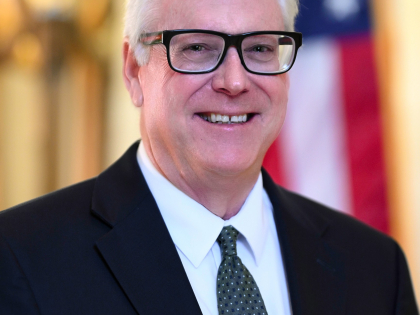
O'Mara on stronger state support for local roads: It's all the funding that localities have for their local roads and bridges (WATCH)
February 3, 2026
-
ISSUE:
- 2026-27 State Budget
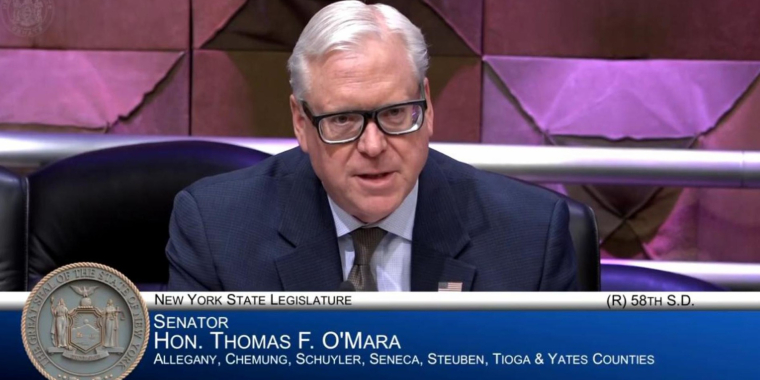
“Our local roads, our local communities have faced these same inflationary pressures as the state projects," said O'Mara.
State support is critical to our smaller, local governments. In many cases, that’s all the funding that they have for their local roads.
Albany, N.Y., February 3—State Senator Tom O'Mara (R,C-Big Flats), Ranking Member on the Senate Finance Committee, is again joining legislative colleagues in Albany this week to continue a monthlong series of joint Senate-Assembly hearings on Governor Kathy Hochul’s proposed 2026-2027 New York State budget.
On Tuesday, the hearing is examining the governor’s specific proposals for transportation.
New York State Department of Motor Vehicles Commissioner Marie Therese Dominguez testified before the panel earlier today and faced questioning from legislators, including O’Mara, on a range of concerns and issues.
O’Mara focused his questioning on Hochul’s proposal to hold state funding flat at last year’s level for the Consolidated Local Street and Highway Improvement Program (CHIPS) -- the state’s primary source of funding for local roads, bridges, and culverts -- along with other key state programs for local roads including Winter Recovery and PAVE-NY.
He said that New York’s local roads associations are seeking a $250 million increase in CHIPS funding. They argue that the Hochul proposal fails to recognize the enormous impact inflation is having on the costs of construction and, consequently, on the budgets of local highway departments. Nationally, according to the Federal Highway Administration’s Highway Construction Cost Index, highway construction costs over the past several years have increased by at least 70 percent.
Since 2013, O’Mara and Assemblyman Phil Palmesano have help build a coalition of support within the state Legislature and worked closely with local transportation advocates from throughout New York on the “Local Roads Are Essential” advocacy campaign annually sponsored by the New York State Association of County Highway Superintendents (NYSCHSA) and the New York State Association of Town Superintendents of Highways, Inc. (NYSAOTSOH).
The coalition notes that every $1 invested in the CHIPS program can save from $6-$14 in long-term rehabilitation costs and help ease the burden on local property taxpayers. Additionally, each $150 million increase in funding for local roads, bridges, and culverts results in the creation of up to 4,200 highway construction-related jobs.
O’Mara highlighted the ramifications of the stagnant CHIPS and other local transportation aid proposals put forth by the governor and its impact on already overburdened localities, local highway departments, and property taxpayers. He noted that last year’s enacted state budget provided $800 million in additional funding to address inflation-related costs on state transportation infrastructure projects.
O’Mara said, “Our local roads, our local communities have faced these same inflationary pressures as the state projects. I think the $250 million (funding increase) is on par” with what was provided to address inflationary pressures for state road projects.
O’Mara also asked if it would make sense and be more cost effective and efficient to consolidate the state’s myriad local aid programs and administer them through a single fund “based on a fair formula.”
“They are critical to our smaller, local governments,” O’Mara said. “In many cases, that’s all the funding that they have for their local roads so it’s important that we work to increase those funds and maximize them where we can.”
[Watch Senator O'Mara comments at today's hearing HERE]
Senator O'Mara has served as the Ranking Member on the Senate Finance Committee since 2021.
"We welcome this year’s budget hearings, at this critical time, for direct input and critique on a range of policy areas that will decide the short- and long-term future and strength of our local communities and economies.” said Senator O’Mara, who represents the 58th Senate District comprised of Chemung, Schuyler, Seneca, Steuben, Tioga, and Yates counties, and a part of Allegany County.
Read more and find the full hearings schedule HERE.
Newsroom
Go to Newsroom