
Senator Weik Stop the Bleed 2026
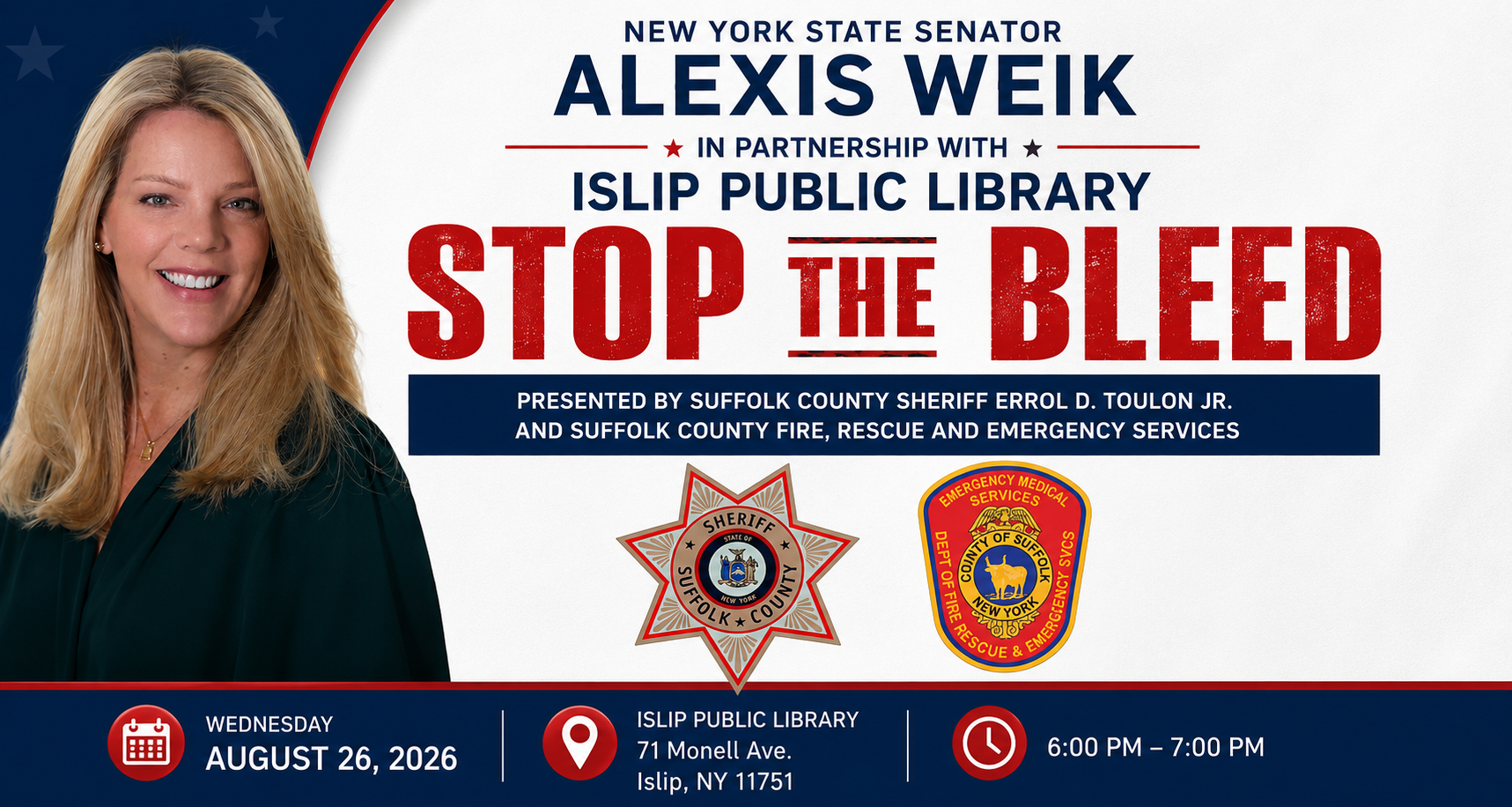
New York State Senator Alexis Weik in Partnership with Islip Public Library
STOP THE BLEED
Presented by Suffolk County Sheriff Errol D. Toulon Jr. and Suffolk County Fire, Rescue and Emergency Services
Studies have shown that the help given by an immediate responder can often make the difference between life and death, even before professional rescuers arrive. Stop the Bleed training is a presentation and hands-on practice of direct pressure application, wound packing, and the use of a tourniquet.
The course was developed for a nonmedical audience to address best practices for immediate responders to control life-threatening bleeding until help arrives. The Suffolk County Sheriff’s Office Stop the Bleed training is available for all schools, community organizations, businesses, and religious organizations in Suffolk County.
Wednesday
August 26, 2026
Islip Public Library
71 Monell Ave. Islip, NY 11751
6:00 PM — 7:00 PM
All are welcome!
Every minute is crucial, so join us to learn how to save a life!
Our registration form for STOP THE BLEED:
Event Timing: Wednesday, August 26 from 6:00 PM-7:00 PM
Event Address: Islip Public Library, 71 Monell Ave, Islip, NY 11751
Contact us at (631) 665-2311 or email gleis@nysenate.gov if you have any questions.
Event Address: Islip Public Library, 71 Monell Ave, Islip, NY 11751
Contact us at (631) 665-2311 or email gleis@nysenate.gov if you have any questions.
What you will learn!
This training teaches basic trauma care, including how to control life-threatening bleeding, until professional help arrives. The training is part of a national campaign to empower bystanders to respond in bleeding emergencies.
- Hands-on practice:Participants learn and practice techniques like direct pressure application, wound packing, and using a tourniquet.
- Accessibility:The training is designed for a non-medical audience, making it accessible to anyone who wants to learn these life-saving skills.
- Community focus:The Sheriff's Office offers the training to various community groups, including schools, businesses, and religious organizations.
- Why it's important: In situations like accidents or active shooter events, quick action can be crucial in controlling bleeding and potentially saving lives.