What should White Plains with proposed $50 million windfall from Galleria garage sale to Capelli’s development group?
Originally published in
Hudson Valley Digger
on
.
Common Council approves new zoning, $50 million price-tag on Galleria garages
What does a city do with a $50 million windfall?
Should it support affordable housing? Upgrade infrastructure? Retire city debt? It’s a question certain to spark extensive debate in White Plains in coming months.
That question now looms as redevelopment of the shuttered Galleria Mall cleared two major hurdles in early December, which included establishing a $50 million price tag on the sale of the city’s aging Galleria parking garages.
But clearing those hurdles has also put on hold developer Louis Cappelli’s proposal to add an additional 460 units of affordable housing to what would be Westchester County’s largest residential project ever proposed.
Cappelli, whose buildings have reshaped the skylines of White Plains and New Rochelle, scored an important victory on Dec. 1 when the all-Democratic White Plains Common Council unanimously approved zoning changes for the 11-acre site.
At the same time, the city is seeking $50 million for its two Galleria garages, which together account for about 4 acres of the downtown property. Cappelli said it will cost another $25 million to demolish the aging structures, including the west-end garage that is currently closed due to structural problems.
Cappelli and SL Green Realty together own a 5% stake in the project’s sponsor, Galleria City Holding Company LLC, with the remaining 95% owned by Aareal Bank Group of Germany, Cappelli said. Cappelli’s partnership has an option through June 30, 2026 to purchase either 51% of the project, or the entire redevelopment.

White Plains developer Louis Cappelli says he’ll need state, city, and county aid to build an additional 460 affordable apartments at his Galleria redevelopment project. Photo: David McKay Wilson
For the garage purchase, the holding company will make a $5 million down payment, followed by $17.5 million paid 30 days after the city’s Planning Board approves the site plan, according to the plan approved by the Common Council. The city would then issue Cappelli a three-year mortgage, secured by the parking garage, on the remaining $27.5 million, according to Corporation Counsel John Callahan, who will step down Jan. 1 after 16 years when incoming Mayor Justin Brasch takes office.
The city could also lease the remaining Galleria garage from the developers for up to two years.
At the Dec. 1 meeting, Councilman John Martin said the $50 million windfall should be used to retire city debt. Mayor Tom Roach wants it dedicated to infrastructure. Councilman Jeremiah Frei-Pearson said on Facebook he’d like to see the money used, in part, to repair city parking garages.
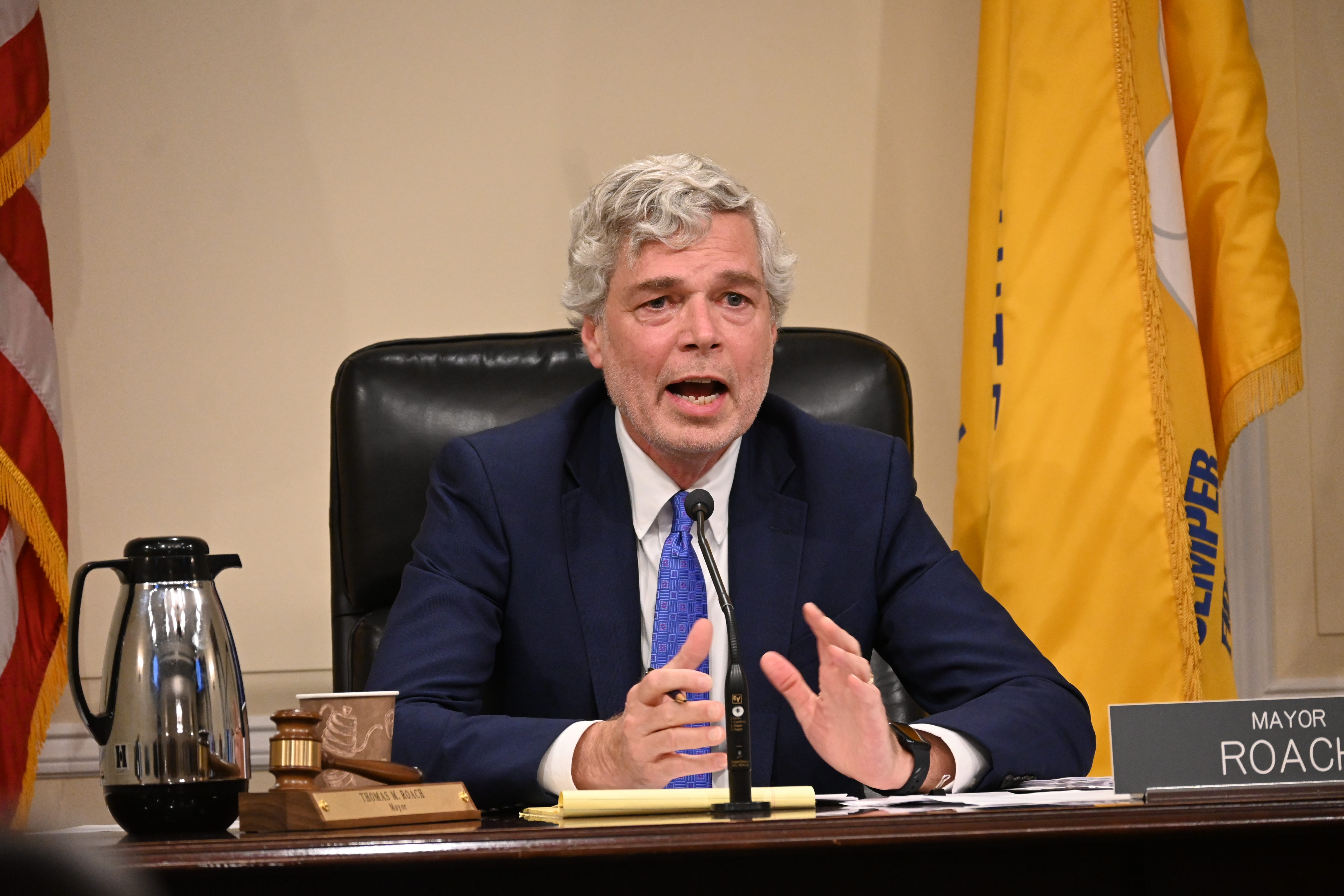
White Plains Mayor Tom Roach wants the $50 million from the Galleria parking garages dedicated to infrastructure investments. (Photo: David McKay Wilson)
Housing advocates, meanwhile, argue that the funds should support additional affordable housing at the Galleria site.
“We have an opportunity to take $50 million and apply it to affordable housing with a competent developer,” said White Plains resident Allen Weintraub.
Ben Brown, founder of the Coalition for Addition without Subtraction, wants all $50 million dedicated for affordable housing.
“I think it is essential that the entirety of the $50 million be used to construct affordable housing at the project site,” he said. “Also, these approvals raise grave questions about whether municipal officials are acting based on the kind of rigorous analysis that I would expect for a development of this size.”
The city engaged a consultant to determine the price, according to the ordinance.
He noted that the ordinance approved the garage sale made no mention of affordable housing. He held out hope that the city’s corporation counsel negotiates for added units as they negotiate the details of the sale.
“I hope he does due to the severity of the housing crisis that is crippling my generation,” said Brown, a White Plains attorney.
Looking for state help
Cappelli said he will seek support from the city, county, and state to add more affordable housing beyond the 360 units already interspersed in the seven market-rate towers in the current conceptual plan.
In May, he proposed building an additional 460 affordable units if the city would grant concessions, including a lower price for the garages.
“There are a lot of programs at the state, city, and county levels,” Cappelli said. “We are going to need those programs to put up this affordable housing. It depends on the city, state, and county balancing how important affordable housing is to them.”
Talks with state legislators are already underway. Lou Sanchez of Local 3, International Brotherhood of Electrical Workers, and co-chair of the political action committee of the Building and Construction Trades Council, said early discussions involved expanding state tax credits for projects addressing soil contamination, known as brownfields.
The deal would also include a project labor agreement for the Galleria project, Sanchez said.
Mayor-elect Brasch said his administration will work with the Westchester delegation to pursue state assistance.
“When you work as a team, you can do good things,” Brasch said. “We’re going to all pull together to make it happen.”
A key figure will be state Sen. Shelley Mayer, D-Yonkers, whose district includes White Plains. Hannah Kirk, Mayer’s communications director, said it was premature to comment. Assemblyman Chris Burdick, D-Bedford, whose district includes downtown White Plains, did not return phone messages.
Affordability in White Plains
Under city regulations, considered the most favorable in Westchester County, developers must provide 12% of units in major projects for tenants earning up to 60% of area median income: $71,400 for a single person and $91,800 for a family of three.
In July, Cappelli sought a lower garage price in exchange for constructing two stand-alone affordable towers.
But the city later lowered the income threshold for affordability from 80% to 60% of area median income, reducing rental revenue on those units. Mayor Roach rejected Cappelli’s request for a lower garage price at the time, arguing that taxpayers deserved a fair return on public assets.
Cappelli said the heightened affordability requirement sharply cuts rental income.
“Just from the economics, the $50 million request for the parking garages doesn’t allow us to put up affordable housing on that property,” he said. “With the price at $50 million, the additional units will not be in the site plan we are seeking. The numbers just don’t work.”
The rezoning—previously designed for the 1980s-era 8-story enclosed mall—now allows multiple residential towers, some rising as high as 450 feet. It also requires extensive open space, a city park, and commercial uses along Main Street, Court Street, Martine Avenue, and Dr. Martin Luther King Jr. Boulevard.
With zoning approved, Cappelli can now submit a site plan to the Planning Board. He hopes to win approval by April.
“Passage of the zoning is a positive step for the project,” Cappelli said. “There’s still a tremendous amount of work to do.”