Amazon Came to Woo This Small Town. It Got More Than It Bargained For.
Originally published in
New York Times
on
.
An Office Born of Scandal
In the summer of 2021, a corruption scandal rocked Orange County.
The county’s district attorney, David M. Hoovler, and the state’s comptroller, Thomas P. DiNapoli, jointly announced that they had obtained felony guilty pleas from three top officials at the Orange County Industrial Development Agency, including its former managing director, Vincent Cozzolino.
Prosecutors say that Mr. Cozzolino used his position at the agency to direct lucrative contracts to his own company, pocketing over $1 million in the process. Two other members of the agency’s upper ranks — its chief executive and a board member — admitted to secretly working for Mr. Cozzolino’s company and getting paid tens of thousands of dollars, according to a report issued by the comptroller’s office.
The scandal provided a rare opening for a Democratic state senator representing Orange County, James Skoufis, to rein in a development agency that he had long cited as being out of control.
He seized on the moment in 2023 to pass a law creating the post of the independent monitor, who would be hired by and report to the state inspector general and whose salary would be funded by the development agency.
The job went to Brian Sanvidge, a certified fraud examiner and top official at a New York City accounting firm.
About a year later, the proposed Amazon subsidy deal landed on his desk.
‘Dead on Arrival’
When it was presented to the public at a hearing last June, some residents reacted with outrage, asking why a multi-trillion-dollar company should receive any tax breaks at all.
Others at the hearing said Wawayanda, a town of about 8,000 people, could benefit from the warehouse construction and the more than 700 jobs it was supposed to create.
Mr. Skoufis called the subsidy package “highway robbery.”
And after Mr. Sanvidge reviewed it, he said, he told the development agency’s chief executive that the proposal was “dead on arrival.”
Scrambling to quell the criticism, new officials at the agency chopped about $20 million from the property tax subsidies in the deal and added requirements for Amazon to start paying its full property tax bill after 15 years instead of the 20 included in the initial proposal. The agency approved that offer last October.
But then, in November, Mr. Sanvidge vetoed the tax breaks, saying he couldn’t get a sit-down meeting with Amazon or obtain basic answers about why the retailer needed the subsidies and what alternative sites it was considering, if any.
Heated litigation ensued. The development agency sued Mr. Sanvidge, claiming he had overstepped. It also hired an Albany lobbying powerhouse, Brown & Weinraub, to work on its behalf as Mr. Skoufis sought to bolster the monitor’s reach.
In June, a judge threw out the lawsuit, which set the stage for a compromise. According to Mr. Sanvidge, who has access to the agency’s financial records, it spent over $400,000 on legal fees — including to reimburse his lawyers — in connection with the suit, and another $52,000 for the lobbying fees.
“They spent roughly $500,000 to avoid transparency,” Mr. Sanvidge said, “and at the end of the day, the project, if everything goes as planned, will get built at a significantly lower cost to the taxpayers with total transparency.”
A ‘Win for Taxpayers’
Now open again to making a new bargain, the development agency pared back its offer to Amazon still more.
The online behemoth would get a property tax break of about $70 million, significantly less than its original ask of $103 million, and it would have to start paying its full property tax bill in 10 years rather than 20, records show.
It would also receive about $30 million in sales tax exemptions during the construction phase, a provision that went unchanged from the original proposal.
And there was another new concession: Amazon, which has faced criticism for being antilabor, agreed to requirements that it would primarily use unionized workers during construction, which would ensure higher guaranteed pay rates than in the earlier iterations of the deal.
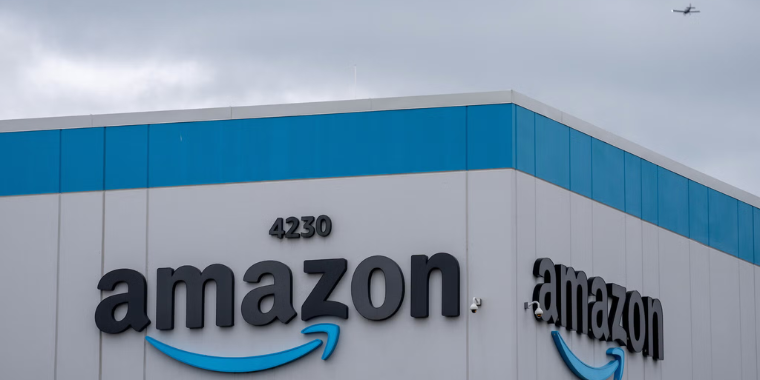
Amazon’s director of economic development, Brad Griggs, said the company would only receive tax breaks “when we deliver on our commitments.” He said local construction firms and workers would benefit long before the 3.2 million-square-foot warehouse opened its doors.
“We understand that people can have different perspectives on agreements like this, and we respect that,” Mr. Griggs said, adding that the jobs created in Wawayanda would offer “competitive pay and benefits starting on Day 1.”
Bill Fioravanti, the new chief executive of the county development agency, said that Amazon would still pay about $20 million in taxes over the 10-year incentive period.
“A lot of people think it’s tax free,” he said. “It’s far — very far — from the truth.”
Mr. Skoufis said the compromise meant more tax money to support “our school district, local infrastructure and law enforcement.”
He said the county’s special monitor had “brought Amazon to their knees.”
“This is an enormous win for taxpayers,” he said.
Newsroom
Go to Newsroom