Pothole problems: Officials demand more state investment in Hudson Valley roads
Originally published in
Halston Media Group
on
.
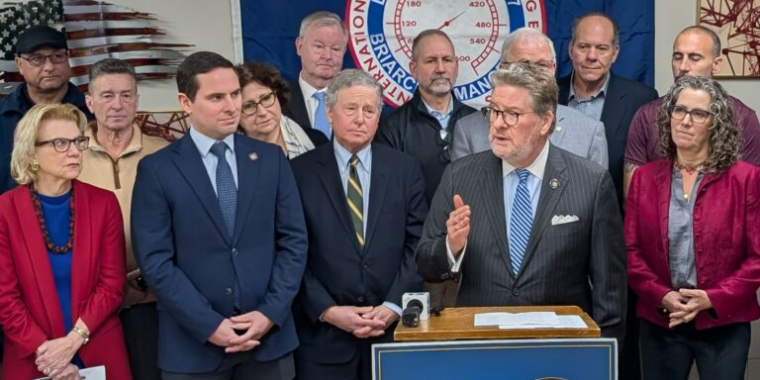
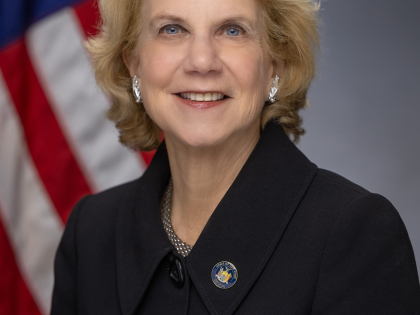
WESTCHESTER COUNTY, N.Y. - The Hudson Valley region has more state roads in greater need of repair than anywhere else in New York, state Sen. Pete Harckham (D-40th District) of South Salem, other elected officials, and union representatives said at a press conference on Friday, Jan. 9.
The bipartisan group called on the state to increase investments in road safety projects. It also demanded that Albany more equitably allocate such funding in the state Department of Transportation’s Region 8, which covers 5,963 miles of state highways and 1,143 bridges in a 4,295-square-mile area.
That adds up to 13 cities, 75 villages, and 107 towns in Westchester, Ulster, Rockland, Putnam, Orange, Dutchess, and Columbia counties.
According reports, it has the worst roads in the state.
The gathering took place at the International Union of Operating Engineers (IUOE) Local 137 Training Center in Montrose.
“While there has been an appreciable commitment to funding road and transportation infrastructure repairs by Governor Hochul these past few years, now is the time to continue this momentum,” Harckham said. “This is especially true for the Hudson Valley region, which has more state roads in greater need of repair than anywhere else in New York.”
If the state is serious about preserving quality of life, fostering economic growth, and creating good paying jobs, it needs to make the critical investments necessary to ensure the safety and viability of its roads, he added.
Attendees noted that last year they were able to work with Gov. Kathy Hochul to secure an increase in the DOT’s capital plan of $800 million and in the Consolidated Local and Street and Highway Improvement Program (CHIPS) by $50 million for a total of $648.1 million.
The DOT’s five-year capital plan now stands at $34.1 billion.
Attendees included state Sen. Shelley Mayer (D-37th District) of Yonkers, Assemblyman Matt Slater (R-94th District) of Yorktown and fellow Assembly members Dana Levenberg (D-95th District) of Ossining, Steve Otis (D-91st District) of Rye, and MaryJane Shimsky (D-92nd District) of Dobbs Ferry.
Slater promised that lawmakers “will not stop digging our heels in on this issue” until they see that roads “get the funding and attention they need, especially when we were promised assistance that never came.”
“The facts don’t lie: our region needs more investment, and you could argue this is a life-or-death situation when roads are so bad that accidents are happening because of their poor condition.” he said.
(Somers has several major state roads, including Routes 35, 100, 118, 139, and 202.)
Jeff Loughlin, president of the Westchester Putnam Building and Construction Trades Council and business manager of IUOE Local 137, hosted the event with John T. Cooney, executive director of the Construction Industry Council of Westchester and Hudson Valley, Inc.
Cooney noted that while the DOT’s funding was increased last year there’s much more to be done.
“The Construction Industry Council of Westchester and Hudson Valley, along with our partners in organized labor, need to highlight the need for continued increased investment in New York State’s roads and bridges brought on by the over 30 percent inflation in construction materials post pandemic,” he said.
“Our roadway infrastructure, which serves as the state’s lifeblood of the transportation network, is severely outdated and in dire need of major capital investments in New York State Region 8," said Loughlin, adding that he was "confident" that the governor "will recognize we must continue to address these deficiencies, as they limit the region’s economic potential and put residents’ safety at risk."
They were adamant that an increase of $950 million is necessary to restore the “buying power” of the original five-year capital plan.
CHIPS also needs a $250 million boost in order to “improve the safety and conditions of the motoring public in the Hudson Valley,” Cooney added.
Calling it an “affordability issue same as any other,” Levenberg insisted that folks can’t keep “paying for preventable car repairs on top of everything else they have to shell out for” – like food, medicine, and electricity.
“We are finally starting to make some progress fixing the roads in this district, thanks to previous investments and the hard work of our brothers and sisters in labor. We can’t stop now,” she said.
Union leaders joining them Friday were representatives from Laborers (LiUNA) Local 17, Laborers (LiUNA) Local 60, Bricklayers and Allied Craftworkers Local 1, Ironworkers Local 40, UA Local 21 Plumbers & Steamfitters, Sheet Metal Workers Local 38, Laborers (LiUNA) Local 754, Carpenters Local 279 and Teamsters Local 456.
The lower Hudson Valley has more lane miles and older facilities than elsewhere in New York, said Shimsky, adding that “despite this, our region has been historically underfunded.”
Pothole Problems
The poor condition of state roads in Region was outlined in a report the agency issued in August 2025. Region 8 roads had the lowest percentage of “Good + Excellent” roads in the state -- 46.5 percent. The same is true with state and local bridge conditions: Region 8 is the worst in New York, it contended.
Also according to speakers, the number of repaved lane miles in Region 8 dropped by almost half in two years, from 430 miles in 2022 to 245 miles in 2024.
Region 8 also has the worst repaving cycle in the state, they said, noting that it takes 16 years on average for state roadways to be repaved in Region 8, while the repaving cycle is only 12 years in the rest of the state.
A 2025 report from TRIP, a national transportation research organization, concluded that poor road and bridge conditions cost motorists $38 billion annually due to vehicle damage, crashes and traffic: a veritable “pothole tax” that few families can afford.
It also noted that delaying repairs ends up increasing costs for state and local governments exponentially more. Every $1 of deferred maintenance costs an additional $4 or $5 in needed future repairs.