Sen. Gounardes Proposes Major New AI Safety and Transparency Regulations
October 29, 2026
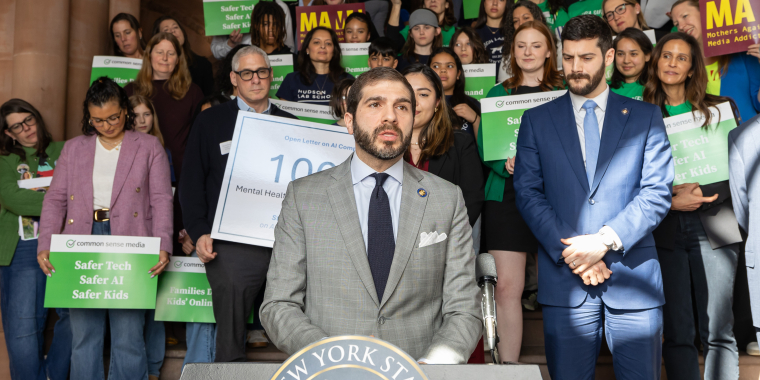
New “RAISE Act 2.0” empowers state to “pace the AI frontier” by forcing developers to slow down if models pose serious danger
FOR IMMEDIATE RELEASE: OCTOBER 29, 2026
View the full legislation (S.10731) here.
Brooklyn, NY – New York State Senator Andrew Gounardes and Assemblymember Jordan Wright introduced new legislation today to protect New Yorkers from the increasingly catastrophic risks posed by the development of advanced artificial intelligence. The new bill builds on Senator Gounardes’ Responsible AI Safety and Education (RAISE) Act, passed last year, by strengthening safety and transparency standards to account for troubling incidents in which AI models have put our safety and economy at risk.
Since the passage of the RAISE Act—which requires large AI developers to publish safety frameworks and report critical safety incidents—the behavior of advanced AI models has become ever more erratic and unpredictable. In July, AI agents created by OpenAI breached their test environment with no human direction and hacked another company’s systems while trying to “cheat” on a cybersecurity test. Google, Meta, and Anthropic have each reported similar unauthorized hacks by their own models in recent months.
Increasingly, the creators of these rogue AI models are themselves calling for government regulation. Over 1,100 employees of frontier AI companies, including Anthropic's CEO and the chief scientists of OpenAI and Meta, have called on the federal government to back an international effort to pace AI development to ensure safety and security. But the White House has proposed only "morally binding" voluntary controls that carry no penalties, require no public disclosures, and create no enforcement mechanism.
Senator Gounardes’ and Assemblymember Wright’s new proposal fills that gap by strengthening several key elements of the original RAISE Act:
- It requires large developers to report quarterly on how much of their AI research is automated (i.e., “recursive self-improvement”) and how they use their computing power. They must also report any substantial jump in risk or in their models' ability to automate AI research within 72 hours.
- It empowers the newly-created state Office of Digital Innovation, Governance, Integrity and Trust (DIGIT) to “pace the frontier” by limiting the computing power large developers devote to training new models or to automated AI research in order to reduce catastrophic risk, prevent a critical safety incident or avert a covered emergency. It enables the Attorney General to ask a court to halt dangerous activity, including by restricting a model's deployment in New York.
- It expands the law to apply to any company that spends more than $1 billion on AI development in three years, and adjusts computational thresholds to match those adopted by the European Union. It also empowers DIGIT to regulate other models that pose catastrophic risk or that could automate AI research. And it expands the definition of "critical safety incident" to include models evading their developer's controls, unprompted attacks on other computer systems, and near-misses.
- It requires large developers to retain an independent, state-licensed “frontier examiner,” who would conduct annual audits of the company’s compliance with the company’s safety frameworks as well as broader safety evaluations and make catastrophic risk assessments every 90 days. The examiner’s reports would be shared with the state and made publicly available. Examiners would also be required to alert the state within 72 hours of an emergency event.
- It requires DIGIT to adopt binding minimum standards for safety frameworks and risk mitigation.
- It reinforces that whistleblower protections in state labor law apply to employees of large developers, bans contracts that silence them and requires annual notice of their rights. Penalties rise to as much as $1 million per day for a first violation and $3 million per day for later ones, and a senior officer must certify filings under penalty of perjury.
This new bill builds on the foundations established by the RAISE Act, ensuring New York's nation-leading oversight of advanced AI is in step with a fast-evolving technology. In doing so, the state can protect public safety while still allowing beneficial uses of AI to grow.
“It’s time to rein in the AI arms race,” said State Senator Andrew Gounardes. “Every day, frightening new headlines make it clear: when it comes to AI, we can’t trust Big Tech companies to regulate themselves. This isn’t science fiction. Our safety, our economy, and our very humanity is at serious risk. As lawmakers, our number one responsibility is to keep our communities safe. Since the federal government has failed to act, states like New York must act instead. My bill creates safety and transparency requirements with real teeth, so we can hold powerful corporations accountable and put New Yorkers’ safety first.”
“New York’s RAISE Act was the first law in the nation to put real safety guardrails on the most powerful AI models, and this technology hasn’t slowed down since. Neither can we,” said Assemblymember Jordan Wright. “This legislation builds on the foundation RAISE laid. It brings in independent, state-licensed examiners to make sure companies are actually following their own safety commitments, requires developers to tell the state how much of their AI research is being done by AI itself, and gives our new DIGIT office the authority to step in when a model poses a catastrophic risk. When folks inside one of these companies see something wrong and speak up, New York will have their back.”
“When an OpenAI engineer sounded the alarm on the rapid pace of AI development, warning that this technology has the potential to have cataclysmic consequences, it wasn’t just deeply alarming—but a call to action,” said Senator Patricia Fahy (D–Albany). “Critically, the 2026 International AI Safety Report warned that the mass proliferation of AI development and rapid deployment is outpacing the effectiveness of current imperfect safeguards, underscoring the need for strong and effective oversight of model safety. This legislation establishes strong safeguards, independent third-party analysis and assessments of existing AI models, and includes a ‘kill switch’ if a model is deemed to pose a catastrophic risk. If the federal government won’t step in to regulate AI and institute commonsense safeguards, New York State will. I’m proud to introduce this legislation alongside sponsor Senator Gounardes, who has been a champion of AI safety and crafted the landmark RAISE Act, as well as Assemblymember Wright, to continue protecting New Yorkers from the dangers of AI and hold the large, bad corporate actors accountable.”
“When we passed the RAISE Act, we put New York ahead of the risks posed by increasingly powerful AI systems,” said Assemblymember Alex Bores. “Now those early warnings are playing out in real life as AI models act in ways their own developers can't control. The RAISE Act was always meant to be the floor, not the ceiling, and while Washington continues to sit on its hands—or worse, enable Silicon Valley billionaires—Senator Gounardes is once again showing what it means for states to lead. I'm proud to stand with him in making sure New Yorkers, not just the companies building these systems, have a say in how AI shapes our future.”
“Sen. Gounardes and Asm. Wright recognize the constantly evolving need to address emerging AI risks," said Ben Snyder, Director of State Policy at Encode. "Their new bill amends the RAISE Act to strengthen guidance and accountability for the largest AI developers, provide real independent oversight, and help ensure people – not profits or the pressure of the race to the top – are driving AI development. Together, these changes would reinforce New York’s leading AI safety standards without unnecessarily stifling innovation.”
"The capability of AI systems, and their attendant risks, continues to grow,” said Scott Wisor, Policy Director, Secure AI Project. “Senator Gounardes and the New York State government intend to meet the moment with new protections to build upon the RAISE Act, ensuring that independent third parties have meaningful oversight of AI companies and the government is empowered to protect the public from serious risks."
Press Contact:
Billy Richling
Communications Director
State Senator Andrew Gounardes
billy@senatorgounardes.nyc
###
related legislation
Newsroom
Go to Newsroom