
Senator Baskin Introduces Legislation to Tackle the State’s Long-Vacant “White Elephant” Buildings
March 30, 2026
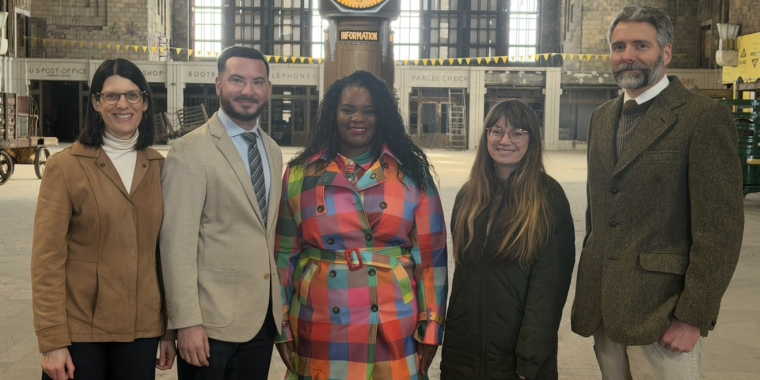
Legislation Will Catalyze Redevelopment of Long-Vacant Historic Buildings, like Buffalo Central Terminal, Richardson Olmsted Campus, and former AM&A building
New York State Senator April N.M. Baskin on Monday announced legislation to address New York State’s largest and most chronically vacant historic buildings, commonly known as “white elephants.”
These structures are defined as certified historic buildings that are very large in scale, have been vacant for at least 10 of the past 15 years, and require more than $50 million to rehabilitate. This legislation strengthens the New York State Historic Rehabilitation Tax Credit program, an already successful economic development program.
“The New York State Historic Rehabilitation Tax Credit has been a resounding success since 2010,” Senator Baskin said. “But the current $5 million cap is simply not enough to tackle these significantly larger projects. By strengthening that incentive, we make it financially realistic to bring these properties back to life. We shouldn’t let buildings like these sit vacant when they could be economic engines for our communities.”
Senate Bill S6021A would raise the cap on available credits from $5 million to $15 million for qualifying white elephant buildings. The State Historic Preservation Office has identified 35 buildings statewide that could qualify, including Buffalo’s Richardson Olmsted Campus, Central Terminal, and potentially the DL&W Terminal, Statler Tower, former AM&A’s buildings, and the Pierce Arrow Factory. The companion bill, A10366, has been introduced by Assemblymember Pamela Hunter (D-Syracuse).
City of Buffalo Common Councilmember Mitchell Nowakowski, who represents the Fillmore District, said, "Buffalo is home to some of New York's most iconic historic buildings, but too many have sat vacant for decades because the financial tools haven't matched the scale of the challenge. This legislation changes that. I urge the State Legislature to act quickly to give us the tools to unlock projects like the Statler and the former AM&A's building to bring them back as housing and economic assets."
Erie County Legislator Lawrence Dupre said, “Senator Baskin’s ‘white elephant’ law is a forward-looking investment in our communities. By transforming these long abandoned and dilapidated properties into opportunities of much needed housing and economic stimulation, it will breathe new life into neighborhoods that have long been left behind.”
Monica Pellegrino Faix, Executive Director of the Central Terminal Restoration Corporation, said, “The increase in the cap will be a game changer. We’ve made steady progress, but this legislation brings us much closer to realizing the full reuse of this magnificent building.”
Paris Roselli, Executive Director of the Richardson Olmsted Campus, said, “The state’s past investment transformed key portions of the campus, but additional support is needed to complete the remaining buildings. This cap increase may finally attract a developer to take on the next phase.”
Jay DiLorenzo, President of the Preservation League of New York State, said, “This bill will prevent the loss of major historic properties through demolition by neglect and drive economic growth. Every dollar in tax credits generates roughly four dollars in private investment.”
Bernice Radle, Executive Director of Preservation Buffalo Niagara, said, “Buffalo’s historic buildings are irreplaceable. Their reuse strengthens neighborhoods, preserves craftsmanship that requires specialized knowledge, and ensures these skills are passed to future generations.”
Paul Brown, President of the Buffalo & Niagara County Building & Construction Trades Council, said, “For our 18 member unions, this legislation means long term economic impact, job creation, and increased local spending.”
Since 2010, the New York State Historic Rehabilitation Tax Credit has supported more than 1,500 projects representing over $17 billion in investment. The program has created 14,000 housing units, including 4,300 affordable units, and supports thousands of construction jobs annually. Historic rehabilitation also generates significant secondary employment, with each 10 construction jobs creating an additional 1.8 to 2.4 jobs in other sectors.
“State tax credits leverage federal funding and private investment, stabilize neighborhoods, support new businesses, and create new housing. Increasing this cap may well determine whether these buildings are saved and reused – or lost forever,” Senator Baskin concluded.
related legislation
Newsroom
Go to Newsroom


Helping residents access state services
April 16, 2026