Transportation Chair Cooney, Senator Fahy Rally With Upstate Coalition To Sound The Alarm On Public Transit Funding In Upstate New York, Call For Substantial Funding Increase In This Year's Budget
March 25, 2026
-
ISSUE:
- Public Transit
Senate One House Budget Includes 15% Increase For Upstate Public Transit
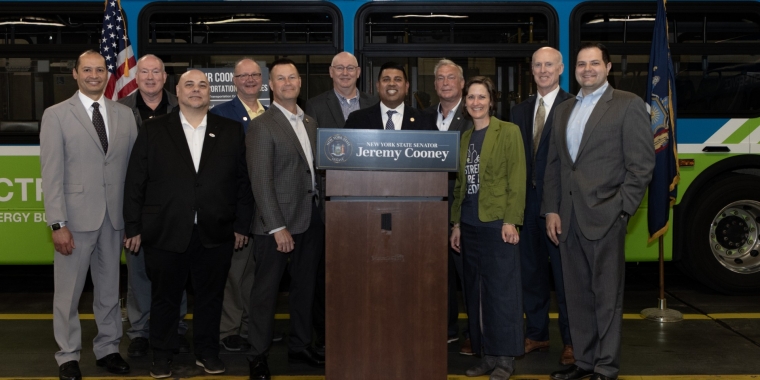
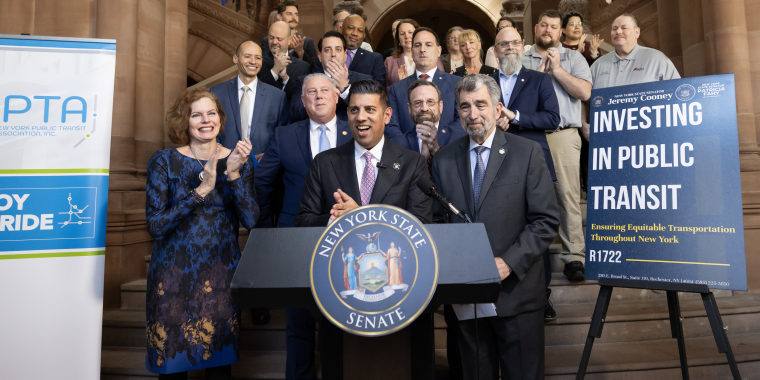
(ALBANY, NY) - Today, Senate Transportation Chair Jeremy Cooney (D-Rochester), Senator Pat Fahy (D-Albany), Assembly Transportation Chair William Magnarelli, The New York Public Transit Association (NYPTA), and public transit agencies from across Upstate New York rallied on the Million Dollar staircase to call for a 15% funding increase for upstate public transit agencies in this year’s budget. Senators Cooney and Fahy were joined by a coalition of legislators from across upstate New York.
“We can’t promote affordability in New York without bolstering public transit,” said Senator Cooney. “Public transit is the great equalizer, breaking down barriers to transportation, education, healthcare, and job opportunities. If we don’t ensure our upstate public transit agencies have the resources they need, we miss an opportunity to promote equity, efficiency, and fairness across our communities. A 15% increase isn’t a luxury, it’s a necessity to keep all New Yorkers connected.”
“Upstate transit authorities are grappling with the same rising cost of gasoline as working families thanks to the ongoing war with Iran and other external factors,” said Senator Patricia Fahy (D–Albany), member of the Senate Transportation Committee. “Here in the Capital Region, CDTA moves more than 50,000 riders every day across our communities, helping people get to work, medical appointments, and complete other daily tasks. For every dollar we invest in public transit, we generate $5 in economic return that boosts our small businesses and encourages spending in our communities. Working people in particular rely on public transportation, and during periods of energy crises, we see ridership rates and public transit utilization rise as gasoline prices break the bank. This year, a 15% STOA increase isn’t just necessary, it’s the lifeline keeping our public transit authorities afloat, and this year’s final budget must reflect that reality.”
Assembly Transportation Chair Magnarelli said, “Public transit is vital for the economic growth and environmental health of our Upstate communities. For too long, our authorities have been underfunded and reliant on the State’s General Fund to fill gaps. To build public transit systems to meet these challenges we need a reliable, predictable source of funding. In Central NY, CENTRO needs these funds to expand in order to meet the service demands the Micron project will bring to the region. As Chair of the Assembly Transportation Committee, I look forward to working with my colleagues in the Senate and Assembly to secure these resources in the final State Budget.”
“The best way to address affordability and ensure our customers continue to have access to transportation that is safe, reliable, convenient, and sustainable, is to secure at least a 15% increase in State Operating Assistance in the final state budget,” said RGRTA CEO and NYPTA President Miguel Velázquez. “While ridership and demand for more service in the Rochester region continues to grow, our structural deficit threatens to undermine access to jobs, education, health care, childcare, and other daily basic needs. Increased investment in public transit this year and into the future will help us maintain service and put us on solid footing so we can expand service and meet the needs of our customers.”
“If we want transit that is frequent, reliable, and truly accessible, a 15% increase in State Operating Assistance is essential,” said CDTA CEO Frank Annicaro. "CDTA has spent the past several years expanding service and driving innovation, resulting in nearly 20% growth in pre-pandemic ridership. But transit funding in upstate New York has not kept pace. Without this investment, we risk service reductions and fewer mobility options for the riders who depend on us every day. As the Capital Region, especially downtown Albany, continues to grow, that momentum depends on strong public transportation. When transit falls behind, our communities do too. We are thankful that state leaders have long supported CDTA, and now is the moment to build on that commitment.”
“Ridership is increasing in every community we serve and the fastest growing segment is the most vulnerable – those who are elderly or disabled. Services for those individuals are surging more than 10% each year and will continue to increase as our population ages,” said Centro Chief Executive Officer Christopher Tuff. “We need additional support so we can deliver workers to new employers. In Central New York, Micron’s investment will need to be matched with adequate transportation services to ensure success and provide workers with access to their site for decades to come.”
The Senate one-house included a 15% increase to State Operating Assistance (STOA) from last year’s enacted funding. This would mean an additional $75.8 million for upstate public transit systems, for a total of $1.09 billion. The Assembly one-house included a 7.45% increase, and the Governor’s executive budget a 5.8% increase. Senators Cooney and Fahy explained that the 15% increase is critical to support the operations of transit agencies like RTS in Rochester and CDTA in the Capital Region and to prevent disruptions to service.
Statistics provided by the American Public Transit Association underscore the impact public transit agencies have on affordability and economic development. According to NYPTA, for every $1 invested in public transportation, $5 is generated in economic returns. They also report that an individual can save up to $13,000 a year on average, roughly $1,100 a month, by choosing public transportation instead of driving.
With gas prices rising nationwide, in large part due to the ongoing war with Iran, it was recently reported that prices in New York have risen 16% compared to this time last year. Even before these increases, agencies like RTS and CDTA have already reported double digit gains in ridership year over year. The Senators explained that with rising costs, now is the time to fully commit to adequately funding public transit in upstate New York.
The legislators’ push also comes at a time when car ownership is becoming increasingly unattainable for more Americans. A recent article reported that “the average monthly new-car payment reached $774 in January, up from $588 in January 2021” and that the “total cost of owning a vehicle has risen more than 40 percent since January 2020.”
Assemblymember Harry Bronson (AD-138) said, “Public transportation is a lifeline that connects people to their communities. It serves as a vehicle to not only physically get people where they need and want to go, but as a vehicle to opportunity — to jobs, to education, and to a better quality of life. Upstate New York's transit agencies deliver on that promise every day, and they deserve the resources to keep doing so. That is why I join my colleagues in calling for a 15% funding increase for upstate public transit agencies to be included in this year's final budget.”
Senator Samra Brouk (SD-55 Rochester) “As global conflicts caused by the Trump administration drive up gas prices and strain household budgets, investing in our upstate public transportation systems is now an even more urgent economic concern. Reliable, affordable public transit gives working families an alternative to volatile fuel costs and allows people to feel confident that they can pursue employment and education opportunities and have a way to get to the grocery store and doctor appointments. If we are serious about a sustainable and inclusive future, we must treat public transportation as a fundamental public good worthy of sustained investment.”
Assemblymember Jen Lunsford (AD-135) said, “Public transportation is an essential component of our climate action plan, of our anti-poverty initiatives, our housing plans and our economic development programs. Without a robust public transportation network our state cannot reach its goals. Investments in public transportation are investments in communities. I stand with my Upstate colleagues to demand robust investment to allow our public transportation systems to provide the service our communities need and deserve.”
"Public transportation is essential for many Central New Yorkers who rely on it to get to work and meet a variety of everyday needs. That’s why the Senate’s one-house budget includes a 15% increase in STOA funding for upstate transit. I’m urging Governor Hochul and the Assembly to match that investment. My constituents depend on it, and we need this funding delivered this year,” said Senator Rachel May.
Assemblymember John T. McDonald III, RPh said: “Public transit is a critical lifeline that connects people to jobs, healthcare, education, and essential services. As costs continue to rise, more people are turning to public transportation as an affordable and reliable option. That’s why we need to make meaningful investments in our upstate transit systems. We will continue working toward a final budget that fully supports these systems, strengthens our local economies, and ensures that every community remains connected.”
Assemblymember Demond Meeks (AD-137) said, “In Rochester, we know that public transit is more than just a ride. It is a lifeline for our working families and a cornerstone of economic equity. As gas prices surge due to the federal government and the cost of living hits our underserved neighborhoods the hardest, we must treat the 15% increase in State Operating Assistance as a non-negotiable priority. Investing in RTS and other public transport isn't just about moving buses; it is about putting $1,100 back into the monthly budgets of New Yorkers and ensuring that our transportation infrastructure serves everyone, not just those who can afford a car. We have the data, a 5-to-1 return on our investment, and we have the demand. Now, we need the political will to fund the transit systems our community deserves fully."
Matthew Rosenbloom-Jones, General Manager, TCAT, Inc. said, "Tompkins Consolidated Area Transit in Ithaca, New York has seen a ridership increase of 32% year over year as of the end of February 2026. Rapid ridership growth has led to full buses and we are struggling to meet demand for transit in our community. At the same time, costs continue to outpace revenue growth. A 15% STOA increase is desperately needed to offset growing labor, fuel, insurance and parts costs to keep upstate residents from being left at the bus stop at this critical moment for public transportation in New York."
Greg Kilmer, Broome County Commissioner of Public Transportation, said, “The requested increase in State Operating Assistance will not only enable BC Transit to maintain its’ current service levels in an inflationary economy but, will allow for route modifications that better connect new housing projects with the community. As the community grows, demand for public transportation needs to keep pace to provide access to services, retail, education, healthcare and housing.”
###
Newsroom
Go to Newsroom