Fahy, Peoples-Stokes Introduce Legislation Creating State Tax Credit for Office to Residential Building Conversions
February 24, 2026
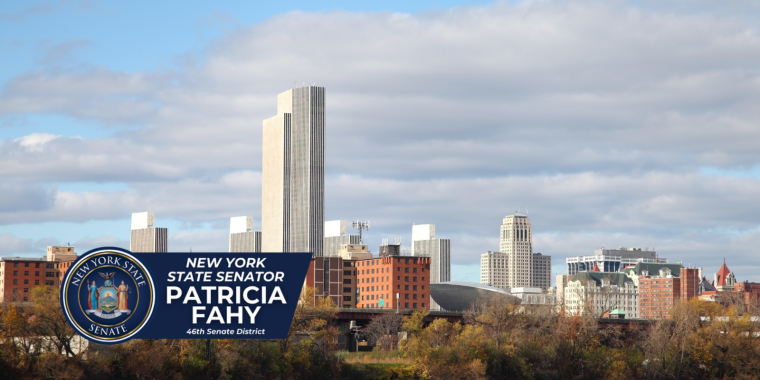
With office building vacancy rates above 20% in Albany, Buffalo, & Rochester, bill seeks to help Upstate cities revitalize and address vacant office building stock
ALBANY, N.Y. — Senator Patricia Fahy (D—Albany), Assembly Majority Leader Assemblymember Crystal Peoples-Stokes (D—Buffalo), and Assemblymember John T. McDonald III, RPh (D—Cohoes) announced introduction of legislation (S.9259/A.10192) today to spur the conversion of underutilized office buildings and space into residential housing in communities outside of New York City.
This legislation enables property owners who pursue substantial rehabilitation of vacant office buildings into residential units to earn a refundable tax credit equal to 10 percent of qualified rehabilitation expenditures. Eligible projects must be in cities, towns, or villages with populations under one million, and at least 50 percent of the building must be vacant and converted to residential use. Additionally, this legislation creates a new tax credit to apply to historic rehabilitation projects that meet the same residential conversion goals.
Across New York State, downtown office space continues to sit empty as a result of the COVID-19 pandemic at the same time families and New Yorkers are experiencing a housing crisis. In downtown Albany, the vacancy rate now exceeds 27%, and the regional vacancy rate stands at 14%. In the City of Buffalo, overall office vacancy has climbed to roughly 16% regionally, with prime downtown office space exceeding 20% vacancy. Similarly, the City of Rochester’s office vacancy rate has risen to almost 28%. These numbers are reaching crisis levels.
For example, New York City has already demonstrated how converting underused office buildings into housing can work, and work well by similarly providing property tax exemptions for office space conversions. In recent years, landmark projects like the transformation of 25 Water Street in Lower Manhattan, once the JPMorgan Chase back office and Daily News headquarters, have been reinvented as more than 1,300 residential apartments, with a mix of market-rate and affordable units now occupied.
These conversions are occurring at the highest pace the city has seen in nearly two decades, reshaping vacant commercial space into vibrant neighborhoods and helping address New York’s persistent housing shortage. Underscoring just how important these conversions are, the New York City metro area now leads the nation with 8,310 units in its conversion pipeline for 2025 alone.
Furthermore, across the country, the number of office-to-apartment conversions has skyrocketed from 23,100 in 2022 to a record-breaking 70,700 in 2025. Office-to-apartment conversions now make up almost 42% of the nearly 169,000 apartments in future adaptive reuse projects thanks to local programs and initiatives.
Studies estimate that more than 800,000 additional housing units will be needed over the coming decade in New York State to stabilize rents and meet demand, and Governor Hochul has committed to achieving that goal through New York State’s Housing Compact. Right now, Upstate communities face a dual challenge in stagnant housing supply alongside downtown corridors struggling with commercial vacancy.
“In the aftermath of the COVID-19 pandemic, Upstate cities like Albany have been hit hard as employers shift to remote-based work, where our office building vacancy rate stands above 25% or more than one-quarter of available space,” said Senator Patricia Fahy (D—Albany). “New York is in a housing crisis as homeowners and renters struggle to find homes they can afford in communities across the state. Office buildings, previously full of employees prior to the pandemic, now sit empty in downtowns like Albany, Buffalo, and Rochester, and our legislation adds another critical tool in the toolbox for municipalities and developers to begin large-scale conversion projects. New York needs to build, convert, and get creative about solutions, and that begins with using every tool at our disposal to address both the housing crisis and rising vacancy rates in cities across Upstate.”
“The cost of housing has become unaffordable for far too many people in Buffalo and in so many other communities across the State. We need to explore all options to address this problem and make sure as many new residential units are coming into the market as possible to drive prices down,” said Assembly Majority Leader Crystal Peoples-Stokes. “There is a significant amount of unused office space throughout the state that could be converted to residential units. Providing state tax credits is an appropriate incentive to promote converting unused office space into residential housing. I look forward to partnering with Senator Fahy, Assemblymember McDonald, and all my colleagues, to tackle the housing affordability crisis in our State.”
"Upstate communities are facing high office vacancy rates and a pressing need for housing at the same time,” said Assemblymember John T. McDonald III, RPh (D—Cohoes). “This legislation gives cities the tools to convert vacant office space into new homes, strengthening our downtowns and expanding housing options across the Capital Region. Converting underused buildings into housing is a practical solution that can bring new residents and economic activity back to cities across Upstate."
“Our upstate communities are facing the housing crisis impacting the entire state, and far too many office buildings are sitting empty while families are struggling to find an affordable place to live,” said Assemblymember Gabriella A. Romero (D, WFP-Albany, Guilderland, New Scotland). “We need to use every tool in our toolbox to address these issues and create more housing, and that includes converting these long vacant office spaces into vibrant residential units. By increasing density and reimagining unused buildings, we can address our housing shortage while at the same time combatting blight and revitalizing our downtown corridors in places like Albany, Buffalo, and Rochester. Upstate needs diversified, forward-looking solutions that keep us competitive, strengthen our local economies, and ensure our communities are places people can live, work, and thrive.”
“Albany is facing two realities at the same time,” said Albany Mayor Dr. Dorcey Applyrs. “We have a housing shortage that is putting pressure on families, and we have office buildings downtown that are sitting underused. This legislation gives cities like ours a practical tool to address both. A targeted tax credit for office-to-residential conversions can help bring new housing online, reactivate vacant buildings, and restore energy to our downtown corridors. We have seen conversions work in other markets, and we know they can work here. I appreciate Senator Fahy and Majority Leader Peoples-Stokes for advancing a solution that supports housing growth, strengthens property values, and helps reposition Upstate cities like Albany for long-term stability.”
"Buffalo is facing two difficult realities at the same time: a shortage of housing that people can afford and underutilized office space in our downtown,” said Buffalo Mayor Sean Ryan. “This legislation helps us turn that challenge into opportunity by creating new homes, bringing more residents downtown, and supporting the downtown revitalization of our city. Conversions like these are the creative tools that Buffalo needs to meet the challenges of the present day."
###