Elected Officials and Utility Customers Call on State to Rein in NYSEG
February 16, 2026
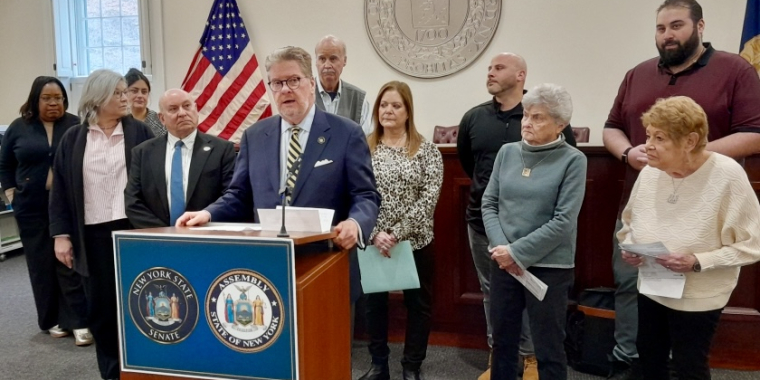
State Sen. Pete Harckham at the podium during the NYSEG press conference
“New Yorkers are Facing a Cost-of-Living Crisis”
Bedford Hills, NY - New York State Senator Pete Harckham and Assemblymember Chris Burdick were joined by Westchester County Legislator Erika Pierce, Bedford Deputy Supervisor Stephanie McCaine, and a group of utility customers to urge the state Public Service Commission (PSC) to rein in NYSEG’s proposed rate hikes, saying utility bills are already unaffordable.
“New Yorkers are facing a cost-of-living crisis,” Harckham said. “At a time when families are struggling to pay rent, buy groceries, and afford medicine, imposing dramatic utility rate hikes is not the answer. The PSC must stand with consumers - not approve massive increases that most households simply cannot afford.”
Harckham and the others delivered their message at a livestreamed press conference at Bedford Town Hall. Several constituents shared stories of NYSEG bills soaring past $1,000 for a single month; one customer is $5,000 in arrears.
To see a video of the press conference, click here.
New York State Electric & Gas (NYSEG) has proposed increasing electric delivery rates by approximately 35% and natural gas delivery rates by nearly 39.4% - far exceeding general inflation, which has remained in the low single digits over the past year.
Burdick said: “Our constituents have seen their utility bills double and even triple in recent years. People who have lived within their means are now struggling to make ends meet because of soaring utility rates. As an intervenor (party) in the ConEd rate case, and as an intervenor in the NYSEG rate case, I have seen firsthand how the process of setting delivery rates is not working. I urge residents to submit a public comment to the PSC, letting them know that NYSEG’s proposed rate hikes are unconscionable. I will continue to do all I can to represent my constituents and fight against the unreasonable rate hikes.” He said the PSC could be contacted at: 1-800-335-2120. He also suggested calling the Governor’s office at: (518) 474-8390.”
Pierce said: “For years, I have been working with individual constituents and the Public Utility Project on a myriad of issues related to NYSEG and its billing practices. It is bad enough when the bills are too high, which they currently are, but it is even worse when the bills are also frequently incomprehensible or just downright wrong, and connecting with customer service is an impossibility. For so many reasons, the PSC must say no to this rate request, and further, must demand more accountability and better customer service from NYSEG.”
McCaine said, “We are so grateful that we can host this event. We have a majority of NYSEG customers in the Town of Bedford. This issue is very important. We are very grateful to have our county and state partners here and members of the community to shed light on this very important issue.”
Seven members of the community, who were angry about their bills and their treatment by the utility, also took part in the event.
Janet Pearlmutter said, “It’s ridiculous to pay $867 more a month. No one can basically afford that. This is totally crazy. I beg you, Public Service Commission, do whatever you can to help us. We really can’t afford this.”
Nancy Felton said, “In the last few years, NYSEG customers have received bills that are double, triple and even quadruple of what they were. I, for example, have an outstanding balance of over $5,000 and it continues to grow each month. We need relief, not excuses. We need action.”
Jackie Silkowitz said, “My neighbors have $1,300 and $1,400 bills. NYSEG should not be allowed to pass along the cost of supply. It’s absolutely outrageous.”
Mike McBride said, “My bills have gone up from $329 in January 2022 to $1,080 this past January. The delivery charge has gone from three and a half cents per kilowatt hour to nine and a half cents per kilowatt hour.”
Leanne Bretti said, “I have a one bedroom condo. In December my bill was $250, in January it was $950 and in February it was $1,100 and I am away all day.”
Matt Mancuso said, “For the month of October my bill was $300 and in January it was $1,400, it doubled and then some. We need an explanation on why they increased this and how they come up with the number.”
Mark Mancuso said, “I have no faith or belief in NYSEG or what they do. I have fought them, non-stop day in and day out and they have not been able to explain my bill. It just seems like a scattered mess and not really organized to show the customer what it is that we are putting our money toward.”
Lawmakers across the state, including in the Hudson Valley, have also called for greater scrutiny of utility rate requests and more transparency in billing practices affecting affordability and fairness.
State Senator Shelley Mayer said, “I join my colleagues in Northern Westchester to urge the PSC to reject NYSEG’s proposed rate hikes. It has been apparent for some time that utility rates, such as those imposed by Con Ed and NYSEG, impose a tremendous financial burden on many Westchester households. I am a party to this rate case, which means I am a formal, active participant in the rate hike proceeding. The process is complex, time-consuming, and almost impossible for most ratepayers to join. We need to change to a process that is simpler and more transparent so that the voices of ratepayers are heard and taken seriously. NYSEG ratepayers are families, seniors on fixed incomes, and small businesses. They should not have to struggle to afford the basic essentials of heat and electricity. We demand fairness and accountability in the rate-setting process, and rates that New Yorkers can afford. So far, we have neither.”
State Assemblymember Dana Levenberg said, “I'm proud to support my colleagues speaking out against the NYSEG rate hikes. Residents are struggling to afford their bills all over New York State, and our utility rate case process is partly to blame. As an intervenor in the Con Ed rate cases last year, I saw firsthand how much the current rate case process favors utilities. We are in dire need of rate case reform and I will continue working with my colleagues to bring much needed change for New York ratepayers.”
Assemblyman Matt Slater said, “Families and individuals are still facing high costs for housing, food, healthcare, and other essentials. For many, any increase in utility rates represents not just an inconvenience, but a genuine hardship. The PSC must act in the best interest of consumers and rein in NYSEG's proposed hikes.”
Mayer, Levenberg and Slater were unable to attend the press conference.
Even before the proposed rate hikes take effect, utility unaffordability is already a crisis.
New statewide data shows more than 1.3 million customers are over two months behind on bills, with total unpaid balances exceeding $2 billion. Tens of thousands of households have been disconnected in 2025 alone.
Consumer advocates, including AARP New York, have urged rejection of significant utility rate increases, citing the severe impact on retirees and fixed-income households.
“Utilities operate as regulated monopolies with guaranteed returns,” Harckham said. “Shareholders should share in the risk too. They should not be insulated from economic realities while families make impossible choices between heating their homes and feeding their children.”