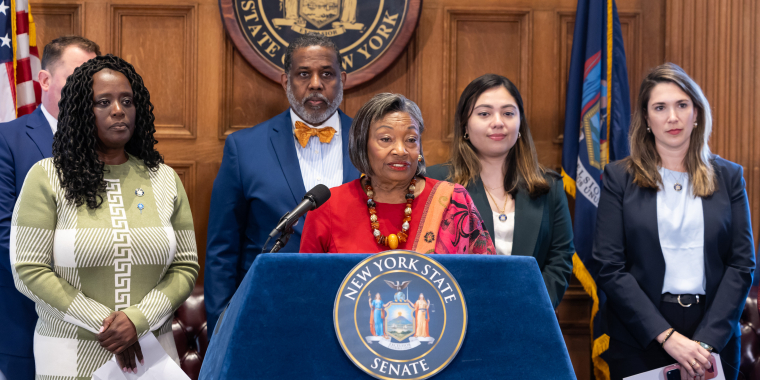
Senate Advances Legislation to Ensure Fair Rates, Deliver Relief to Ratepayers
April 15, 2026
The New York State Senate today advanced legislation to protect ratepayer access to utilities, ensuring such services are provided in a manner that is equitable, affordable, and imposes no undue financial burden. This package includes legislation that would establish protections for customers related to service termination and overdue payment, prohibit utilities from terminating services during extreme weather events, provide direct and timely financial relief to ratepayers affected by utility misconduct, automatically re-enroll individuals and households who continue to meet the eligibility requirements for the Home Energy Assistance Program (HEAP), and restrict retroactive service charge increases for small non-residential customers.
Senate Majority Leader Andrea Stewart-Cousins said, "New Yorkers cannot afford to wait for relief as utility bills rise and families face growing financial pressure, compounded by national economic challenges like rising gas prices. Our work on affordability continues in tandem with budget negotiations, and today we are advancing our second utility package of the year. This package prioritizes affordability and equitability by introducing measures to prohibit utility disconnection during extreme weather events, limiting utility companies’ capacity to recover legal fees from ratepayers, and establishing protections for customers while a utility company is under investigation by the Public Service Commission. I thank today’s bill sponsors for putting ratepayers first by introducing regulations that will ensure fair and affordable continuity of service.”
Chair of the Energy and Telecommunications Committee, Senator Kevin Parker said, “By including these measures in a comprehensive ratepayer package, we are taking meaningful steps to protect New Yorkers from unfair utility practices and ensure that the benefits of the energy system are more equitably shared across all communities. As Chair of the Energy & Telecommunications Committee, it was especially important to me, working alongside this strong Majority Conference, to advance both immediate and long-term legislation that protects working families from rising utility costs and the unpredictability driven in part by shifting federal policies since 2016 & now again in the stress vacuum reestablished at the start of 2025 federal administration, only makes this more important as we look at the current state of our country due to untethered federal policy. This moment makes it more critical than ever to deliver a ratepayer package that provides stability, fairness, and real relief for New Yorkers.”
Extends Rollover Credit Period for Customer-Generated Electricity: This bill, S.1553, sponsored by Senator Parker, would extend the time during which they can receive net metering credits for energy generated by their wind or solar in excess of what they use from one year to an indefinite period, and would entitle ratepayers indefinitely accumulating such credits to be reimbursed the avoided cost of those credits every five years.
Consumer Credit Reporting by Utilities Study: This bill, S.2011, sponsored by Senator Parker, directs the Department of State and the Public Service Commission to study and report upon the prevalence of the disclosure by public utilities, cable television companies, and cellular telephone service providers to credit reporting agencies of late payments and defaults in payment of fees and charges by consumers.
Prohibits Utility Disconnection During Extreme Weather Events: This bill, S.120A, sponsored by Senator Cleare, would prohibit utilities and municipalities from terminating electricity or gas service for ratepayers during extreme weather forecast periods. Those extreme weather forecast periods would include any day that is forecasted to be 32 degrees or colder, and days that are forecasted to be 90 degrees or higher.
NYSERDA Legislative Transparency Act: This bill, S.8019, sponsored by Senator Comrie, would call for the New York State Energy Research and Development Authority to also submit a semi-annual report on the systems benefit charge to the chair of the Assembly Energy Committee and of the Senate Energy and Telecommunications Committee, and would require this report to include a summary on how Systems Benefit Charge funds are used.
Penalty Ratepayer Recovery Act: This bill, S.8908, sponsored by Senator Comrie, would require civil penalties and forfeitures recovered from public utilities for violations of the Public Service Law or Public Service Commission orders to be returned directly to affected ratepayers in the form of bill credits as soon as practicable and no later than 90 days.
Consumer Utility Protections During Investigations (CUPDI) Act: This bill, S.904B, sponsored by Senator Gonzalez, would establish protections for customers related to service termination and overdue charges to be in force while a utility is under investigation by the Public Service Commission.
Limits Utilities’ Use of Retroactive Billing for Small Businesses: This bill, S.8710, sponsored by Senator Hinchey, would prohibit utilities and municipalities from increasing a bill previously rendered to a small non-residential customer after twelve months from the time the service was provided. This would be extending a protection that residential customers currently receive to small non-residential customers.
Expands Utility Penalty Provisions: This bill, S.1701, sponsored by Senator Mayer, would increase flexibility of regulatory standards and discretionary power for the Public Service Commission to assess penalties on utilities by removing statutory caps on penalties for Public Service Law violations and implement stricter violation standards, as well as adding an emergency response plan filing requirement for cable and telephone companies.
Limits Utility Legal Fee Recovery from Ratepayers: This bill, S.3734B, sponsored by Senator Mayer, would authorize and direct the Public Service Commission to establish rules to limit a utility's ability to recover certain legal expenses such as its direct or indirect costs associated with its attendance in, participation in, preparation for, or appeal of any rate proceeding conducted before the commission, as well as employee compensation.
Establishes Automatic Reenrollment for HEAP Recipients: This bill, S.1966, sponsored by Senator Ryan, would require social service districts to automatically re-enroll individuals or households currently receiving assistance through the low-income Home Energy Assistance Program (HEAP) as long as they continue to meet federal and state eligibility requirements.
Establishes an Energy Usage Monitor Program for Metered Billing: This bill, S.8062A, sponsored by Senator Webb, would require utility companies to offer residential customers who use smart meters the ability to receive notices throughout the month related to their energy usage. The customer under this program will set their own pre-determined usage threshold or spending limit during a given billing period.
Bill sponsor Senator Cordell Cleare said, “With the average utility bill for New Yorkers being over $200 a month, many times individuals and families must carry a balance in order to pay for other necessities of life. When this happens, a balance due on one’s electric or gas bill should not mean New Yorkers risk their lives during the warmest and coldest days of the year. There are times when heating and cooling are essential and this bill recognizes that principle.”
Bill sponsor Senator Leroy Comrie said, “New Yorkers deserve a utility system that is transparent, accountable and fair. For too long, ratepayers have been left in the dark about how funds are used and have not seen relief when utilities fail to meet their obligations. This legislation ensures that critical energy funding is reported clearly and that when utilities violate the law, the financial penalties are returned directly to the people who were impacted, the ratepayers. This package is about restoring trust, strengthening oversight and putting New Yorkers first when it comes to energy affordability and accountability.”
Bill sponsor Senator Kristen Gonzalez said, “New Yorkers are struggling to keep their lights on while utility companies operate with deceptive business practices and push for rate increases. This legislative package is an annual reminder that energy companies must be held accountable, and New York must take the steps to protect consumers across the state. I’m proud of my bill, the Consumer Utility Protections During Investigations (CUPDI) Act’s inclusion in this package, and I look forward to the passage of this suite of bills that put people over profits.”
Bill sponsor Senator Michelle Hinchey said, “No New Yorker should open their mail to find a surprise bill from their utility company, increasing charges on a bill they’ve already paid, but that’s exactly what’s happening to many small businesses and other non-residential customers across our state. Our legislation builds on my prior back billing law by preventing utilities from retroactively increasing charges more than 12 months after the date of service for small non-residential customers — extending the same protection residential customers already have. If a utility makes a billing mistake, they should fix it promptly, not pass the cost onto their customers years down the line."
Bill sponsor Senator Shelley Mayer said, "I am pleased that two of my bills are included in today’s ratepayer protection and fair utility rate bill package. Three other bills I sponsored passed the Senate earlier this year as part of another utility package. My first bill in this package, S.1701, will strengthen utility companies’ storm response and compliance by giving the Public Service Commission more flexibility to levy penalties on violations and by expanding emergency response plan requirements. This will ensure utility companies are held accountable for failure to prepare for and respond to storms. My second bill, S.3734B, allows the PSC to limit a utility's ability to recover certain operating expenses, such as attorney and expert witness fees and other expenses for participating in the ratemaking process. There is no reason why we, as ratepayers, should be paying for utilities' efforts to raise our rates. I am grateful for the advocacy of the tens of thousands of Con Edison ratepayers, and I thank Senate Majority Leader Andrea Stewart-Cousins and my colleagues for prioritizing the crisis of utility rates.”
Bill sponsor Senator Chris Ryan said, “Too many families are forced to jump through hoops just to keep the heat on and the lights running. My legislation will make it easier for eligible New Yorkers to stay enrolled in HEAP, cutting unnecessary red tape and ensuring people get the help they need without interruption. As part of this broader package, we’re putting ratepayers first — because no one should have to choose between paying their utility bill and putting food on the table.”
Bill sponsor Senator Lea Webb said, “Too often, families are shocked by their high bills without warning, context, or any real opportunity to adjust their usage in time to prevent financial strain. My bill would create an Energy Usage Monitor Program so customers can set their own usage or cost limits and get notified when they’re close to going over. If utility companies are keeping track of the energy that their customers are using, they should be required to share that information with the consumer. My bill is a simple, proactive step that puts power back in the hands of the people and will enable families to plan their monthly expenses. Thank you to Majority Leader Stewart Cousins for bringing this package of legislation to the floor.”
Executive Director and Counsel of the Public Utility Law Project Laurie Wheelock said, “At a time when too many New Yorkers are behind on their essential utility bills and vulnerable to shutoffs, proposals that improve utility oversight, increase transparency, and provide stronger safeguards against harmful practices are both timely and necessary. We appreciate the Senate Majority’s continued focus on ratepayer protection and utility accountability, and its effort to keep the needs of New York’s utility customers at the forefront.”
Executive Director of NY Statewide Senior Action Council Maria Alvarez said, “We are pleased that the Senate has assembled a package of ratepayer bills that address the economic difficulties that many older New Yorkers and their families are confronting today. By ensuring more regulation, thoughtful process, and taking into account how consumers are being impacted by changing policies, the public utility infrastructure will be able to address the needs of senior citizens as they strive to age in their homes with dignity.”
AARP NY State Director Beth Finkel said, “As utility bills become increasingly unaffordable and service terminations for lack of payment are at unprecedented levels for residential households, AARP New York supports Senate action to deliver meaningful consumer protections for ratepayers. New Yorkers deserve an energy rate‑setting process at the Public Service Commission that is transparent, accountable, and puts consumers first.”
related legislation
Share this Article or Press Release
Senators Involved
35th Senate District
21st Senate District

30th Senate District
14th Senate District
59th Senate District
41st Senate District
37th Senate District
50th Senate District
52nd Senate District