Albany Times Union Commentary: Readers deserve to know when AI generates the news
September 29, 2026
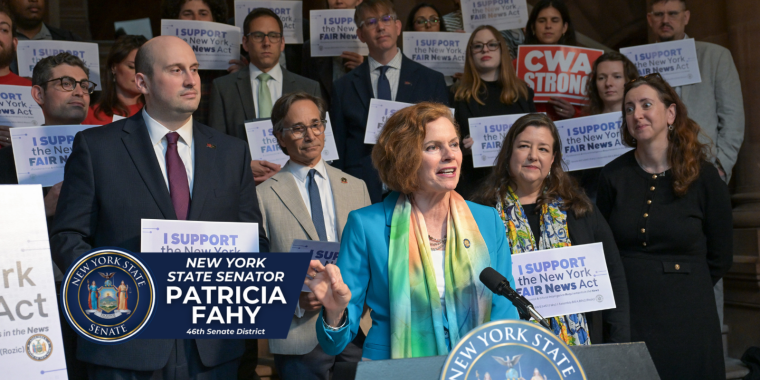
Senator Fahy at a press conference calling for passage of the FAIR NEWS Act
Gov. Hochul should sign the FAIR NEWS Act, which would require disclosure when published media is substantially generated by artificial intelligence
Let’s fast-forward two months, and it’s election night 2026. Polls have closed in New York, and you join millions of people glued to their phones, eagerly awaiting results. Then, a headline appears on your phone: “BREAKING NEWS: CANDIDATE X WINS SEAT IN CONGRESS.” You recognize the candidate and hundreds of people begin commenting and sharing, so you share it as well.
There’s just one problem: The race hasn’t been officially called yet, and the headline was posted by an AI-generated website — the same kind that now make up a stunning one-third of all new websites created — but not before thousands of people saw it and accepted it as fact.
For many, the damage could already be done — to their trust in our news, accurate reporting and even our institutions — at a time when that trust is already dangerously low. And New Yorkers’ trust in AI? Virtually nonexistent, with only 29% holding a positive view.
New Yorkers need to know what was written by a human being with editorial control and what was generated or “written” by a machine, bot or algorithm. My FAIR NEWS Act, with Assemblymember Nily Rozic, would require a disclaimer on articles or media substantially generated or written by AI. The bill awaits Gov. Kathy Hochul’s signature.
I have firsthand experience with generative AI reporting false information. When I introduced this legislation, a headline flashed across my phone screen: “New York Passes Law Regulating AI in News and Entertainment — National Today.”
Anyone with a basic knowledge of the legislative process could tell you that introducing a bill is a long way off from getting it passed through both houses of the Legislature.
This outlet’s generative AI misread the press release or other information it received, generated a false article, then made it available to countless readers almost instantly.
It’s not the first time it’s happened, either. In Wyoming in 2024, a reporter at the Cody Enterprise used AI to generate at least seven articles that fabricated quotes from six different people, including the governor. Or how about a breaking news alert that announces a mass shooting that never happened, like the app NewsBreak sent out in 2024?
In a more innocuous example, but one that shows how AI-generated material can pass through layers of editorial control, the Chicago Sun-Times published an AI-generated list of book titles for summer reading; almost half were fabricated titles and made-up authors.
As recently as this year, a New York City Council candidate is accused of using generative AI to fabricate news stories and endorsements, without any disclaimer that AI had been used, in an attempt to mislead voters.
Generative AI is particularly dangerous because it regurgitates information without analyzing whether it is accurate or true. For example, in the lead-up to the 2024 election, AI chatbots were disseminating information circulating online from quasi-news accounts that claimed Donald Trump won the 2020 presidential election, substantiating now-debunked electoral fraud theories and misinformation — misinformation that had the power to sway voters.
According to researchers at the University of Maryland, one out of every 10 news articles published each day in the U.S. now contains some form of generative AI. Journalists and news guilds across the country have raised concerns in an attempt to maintain the rigorous standards that govern their critical work.
Journalists holding government at all levels accountable and asking the hard questions is one of the hallmarks of our democracy. It is no small part of why our American experiment continues. My FAIR NEWS Act is simple: When journalists, published media or news companies substantially use generative AI, they must disclose it to the reader and the public.
This legislation isn’t about telling the news media what they can or can't write about, what their angle should be, or even how they write it. It’s about telling the public whether they’re reading a human-generated piece or an AI machine-generated one.
For 250 years, America has been unique among nations of the world because we are a country founded on an idea rather than a shared culture or ethnicity. And how our story is told matters. We must ensure that story continues to be told accurately, by human beings, and in a way that builds public trust rather than eroding it.
State Sen. Patricia Fahy of Albany represents the 46th Senate District.