NYS Senator Kristen Gonzalez Holds Legislative Hearing on Artificial Intelligence in High-Risk Contexts
January 16, 2026
-
ISSUE:
- Artificial intelligence; AI
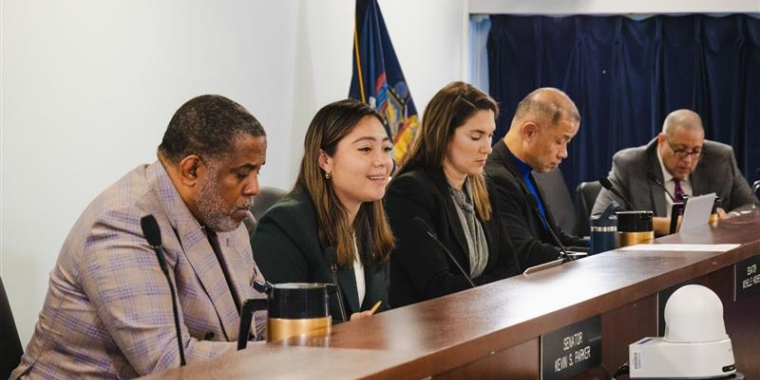
New York State Senators: Kristen Gonzalez, Michelle Hinchey, Kevin Parker, John Liu, and Gustavo Rivera presiding over a Legislative Hearing on AI | Photo by Alexandra Chan
Watch a recording of the hearing here.
NEW YORK, N.Y. – New York State Senator Kristen Gonzalez (D59), Chair of the Senate Committee on Internet and Technology, convened a public legislative hearing to examine the use of artificial intelligence (AI) in high-risk settings within the private sector. The hearing focused on the growing role of AI in critical decision-making processes and the need for strong guardrails to protect New Yorkers from potential harm.
Senator Gonzalez was joined by: Senators Michelle Hinchey, Andrew Goundardes, Jabari Brisport, John Liu, Nathalia Fernandez, Julia Salazar, Kevin Parker, and Gustavo Rivera, as well as Assemblymembers Michaelle Solages and Chair of the Assembly Committee on Science and Technology, Steve Otis.
As AI technologies are rapidly adopted in various industries, including healthcare, technology, and the legal system, concerns have emerged regarding accuracy, transparency, and the potential for discrimination. These systems are increasingly being used to make or influence decisions that impact employment, access to services, and economic opportunity, often without adequate oversight or reporting.
Senator Gonzalez and AM Solages introduced the New York AI Act (S1169A) to address these concerns. The bill would establish clear standards for transparency, risk assessment, and accountability to ensure that AI systems deployed in New York do not harm workers, consumers, or marginalized communities.
Senator Kristen Gonzalez said, “As Chair of the Senate Committee on Internet and Technology and the sponsor of the New York AI Act, I believe it’s our responsibility to meet this moment with urgency. Artificial intelligence is already shaping how New Yorkers learn, work, and receive care, and we’re seeing this in high-risk contexts where mistakes can deepen inequality or cause real harm. Industry representatives want inaction, they want a wait and see approach, but we can’t do nothing– we have to act to protect New Yorkers from harm before it happens. Experts in the field testified that this bill would not stifle innovation but ensure AI is developed and adopted transparently and ethically, so that it truly serves the public interest and earns the trust of the people it impacts.”
The hearing provided lawmakers with the opportunity to hear testimony from invited experts, advocates, labor representatives, and industry stakeholders on the current use of AI in high-risk settings, as well as its real-world impacts on workers, consumers, and the general public.
A major theme that legislators spoke to and reiterated during the hearing was the strong need to act in the face of gridlock in Congress and for greater transparency as a first step in the larger process of regulating AI.
Inaction in the case of regulating artificial intelligence directly hurts our working class communities and marginalized neighbors. The hearing highlighted the reality of workforce automation, algorithmic bias, the theft of intellectual property, climate devastation, and more. New York has the opportunity to make real change, and it starts with conversations like this hearing to get it right.
Senator Michelle Hinchey said, “Leaving AI unchecked is not an option; it’s not enough to talk about future job growth when people are being laid off today. If AI continues on this trajectory, we will accelerate a nightmarish transfer of wealth and power until the only winners are a small circle of tech CEOs and billionaires, while working people are pushed out of the economy entirely. New York must lead with forward-looking policies to support those who are being displaced, which will include passing the AI Labor Information Act this session. I thank Senator Gonzalez for bringing labor and the private sector to the table today as we work toward solutions to keep our economy fair in New York.”
Senator Andrew Gounardes said, “As AI transforms huge swathes of our economy and our society, we have to focus on what's most important: people. This isn't about 'stifling innovation.' It's about putting smart safeguards in place that allow AI best uses to flourish while keeping our communities safe and protected. It's about ensuring innovation benefits all of us, not just a select few."
Senator Julia Salazar said, “There are countless examples of artificial intelligence making mistakes. From incorrectly denying people their insurance claims to rejecting qualified applicants for a job interview, AI cannot be trusted to make high-risk decisions without regulation. We need to have the correct safeguards in place before allowing new and flawed technology to continue making consequential and high-risk decisions.”
Senator Jabari Brisport said, “Unchecked, capitalism incentivizes corporations to use new technologies in any and all ways that increase profits — even when those uses harm the public; with a technology as powerful as AI, the potential for devastating, wide-spread, and permanent harm is enormous. We need to move quickly to set up guardrails that ensure the development and adoption of AI will be done responsibly.”
Senator Gustavo Rivera said, "Artificial Intelligence platforms are increasing exponentially and having untold impacts on our institutions and environment. It is our responsibility as legislators to put necessary safeguards in place to ensure that AI is used safely and in our state's best interest. I want to thank Senator Gonzalez for holding this important hearing and I look forward to working with her to set fair parameters when it comes to AI while fostering innovation."
Senator Kevin Parker said, “We should approach AI the same way we approach energy, broadband, and emerging technologies: with optimism grounded in responsibility. AI can drive efficiency, innovation, and economic growth, but where people’s livelihoods, privacy, and civil rights are on the line, we must ensure strong guardrails, transparency, and accountability. Thank you to Senator Gonzalez for bringing voices together to work for clear standards that protect consumers, promote equity, and ensure these technologies work for the public good.”
Senator John Liu said, “AI today is omnipresent whether or not consumers and workers may be aware, and AI is more and more leading to decisions consequential to employment, housing, healthcare, education, and more. Yesterday's hearing highlighted many of the fast-emerging issues and the need for legislative and regulatory action sooner rather than later. Predictably, industry stakeholders claim they agree with the objectives of the NY AI Act but fear the bill will stifle innovation. The most memorable testimony came from a scholarly expert who pointed out that the advent of brakes allowed automobiles to move much faster, an excellent metaphor for the need for AI regulation. Great Kudos to chairperson Gonzalez for convening this hearing and leading senate efforts on these issues.”
Senator Nathalia Fernandez said, “While AI may be lauded as the next frontier in technology, the harm it can cause our society when left unchecked can be detrimental. As discussed at our legislative hearing, there are risks of privacy leaks, callous health decisions, education concerns, and transferring of wealth when we leave AI unregulated. Senator Gonzalez's New York AI Act is necessary to ensure AI systems are used responsibly and in the best interest of the public. The innovations that go hand-in-hand with AI should not come at the expense of everyday people."
Assemblymember Steve Otis, Chair of the Assembly Science & Technology Committee said, “I would like to thank Senator Gonzalez for assembling such a knowledgeable group of panelists who provided valuable insight into the evolving nature of AI and the risks that New Yorkers face. Careful and wise use of AI requires states to set clear guidelines and parameters for this rapidly expanding technology. The witnesses at this hearing provided valuable testimony regarding the benefits and risks around artificial intelligence systems and will help guide our path to action in the legislature.”
Assemblymember Michaelle Solages said, “Artificial intelligence is increasingly shaping decisions that affect people’s lives. Too often, historical bias and discrimination are embedded into these systems, causing real harm for historically marginalized communities. That is why strong oversight is essential. The New York AI Act sets clear guardrails to prevent algorithmic discrimination and ensure transparency and accountability in high-risk uses of AI. I am proud to sponsor this legislation in the Assembly and to work with Chairwoman Gonzales to ensure innovation serves the public good.”
Julia Stoyanovich, Associate Professor of Computer Science and Data Science, New York University; Founding Director, NYU Center for Responsible AI said, “The hearing made clear that effective AI governance must go beyond guardrails alone. We need sustained investments in education, training, and AI literacy so that regulators, auditors, workers, and the public can meaningfully engage with these systems. We must codify data rights so people are not passive inputs into opaque systems, but active participants in how their data is used. And we should incentivize responsible business practices in AI, just as we do in finance, healthcare, and other regulated sectors that underpin a functioning economy.
Sorelle Friedler, Shibulal Family Professor of Computer Science at Haverford College and Chair of ACM's U.S. Technology Policy Committee said, "AI is not designed to work all the time. The guarantees that we make about AI as computer scientists are statistical. We might say, 'this system achieves 98% accuracy.' 98% sounds pretty good! It also means we got it wrong 2% of the time. A lot of AI governance is about making sure there are systems in place to handle that 2%."
WITNESS LIST (See written testimonies here):
- Odetty Tineo, Associate Director, DC37
- Mia McDonald, Political Director, CWA
- Alex Spryopoulos, Director of Government Relations, Tech: NYC
- Dr. Alex Alonso, Chief Data & Insights Officer, Society for Human Resources Management
- Chris Gilrein, Executive Director, Massachusetts and the Northeast Region, TechNet
- Meghan Pensyl, Director, Policy, Business Software Alliance
- Erin Dupree, Senior Vice President and Physician Executive, Quality and Clinical Initiatives, Greater NY Hospital Association
- Alex Pena, Executive Vice President, Partnership for NYC
- Dr. Ondrej Linda, Senior Director, AI & Engineering, Zillow
- Danny Manimbo, Managing Principal, Schellman
- Julia Stoyanovitch, Director for the Center for Responsible AI, NYU
- Rumman Chowdury, CEO and Co-Founder, Humane Intelligence
- Sorelle Friedler, Shibulal Family Professor of Computer Science, Haverford College
- Kara Williams, Counsel, EPIC
- Ben Winters, Director of AI and Privacy
- Travis Hall, Director for State Engagement, Center for Democracy and Technology
- Corrine Worthington, Research & Advocacy Manager, STOP
- Steven Choi, Co-Founder, Just Futures
- Rahnold Thomas, Chair, Technology Committee, NAACP
- Maren Hurley-Matz, Equal Justice Works Fellow, New Economy Project
##
related legislation
Newsroom
Go to Newsroom