Hinchey and Jacobson Demand Reform to Medical Monopolies in New York State
October 26, 2026
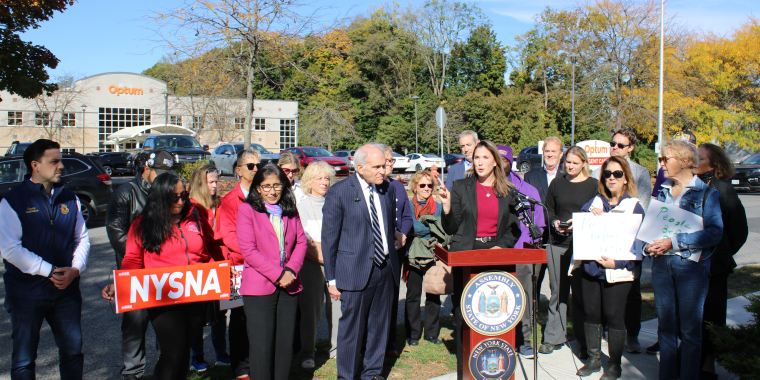
POUGHKEEPSIE, NY - Senator Michelle Hinchey and Assemblymember Jonathan Jacobson announced new legislation to reform anti-competitive practices in the healthcare and insurance industries.
Insurers and medical providers are building corporate monopolies across the state and across sectors, dominating local markets, driving up costs, and reducing options for both staff and patients. In the Hudson Valley, which Hinchey and Jacobson represent, insurance giant UnitedHealth Group has swallowed up local providers through its subsidiary Optum. These consolidations shift market power to a few providers or insurers, creating conflicts of interest and severely disadvantaging independent providers.
The same is happening with pharmacy benefit managers (PBMs), which are often owned by insurers or large pharmacies. This can lead to PBMs underpaying local, unaffiliated pharmacies or negotiating drug prices for the benefit of their owners instead of consumers. In response to this growing crisis, Hinchey and Jacobson have introduced legislation to go after healthcare providers and insurers that rig the market in their favor.
Senator Michelle Hinchey said, “Healthcare should be about saving lives and keeping people healthy, but this industry has strayed so far from that mission and into a model dominated by corporate control, where making money hand over fist for healthcare monopolies takes precedence over what’s best for patients. We know what these monopolies do, because we’ve seen it in our own backyard with Optum — they use their market power to buy up local providers and squeeze out trusted independent practices; they drive up costs for patients; and they limit our ability to find in-network doctors, giving us fewer and fewer places to turn. Our federal government has abandoned its responsibility to take meaningful action, so it’s up to the states to enforce the antitrust laws that New York led on over a century ago. I look forward to passing our bills to restore competition in healthcare through both houses next session.”
“Healthcare is a necessity. All the market power for our healthcare shouldn’t be in the hands of a few corporations,” said Assemblymember Jacobson. “Patients now have fewer choices and have to wait longer for care. With less competition, prices increase and place a heavier financial burden on patients. Healthcare workers have fewer employment options. It’s bad for everyone but the shareholders. Between high insurance rates and cuts at the federal level, New Yorkers are worried about their healthcare. But there are things we can do right now at the state level to protect access to more affordable care. Passing these bills would be a good start.”
One bill prohibits health insurance companies from owning a healthcare provider or vice versa (A.9225/S.9192), to preserve competition in local markets and prevent insurers from steering patients to their affiliates.
A second bill forbids overlapping ownership between insurance companies, pharmacy benefit managers (PBMs), and pharmacies (A.9184/S.9191), because PBMs can’t fairly represent both the interests of consumers and the pharmacy or insurer receiving consumer payments.
Hinchey and Jacobson were joined for the announcement by Dutchess County Legislator Lisa Kaul and Ulster County Legislators Amy Dooley and Dominick Marino. Healthcare workers and advocates from the New York State Nurses Association, 1199SEIU, SEIU Local 200 United, Dutchess County Central Labor Council, American Pharmacies, Communication Workers of America, Northeast Regional Urgent Care Association, Emergency One Urgent Care, Citizen Action of NY, and Indivisible Ulster.
Several people shared personal experiences with medical provider consolidation, including Mici Siminofsky, a retired nurse from Marlboro who spoke about a friend that couldn’t book an appointment with a specialist until February 2028, and Ulster County Legislator Amy Dooley, whose family left Optum after facing delays and other issues.
“I don't blame the people answering the phones or the healthcare workers trying to care for patients under difficult conditions. I saw their frustration, too,” said Ulster County Legislator Amy Dooley. “The patient should be able to count on timely appointments, clear communication, and coordination between the people responsible for their care. When we talk about healthcare monopolies, decisions about how these systems operate reach directly into our lives.”
Krystal Shorette, an Administrative Organizer from 1199SEIU, noted that when Optum closed its obstetrics and gynecology (OB-GYN) practice in Sullivan County, it left a single OB-GYN practice serving more than 80,000 residents and forcing women to travel up to an hour for timely care.
Jason Nessler, a Regional Territory Manager for American Pharmacies, highlighted the struggle of independent pharmacists forced to compete against increasing consolidation between insurers, PBMs and pharmacies. “I've seen firsthand what happens when independent pharmacy owners can no longer make that equation work,” Nessler said, noting that he’s watched independent pharmacies close as a result.
Christina Evans, Director at Large of the New York State Nurses Association and a registered nurse at Vassar Hospital (now owned by Northwell Health), echoed these concerns for patients and workers alike: “Healthcare corporations keep saying that patient care and efficiencies improve when these mergers take place. That is not what we have seen. Healthcare is a public good. Not simply a business.”
The proposed bills by Hinchey and Jacobson represent a coordinated effort to reduce market consolidations and monopolistic practices, ensuring that patients have better access to more affordable care.
###
related legislation
Newsroom
Go to Newsroom


