Harckham, Glick Introduce Amendments to Packaging Reduction Bill
April 29, 2026
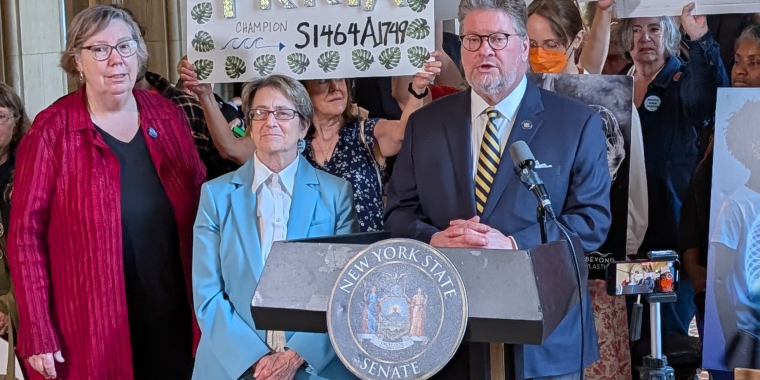
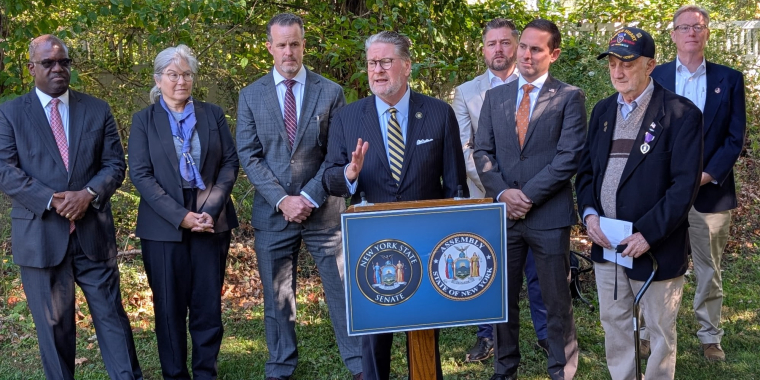
(L-R) Judith Enck of Beyond Plastics, Assemblymember Deborah Glick and Senator Pete Harckham at a June 2025 PRRIA rally and press conference in Albany
Important changes to the legislation underscore a commitment to ensuring industry compliance while holding producers accountable
Albany, NY – New York State Senator Pete Harckham and Assemblymember Deborah Glick announced today their sweeping amendments to the Packaging Reduction and Recycling Infrastructure Act (PRRIA), which encompass nearly 150 changes across the legislation. These revisions reflect extensive engagement with industry leaders, legislators, municipalities, advocacy organizations, and states that have already enacted packaging extended producer responsibility (EPR) laws.
“Through a long and engaged dialogue with stakeholders, we have forged a middle ground with these amendments to our bill, and now we are working to finally gain the necessary legislative and executive approvals that will save New Yorkers millions of dollars each year while helping to protect our environment,” said Harckham. “I thank Assembly Environmental Conservation Chair Glick and all the tireless advocates for their remarkable efforts in shaping this bill and working toward its enactment.”
“The goal has always been to deliver a bill that strengthens environmental and public health protections for New Yorkers while remaining workable for industry,” said Glick. “Following extensive engagement and national research into packaging EPR best practices, including input from industry leaders, municipalities, recyclers, materials manufacturers, and advocacy organizations, these amendments reflect meaningful, hard-fought compromises. They maintain strong protections, reduce the burden on local governments, and provide the consistency with other states needed to allow industry to comply.”
Glick added, “The underlying challenge has not changed. New York is facing a growing solid waste and pollution crisis, and the Packaging Reduction and Recycling Infrastructure Act is a real solution that must be passed this year.”
Designed to significantly reduce packaging waste and single-use plastics by requiring producers to decrease overall packaging use, PRRIA (S1464A / A1749A), enjoys broad public support among New Yorkers. The bill aims to improve recyclability, invest in recycling infrastructure, support municipal recycling programs, and eliminate toxic substances from packaging materials.
The amendments announced by the two legislators underscore an ongoing commitment to developing a workable, effective framework that ensures industry compliance while holding producers accountable for their role in New York’s growing solid waste crisis.
Key amendments include:
- Alignment with other states—Incorporates definitions and policy frameworks used in leading EPR states, particularly Minnesota, including updated definitions of “producer” and the use of “service providers.”
- Adjusted timelines—Extends and aligns compliance timelines with states such as Minnesota and California, including additional time for program implementation and compliance with recyclability and toxic substance provisions.
- Refined toxics provisions—Revises the toxics section by removing five substances and eliminating the Toxic Packaging Task Force.
- Streamlined enforcement—Removes the Inspector General role and consolidates enforcement authority within the Department of Environmental Conservation and the Attorney General’s Office.
- Flexible PCR standards—Updates post-consumer recycled (PCR) content requirements to provide greater flexibility while maintaining high-quality standards that support domestic labor and industry.
- Removal of regionality material mandates—Eliminates regional material mandates and adopts Minnesota’s “responsible end markets” framework to maintain material quality while offering producers clearer, statewide compliance pathways.
- Improved waiver provisions—Strengthens waiver language to ensure compliance with federal health and safety requirements and extends waiver durations from one year to five years.
New York’s massive stream of waste grows daily and continues to rise, posing significant environmental, public health, and fiscal challenges. Nearly all remaining in-state landfill capacity will be exhausted within the next 15 years, forcing increased reliance on waste export or incineration—both of which carry significant environmental and economic costs. At the same time, municipalities are left to shoulder the financial burden of waste collection, sorting, and processing, all which place an increasing strain on local taxpayers.
Under PRRIA, producers with more than $5 million in annual net revenue and responsible for over two tons of annual packaging waste would be required to reduce packaging by 10% within three years and 30% within 12 years.
Adrienne Esposito, Executive Director of Citizens Campaign for the Environment, said, “It’s taken years of discussions, negotiations and careful consideration to craft this important legislation, and now it is time to act. Municipalities, environmentalists, and community members all agree that reducing our cardboard and plastic packaging and increasing recycling will save us money and save the environment. Incentivizing producers and manufacturers to reduce packaging waste is good common sense and alleviates the financial burden from taxpayers. We are thankful for the leadership of Senator Peter Harckham and Assemblywoman Deborah Glick.”
Stephen Acquario, Executive Director of the New York State Association of Counties, said, “For years, counties have watched their landfill capacity shrink and recycling costs skyrocket from the use of excessive and irresponsible packaging. Now, thanks to the leadership of Senator Harckham and Assemblymember Glick, we’re one step closer to requiring that producers have a fair financial stake in the ultimate cost of their product’s packaging. We’re proud to continue supporting this bill, and we remain committed to fighting for meaningful financial relief and the modernized recycling infrastructure that New Yorkers deserve.”
Kate Donovan, Senior Attorney for the Natural Resources Defense Council, said, “Assemblymember Glick and Senator Harckham have achieved the improbable—they have done somersaults to accommodate industry concerns in their latest draft, while still managing to advance a bill that cuts unnecessary packaging, phases out toxic chemicals, and saves money for localities from Buffalo to Montauk. The revised draft is a reasonable bill that all legislators should embrace; it provides more time and flexibility for industry to reform their waste practices yet drives producers to cut pollution and support municipal recycling and waste prevention programs.”
Charles Moon, MD FAAP, Co-Chair of the New York State Chapter of the American Academy of Pediatrics’ Public Policy and Advocacy Committee, said, “Healthcare costs are high, driven by rising rates of chronic disease requiring more visits to the doctor’s office. We know that toxic chemicals are linked to rising rates of chronic disease and that families are commonly exposed to them through the plastics they use in their everyday lives. The Packaging Reduction and Recycling Infrastructure Act is an important step forward in protecting the health of New Yorkers and reducing long term healthcare costs. The NYS AAP urges the state legislature to pass this legislation speedily to improve public health safeguards around toxic chemicals in our lives.”
Kathleen Nolan, MD, MSL, President of Physicians for Social Responsibility – New York, said, “As a physician, I see the direct impact of plastics and the chemicals in them on public health every day. While some of the recent amendments, particularly the toxic provision, scale back some of the important public health protections of PRRIA, we cannot let the perfect be the enemy of the good. This legislation remains a vital first step toward detoxifying our waste stream and reducing the plastic pollution crisis. The core concept is sound, the necessity is urgent, and for the sake of our patients and future generations, New York must pass this bill this year.”
Sarah Paijiyoo, Co-Founder and CEO of Blueland, said, “At Blueland, we believe that the plastic crisis cannot be solved by consumer choices alone; we need systemic change that holds the world’s biggest polluters accountable for the waste they create. The Packaging Reduction and Recycling Infrastructure Act is a critical step towards a future where plastic-free isn’t just an alternative, but the standard. This bill remains a vital tool to detoxify our communities and shift the financial burden of waste from New Yorkers back onto producers. New York, again, has a chance to lead the nation—and we must pass this legislation this year!”
Patrick McClellan, Policy Director for the New York League of Conservation Voters, said, “To achieve our goal of zero waste, New York State must adopt policies to create a circular economy that prioritizes recycled and recyclable materials and incentivizes the use of less packaging in the first place, and that is exactly what the Packaging Reduction and Recycling Infrastructure Act does. We applaud Senator Harckham and Assemblymember Glick for their collaborative approach and for leading the charge to get this measure through the State Senate and Assembly this legislative session.”
Judith Enck, Founder of Beyond Plastics, said, “New Yorkers are drowning in plastic waste, and for too long, taxpayers have been stuck with the bill while multi-billion-dollar companies pump toxic chemicals into our communities. These amendments are a major concession to the plastic industry, but the foundation of the bill remains important, necessary and impactful. We cannot afford another year of inaction. This legislation remains the most significant opportunity we have to mandate real plastic reduction and finally ban the ‘forever chemicals’ and toxins that threaten our public health. The core of this bill is still strong: it rejects the industry’s ‘chemical recycling’ shell game and shifts the financial burden of waste back to the producers—where it belongs.”
related legislation
Newsroom
Go to Newsroom